


Being a Montessori parent starts with a simple idea: you are your child's first educator, and the home is the first classroom. Maria Montessori described the young mind as an absorbent one, soaking up everything in its environment, so the way we set up daily life matters more than any single lesson.
This does not mean turning family life into a rigid method. It means borrowing a few guiding principles, adapting them to your home, and accepting that change happens slowly. Montessori saw education as help to life, and that framing is a good place to begin.

Quick takeaways
- Treat your child as a person with dignity, not a project to manage
- Offer freedom to move and choose, always inside clear limits
- Set the frame calmly, without punishment or reward systems
- Observe your child, then prepare the home around what you see
- Favour real practical-life work over crowded toy shelves
- Expect slow personal transformation, not instant results
Start with dignity and the absorbent mind
Maria Montessori insisted on the dignity of the child. She saw each child as a person working hard to adapt to their surroundings, not as an empty vessel to be filled. When you keep that respect in mind, everyday exchanges shift: you explain instead of ordering, you wait instead of interrupting, and you treat small preferences as real.
She also described the absorbent mind, the way children take in the whole environment without filtering it. That is why the atmosphere at home carries so much weight. A calm voice, an orderly shelf and a predictable rhythm teach more than a lecture. If you want to support early learning at home, think about introducing children to reading through real books and shared time rather than pressure.
Education, in this view, is an aid to life. It encourages the vital drive already inside the child rather than replacing it with adult goals.
Give freedom inside clear limits
Children need freedom to exercise their needs for autonomy, growth and movement. Without room to move and choose, the drive to do things alone withers. But freedom without a frame turns into chaos, so Montessori homes pair independence with clear, steady rules.
In Montessori schools, for example, children may not choose an activity tray they have not yet been shown how to use. They can, however, get a drink or go to the toilet freely. The same logic works at home: a child may choose among a few approved options, but the boundaries of safety and respect stay fixed. If you are planning ahead, our kindergarten check guide covers common questions.
Set the frame without a reward chart
The frame is set without punishment or reward systems. It is offered calmly, in a natural tone, carried by your own conviction that the limit is necessary, much like a seatbelt in the car. You do not negotiate the seatbelt; you simply believe in it. That quiet certainty does more than any sticker chart, and it pairs well with gentle routines such as methods to put the baby when rest is part of the frame. You might also make a baby time capsule together.
| Principle | At home | What to avoid |
|---|---|---|
| Dignity | Explain, wait, listen | Ordering and interrupting |
| Freedom | A few approved choices | Unlimited options |
| Limits | Calm, steady rules | Punishment and rewards |
| Environment | Low shelves, real tools | Clutter and excess |
| Progress | Small shifts over months | Chasing perfection |
Become a parent-researcher
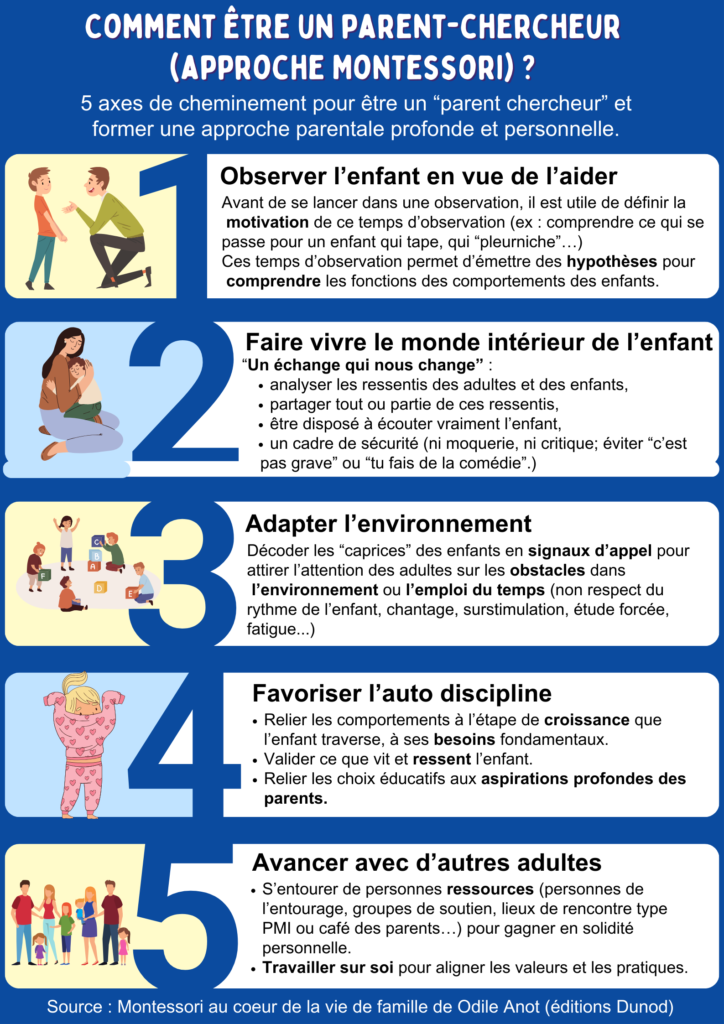
Odile Anot, a specialist in Montessori's thought who runs workshops for parents, offers paths for what she calls parent-researchers. The idea is not to copy a model but to observe your own child, test what works and adjust. She describes a slow personal transformation that builds a deep, personal parental intelligence.
Observation is the core tool. Watch what your child reaches for, what frustrates them, what they repeat. Then prepare the environment around those signals, lowering hooks, tidying shelves, offering real tools. This patient approach echoes how we choose what to place in a child's world, much as you would choosing toys for two year with care rather than volume.
Progress is gradual and rarely linear. Expect small shifts over months, not a dramatic conversion in a weekend, and give yourself the same patience you offer your child.
Prepare the home environment
A Montessori-inspired home is prepared so the child can do things alone. Low shelves, a small pitcher, a stool by the sink and accessible clothing all say the same thing: you are capable. Fewer, better-chosen items beat a crowded room, because order supports concentration.
Practical life comes first. Pouring water, wiping a table, sorting laundry and carrying a plate are real work with real purpose, and children often prefer them to any toy. Building and stacking materials fit naturally here too, and foam blocks are a good example of open-ended play, as you can see in this guide to best foam block toys.
Keep the space calm and uncluttered. Rotate materials rather than piling them up, and let the child return things to their place, which builds both order and pride.

Handle screens, sleep and daily rhythms
An absorbent mind takes in whatever it is given, so the quality of daily input deserves thought. Screens are not forbidden, but they are best treated as a deliberate choice rather than a default. If you are curious about early media products, it helps to ask what they actually offer, as in this look at Baby Einstein programs.
Rhythm supports autonomy. Predictable meals, rest and outdoor time give a child a sense of security from which independence grows. Travel and disruptions test that rhythm, and practical strategies help, such as these tips on surviving children's jet lag after a long trip.
None of this requires perfection. A prepared home is a direction, not a destination, and it can be rebuilt any day.
Keep the approach flexible, not dogmatic
Montessori principles can be applied at home without becoming a dogma. The goal is not to reproduce a classroom but to keep the spirit: respect, freedom within limits, and trust in the child's own drive. If a rule stops serving your family, you can revise it.
This flexibility matters because every child and every household is different. Some days will be calm and orderly; others will not. What counts is returning to the guiding ideas rather than scoring yourself against them. Parents who read widely tend to stay flexible, and even a broader parenting book can help you greeting without kisses respectfully when a child says no. Choosing open ended toys can also support this flexible, child-led spirit at home.
Over time, the small daily choices add up to a home where the child feels capable and the adult feels calmer.

My hands-on take
When I first tried this at home, I made the classic mistake of buying more: more baskets, more materials, more shelves. What actually changed things was subtraction. I cleared one low shelf, put out a small pitcher and a cloth, and stopped hovering while my child poured. The first attempts were messy. The tenth was not.
The other shift was in my tone. I noticed that when I set a limit while secretly apologising for it, it collapsed within minutes. When I set the same limit calmly, as something I simply believed in, it held. I still lose my patience, and I still reset the shelf more often than I would like. But treating it as a slow, personal adjustment rather than a method to master has made our home noticeably calmer.
Frequently asked questions
Do I need special equipment to be a Montessori parent?
No. The approach rests on respect, freedom within limits and a prepared environment, which you can build with everyday objects and a little order.
Is Montessori parenting the same as permissive parenting?
Not at all. Freedom always sits inside clear limits, and those limits are held calmly and consistently rather than negotiated away.
Why avoid rewards and punishments?
The frame is set through quiet conviction rather than a system of prizes and penalties, so the child learns the reason for the limit instead of chasing a reward.
How long does the change take?
It is described as a slow personal transformation. Expect gradual shifts in your habits and your child's autonomy over months, not overnight.
Product Reviews
 Best Toys for Dogs With High Prey Drive |
Best Outdoor Toys for 3-4 Year Olds |
Best Outdoor Toys for 6 Year Olds |
Best Harness for Poodle |
Best LEGO Sets for Adults |
Best Travel Toys for 4 Year Olds on Airplane |
Best Toy Stores in Washington DC |
Best Potty Training Toys |
Best Toys for Tripod Dogs |
Maillot equipe de france







