


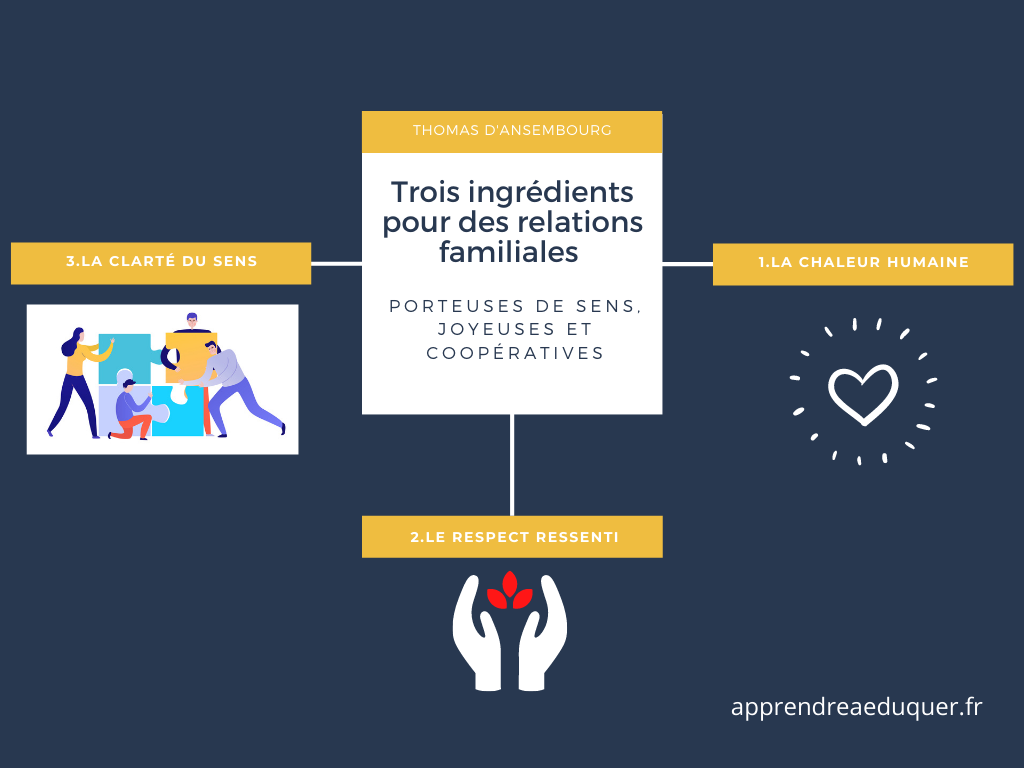
Meaningful family relationships rest on three simple ingredients: human warmth, respect that children genuinely feel, and a clear sense of meaning behind what we do. These ideas, drawn from the work of Thomas d'Ansembourg, are less about techniques than about the climate we create at home.
As adults in contact with children and teenagers, we all have the power to build calming atmospheres where values are not merely declared but truly witnessed in daily life. What matters is not what we think we give, but what our children actually experience.

Quick takeaways
- Warmth is measured by what children feel, not by what parents intend
- Respect is verified by asking, not declared through words or charts
- Real listening means muting the urge to advise, console or scold
- Non-listening is an invisible, ordinary form of mistreatment
- Clear meaning frees us from "I must" and helps us accept trade-offs
- Small shared rituals build a lasting hygiene of joy
Human warmth: love that children can feel
D'Ansembourg speaks of human warmth rather than love because some adults believe they love their children without ever offering nourishing, unconditional signs of that love. The key point is that what counts is not what parents think they give, but what children actually feel. A generous intention does not automatically make our actions adequate.
Warmth can travel through words, but also through a sense of communion carried by non-words: moments spent together without trying to do or say anything, simply savouring the feeling of being well together. This full attention to the bond goes beyond what words can express, and it pairs naturally with conscious parenting and the small rituals that make connection visible. Even everyday logistics, like planning daycare milk, can become caring moments when handled with warmth.
Building a hygiene of joy
D'Ansembourg asks whether we can be durably happy without deep love for living beings, for art and nature, for music and life itself, and without rituals of peace that let us name, share and celebrate that love. These rituals do not need to be elaborate; a shared song, a weekly walk or a moment of gratitude can carry real weight. Families who enjoy playful time together often find that open ended toys and simple games create exactly this kind of easy, unhurried closeness. The same warmth shines through loving grandparents and their gentle rituals.
Respect that is felt, not declared
Respect for another person cannot be claimed by saying "I respect you" or by hanging a charter of values in the living room, and it cannot be prescribed through moral lessons telling everyone to respect each other. Respect is lived, practised daily, and verified with our partner and with our children, even the youngest. How can we know whether someone feels respected if we never ask, and if we never leave open space for them to speak?
Parents and teachers may assume that being well-intentioned and wanting the child's good automatically makes their educational actions respectful. We act as though good intentions excused us from checking how the child feels and how the "we" is doing. Developing our capacity to listen, and daring to apologise, are therefore major keys. Listening well also shapes how we handle everyday friction, such as when parental blackmail creeps into a negotiation. The same patient attention guides us when choosing learning toys and when talking through key fertility facts as a couple.
| Ingredient | What it looks like | What to avoid |
|---|---|---|
| Human warmth | Words, presence, shared quiet moments | Assuming love is felt without showing it |
| Felt respect | Asking how the other feels, apologising | Declaring respect or preaching it |
| Real listening | Silence, full attention, no interrupting | Finishing sentences, changing subject |
| Clear meaning | Knowing why we act, accepting trade-offs | Being driven by "I must" and "I have to" |
Real listening means quieting our reflexes
Few of us truly know how to listen, because listening often means staying silent and muting our reflexes: advising, consoling, recommending, arguing, scolding, moralising or talking about ourselves. Staying quiet is hard when we think we know, when we worry about the child, when we struggle to trust or let go, or when we need reassurance about our own parenting skills.
Real listening means being with the other person to join them in what they are living, and understanding what they feel behind what they show or say. D'Ansembourg calls non-listening an invisible violence, an "ordinary form of mistreatment": we cut in, finish sentences barely begun, assume we know where someone is heading, or change the subject without checking availability. This applies to every relationship at home, including the one the cell phone so often quietly disrupts.
The clarity of meaning behind our actions
The question of meaning keeps us from being steered by "I must" and "I have to". Reflecting on the meaning of our actions, our relationships and our life means becoming aware of our fundamental needs and gaining consciousness. Being clear about the meaning we give our actions also means accepting the unpleasant consequences of each of our choices, and agreeing to give something up, at least for a time.
This clarity changes how we approach learning and daily routines, turning obligations into choices we can explain. It also invites us to notice what genuinely engages children, whether a shared story or a project they help build, much as reading love stories does when a child chooses the book. When we can name why we ask something, cooperation becomes far easier to invite than to demand.
Putting the three ingredients into practice
Warmth, felt respect and clear meaning reinforce one another. A home where children feel loved, listened to and able to understand the reasons behind requests becomes a more cooperative place, not because rules are stricter, but because the relationship carries them. Small, repeated gestures matter more than grand declarations.
This also connects to how we choose what fills family time. A thoughtful outdoor play choice or a calm corner for building gives warmth a place to happen, while a shared project invites the meaning we have been describing. None of this requires perfection; it requires attention, honesty and the willingness to repair when we miss the mark.

My hands-on take
In my own home, the idea that stuck hardest was the distinction between intention and felt experience. I used to assume that because I wanted good things for my children, they experienced my requests as caring. When I started actually asking, "Did that feel fair to you?", the answers were sometimes uncomfortable, and far more useful than my assumptions.
The listening advice was the hardest to practise. My reflex is to solve, console and explain, often before a sentence is finished. What helped was a small rule: wait three seconds after a child stops talking before responding. It sounds trivial, but it changed the tone of our evenings more than any chart on the wall ever did.
Frequently asked questions
Why say "human warmth" instead of "love"?
Because some adults feel love for their children without ever giving signs of it that the child can actually receive. The word warmth shifts attention to what the child experiences rather than what the parent intends.
How do I know if my child feels respected?
You cannot know without asking and without leaving space for an answer. Respect is verified through dialogue with your partner and your children, including very young ones.
What counts as non-listening?
Interrupting, finishing someone's sentence, assuming you know what they will say, or changing the subject without checking. It is a very ordinary form of mistreatment that quietly erodes connection.
What does clarity of meaning change?
It stops us from being piloted by obligations and helps us understand our fundamental needs. It also means accepting the unpleasant consequences of our choices and agreeing to give something up.
Product Reviews
 Best Toys for Dogs With High Prey Drive |
Best Outdoor Toys for 3-4 Year Olds |
Best Outdoor Toys for 6 Year Olds |
Best Harness for Poodle |
Best LEGO Sets for Adults |
Best Travel Toys for 4 Year Olds on Airplane |
Best Toy Stores in Washington DC |
Best Potty Training Toys |
Best Toys for Tripod Dogs |
Maillot equipe de france







