


Divorce with children is a real tsunami. Beyond the heartache, the sadness you have to accompany in your children, the uncertainty about the future, the drop in living standards, other people's judgement and loneliness, there is a whole ideal family to grieve.
Even when you are the one who initiated the separation and see it as a relief, the process stays painful. Naming that grief is the first step towards something calmer.

Quick takeaways
- Divorce with children means grieving an ideal family, even when you chose the split.
- The perfect-family model is socially valued but often maintained at the cost of your identity.
- Think of separation as a moult: a fragile in-between before something better fits.
- Question couple myths and be more authentic about what you actually want.
- Aim for a co-parenting team, with mediation or distance when the relationship is poor.
- Keep the parental link a priority unless safety is compromised.
Why the Ideal Family Is So Hard to Grieve
Couple life is idealised in our culture: fairy tales and romantic films, perfect celebrity couples, and a falsely nostalgic story about older generations who supposedly repaired their relationship rather than break up a family. That story forgets that a huge majority of women in previous generations suffered in their married and family life.
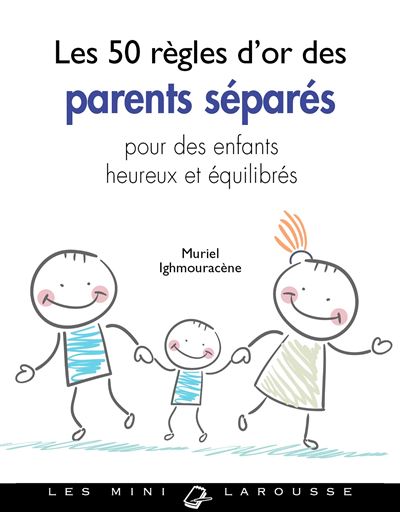
In her book on the golden rules of divorced parents, Muriel Ighmouracène regrets that the heterosexual couple in a house with a small garden, with their two children (preferably a boy and a girl), remains the socially valued model of perfect happiness. Yet life can do us an immense service at the moment of separation, freeing us from the tyrannical grip of that perfect-family image we often unconsciously work hard to maintain, almost always to the detriment of our deepest identity.
If the pressure of a spotless home is part of that image, you may find relief in toy organization tips and in organizing with two babies.
Thinking of Divorce as a Moult
This is not about denying the deep pain a divorce can bring to a family. It is about considering the separation, for the adults and for the children, as a moult: "as if we were a lobster abandoning its shell, now too tight, to build one its own size".
That means wandering for a while naked, fragile and exposed before building something bigger that suits us and resembles us. Children go through their own version of this, and understanding how children understand the world helps you answer their questions without over-explaining.
Small anchors during the naked phase
Keep routines simple and predictable, lean on a few trusted people, and accept that some days will feel wobbly. If a baby is part of the picture, the first days and baby sleep are worth revisiting so the basics stay steady.

| Situation | Possible approach | What it protects |
|---|---|---|
| Calm, respectful exchanges | Direct co-parenting team | Children's stability |
| Tense but workable | Mediation or a trusted third party | Communication |
| Poor relations | Rare, written exchanges only | Peace at home |
| Very conflictual | Occasional, clearly framed visits | Boundaries |
| Safety compromised | Distance and protective measures | Personal safety |
Opening Your Eyes to Couple Myths
A separation is also a chance to open your eyes to the myths around couples. With time, you stop being fooled by images of perfect families because you know every family has its flaws and hard moments. One article noted that men tend to be happier in a couple while women tend to be happier when they have a good network of friends.
You know what happens behind the scenes of a couple, you are no longer fooled, and that lets you be far more authentic with yourself and far freer to live loves that resemble you. Reading helps here: digital books can open conversations about feelings, and children's literature journeys show how stories give children words for change.
Building a Co-Parenting Team
Muriel Ighmouracène invites us to form a team with the other parent. A successful co-parenting relationship is far from easy, especially when relations are poor. It takes time, energy and probably selflessness, especially at the start, because you have no other choice but to overcome resentments.
Even if a fulfilling co-parenting relationship is a win-win ticket for everyone, starting with the children, it is sometimes impossible. In some cases you need mediation, benevolent third parties, or to settle for rare exchanges, perhaps only in writing, putting distance between you or organising occasional, clearly framed visits.
When safety comes first
Keeping the parental link deserves to be a priority objective, unless your own safety or your children's is compromised. If jealousy or tension is part of the picture, a partner jealous is a useful read, and a pediatrician's perspective can help you keep the child's needs central.
Rebuilding a Family That Fits
After the moult comes construction. The new family may be smaller, quieter or more spread out, but it can fit better. Practical toys and shared activities give children continuity: toys for one year old for the youngest, The Rubik's cube the toy for older ones, and Lego vs Lepin Differences if building sets are on the list.
Keep the focus on what you can control: calm transitions, honest words, and a home that feels like yours. The ideal family was a picture; the real one is being drawn now.

My hands-on take
When my own household went through a separation, the hardest part was not the paperwork or the logistics. It was the quiet moment when I realised the family I had pictured was gone, and that no amount of effort would bring that exact picture back.
What helped was small and unglamorous: keeping bedtime the same, letting the children ask the same question five times, and writing short messages instead of calling when tensions ran high. I also stopped trying to prove to others that everything was fine. The moult image stayed with me: for a while you are exposed and fragile, and then you build a shell that actually fits.
Frequently asked questions
Is it normal to feel sad even if I wanted the separation?
Yes. Relief and grief can coexist. You can be glad the couple is over and still mourn the family picture you had in mind.
Do children need to see me grieve?
They need to see that feelings are allowed and named, without being burdened by adult details. Simple, honest words work better than silence.
What if co-parenting feels impossible?
It sometimes is. Mediation, written-only exchanges or framed visits can keep the parental link without forcing closeness.
Should I hide the difficulties from my children?
No, but keep it age-appropriate. Children notice tension; short, calm explanations reassure more than pretending everything is fine.
Product Reviews
 Best Toys for Dogs With High Prey Drive |
Best Outdoor Toys for 3-4 Year Olds |
Best Outdoor Toys for 6 Year Olds |
Best Harness for Poodle |
Best LEGO Sets for Adults |
Best Travel Toys for 4 Year Olds on Airplane |
Best Toy Stores in Washington DC |
Best Potty Training Toys |
Best Toys for Tripod Dogs |
Maillot equipe de france







