


Responding kindly when a child lies starts with understanding what is really going on behind the story. Most lies from young children are not calculated tricks; they come from imagination, fear, the wish to please you, or a simple need for attention.
Because trust and responsibility matter deeply to most parents, a lie can sting more than expected. Recognizing that reaction in yourself is the first step toward answering calmly instead of sharply.

This guide walks through the common motives behind children's lies and offers practical, respectful responses that build honesty over time.
Quick takeaways
- Young children often blur imagination and reality; this is not cunning.
- Many lies aim to please parents or avoid punishment, not to manipulate.
- Describe what you see and ask for what you need instead of trap questions.
- Never label a child a liar; labels tend to become self-fulfilling.
- Explore the need behind the lie and name the emotion out loud.
- Use play and imagination to build connection instead of confrontation.
What a child's lie touches in us
Children who lie can challenge us because most parents care about raising trustworthy, responsible people. The more we value honesty, the more a lie can feel personal, and the more likely we are to react quickly and strongly.
It helps to name this first: trust, responsibility and ethics are important values for you, and a lie shakes them. Simply noticing that reaction creates a small pause before you answer.
That pause matters. A calm reply protects the relationship and keeps the door open, while a sharp one can push a child toward more hiding. If you want to think more about how both parents can stay aligned on this, see parental education teamwork.
The "positive" motives behind children's lies
Children under five do not lie out of cunning or a wish to deceive. That kind of lie needs a brain mature enough to separate reality from imagination, past from present, and to predict another person's reaction. Young children's worlds are built on play and imagination, so they may not always tell the two apart. A child who says the cat ate the last pancake may genuinely believe it.
With slightly older children, lies are still more often about play and the wish to please parents than about manipulation. When a child says they brushed their teeth, it is often to make you happy, because that is what you expect.
Common everyday reasons
Children may lie about brushing because they have better things to do, because it feels unpleasant, because they fear punishment, or because they wish it were true. Sometimes a lie is a way to get something: why lie instead of asking clearly? And sometimes our own questions trigger it. If a child senses a threat in how an adult asks, perhaps a hard tone or a question that already implies the answer, fear kicks in and the child protects themselves by instinct. Lies can also be pure fun, a way to pass the time when bored, or a bid for attention and connection. The same gentle honesty helps when you use stories about periods to explain growing up.
| Situation | Likely motive | Kind response |
|---|---|---|
| "I brushed my teeth" | Wants to please you or dislikes brushing | "I see the brush is dry. Let's brush together now." |
| "The cat ate it" | Imagination, blurred reality | "What a story! Let's check together." |
| "I didn't take it" | Fear of punishment | "I need to trust you. Can you tell me what happened?" |
| Wild invented tale | Fun, boredom or attention | Join the story, then gently note how odd it got |
| Blaming a friend | Protecting self or wanting revenge | "Were you hurt? Let's talk about what you felt." |
Honest answers matter just as much when the topic is bodies, so keep these facts about fertility in mind.
Responding with kindness: practical reactions
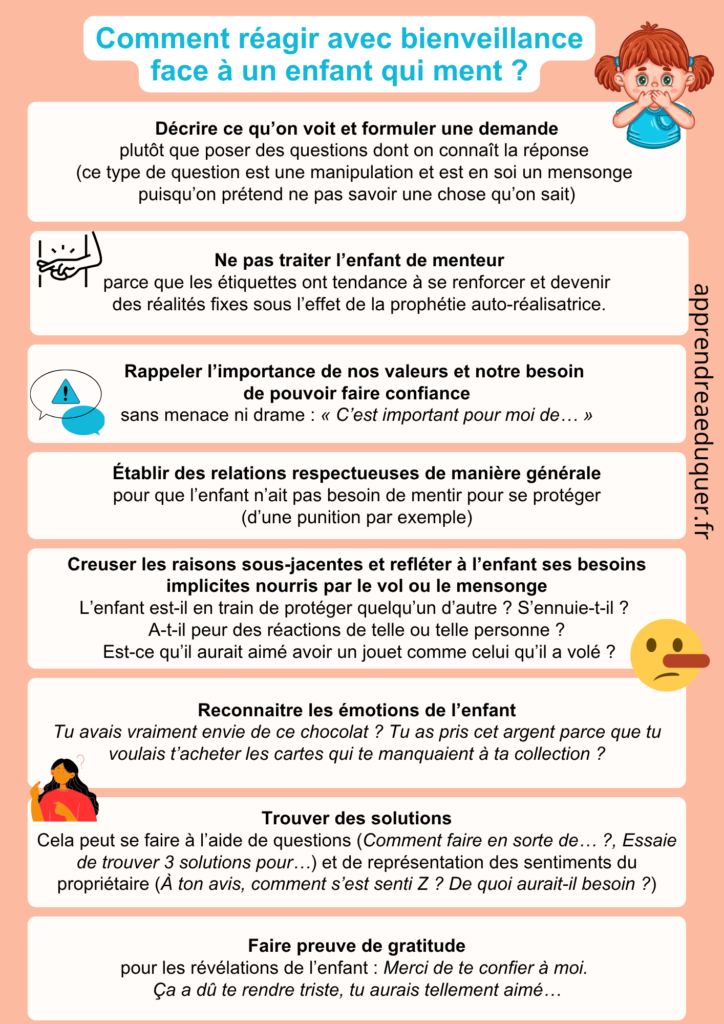
Depending on the motive you detect, several responses work well. Start by describing what you see and making a request instead of asking questions you already know the answer to. Asking those questions is a form of manipulation that triggers fear, and it is itself a small lie, since you pretend not to know something you know.
Do not call the child a liar. Labels tend to reinforce themselves and harden into fixed realities through self-fulfilling prophecy. Instead, remind them of your values and your need to trust them, in your own words: "It's important to me that…" or "I need to be able to trust you," without threats or drama.
Build respectful relationships in general so the child does not need to lie to protect themselves from punishment. Then dig into the underlying reasons and positive motives: is the child protecting someone, bored, or afraid of a particular reaction? This step runs through acknowledging emotions: "You really wanted that chocolate?" or "You took the money because you wanted the cards missing from your collection?"
Reflecting needs and using play
Reflect back the implicit need behind the lie or the taking. "Do you wish your friend played with you more often?" or "Would you have liked a toy like the one you took?" or "Was he mean to you and you wanted revenge?" or "Does he have more friends and you wanted him to feel hurt?" Naming the need out loud often loosens the knot far better than a lecture.
With imaginative stories, you can step into the child's play and build on it until you reach a jointly created, completely implausible version, then note how strangely bizarre the whole tale has become. This creates connection, trust and relationship rather than confrontation. For more ideas on handling lies, cheating and taking through play, look at independent play toys and pretend play toys to keep that playful channel open. The time we spend together in these moments matters more than any correction.
Finally, show gratitude for the effort behind honesty when it appears, however small. A child who feels safe telling the truth has less reason to invent. Keeping routines warm and predictable, such as a calm bedtime sleep phrases routine, also lowers the fear that often fuels small lies. If worries about skin bumps are adding stress, address them calmly too.
Keeping perspective as children grow
Lies about teeth, screens or homework are rarely a sign that your child is becoming untrustworthy. They are usually signals about needs, fears or skills that are still developing. Responding with curiosity rather than accusation keeps the focus on building those skills.
It also helps to remember that honesty grows in relationships where telling the truth feels safe. If a child expects shouting or punishment, hiding becomes the logical choice. If a child expects a conversation, honesty becomes easier.
Practical daily habits support this: keep requests clear, avoid trap questions, and stay consistent between caregivers. Understanding how children learn step by step reminds us that skills develop gradually. Small, repeated moments of calm honesty matter more than any single perfect response.

My hands-on take
I remember my daughter hating tooth brushing because she could not breathe well while doing it. For a while she insisted she had brushed when she clearly had not, and my first instinct was to confront her. What worked better was changing the routine and saying plainly, "I need to be able to trust you about your teeth, and I want brushing to feel easier for you."
In practice, the hardest part is the pause before answering. When I manage that pause, I ask myself what need might be hiding under the story, and the conversation usually goes somewhere useful. When I skip it, we both end up defensive. The pause is small, but it changes everything.
Frequently asked questions
At what age can children lie on purpose?
Deliberate deception requires enough cognitive and emotional maturity to separate reality from imagination and predict reactions. Children under five generally do not yet have that reasoning, so their "lies" are usually imagination or wishful telling.
Should I punish a child for lying?
Punishment often teaches a child to hide better rather than to be honest. A calmer approach, describing what you see, naming your values and exploring the reason, builds trust and responsibility over time.
What if my child keeps lying about the same thing?
Look for the repeated need behind it, such as avoiding an unpleasant task or fear of your reaction. Adjusting the routine or the way you ask can remove the reason to lie.
Is it wrong to ask "Did you do it?"
If you already know the answer, such a question can feel like a trap and trigger fear. Describing what you observe and making a clear request is more respectful and effective.
Product Reviews
 Best Toys for Dogs With High Prey Drive |
Best Outdoor Toys for 3-4 Year Olds |
Best Outdoor Toys for 6 Year Olds |
Best Harness for Poodle |
Best LEGO Sets for Adults |
Best Travel Toys for 4 Year Olds on Airplane |
Best Toy Stores in Washington DC |
Best Potty Training Toys |
Best Toys for Tripod Dogs |
Maillot equipe de france







