


Flow for kids is the art of helping children lose themselves so completely in an activity that time seems to disappear and effort feels effortless. Psychologist Mihály Csíkszentmihályi called this state optimal experience: a moment when attention is freely invested in a personal goal because nothing disturbs or threatens the self.
Children who experience flow often grow stronger, more confident and more effective, because their mental energy has been successfully poured into goals they chose themselves. The good news for parents is that flow is not a rare gift — it is a state families can quietly encourage.

Quick takeaways
- Flow means losing yourself in an activity for its own sake, with clear goals and quick feedback.
- Autotelic children tend to be curious, enthusiastic and confident.
- Internal obstacles include scattered attention and excessive self-consciousness.
- External obstacles include harsh living conditions, negative beliefs and family tension.
- Predictable rules and calm routines free mental energy for absorbing play.
- Rest, open-ended materials and protected concentration make flow more likely.
What Is Optimal Experience, or Flow?
Csíkszentmihályi describes an autotelic person as someone who takes on an activity purely for the deep satisfaction it brings. The experience itself is so enjoyable that people do it for its own sake, which is exactly what he means by optimal experience — also called flow experience or simply flux.
When a person can organize their consciousness to reach this state often, the quality of their life improves inevitably, because even ordinary work routines become intentional and pleasant. In that state, the person controls their mental energy and keeps or strengthens their mastery of consciousness.
The ingredients of flow
Optimal experience has several recognizable components: clear goals and rules, immediate feedback, a sense of control, concentration on the task at hand, motivation, and a challenge that matches skill. Autotelic people tend to radiate joie de vivre, curiosity, harmony and enthusiasm — qualities that echo Ken Robinson's idea of the Element or Carol Dweck's growth mindset.
Internal Obstacles to Flow in Children
Some barriers come from inside the child. An inability to control the contents of consciousness, as in schizophrenia or ADHD, means irrelevant stimuli are processed involuntarily and attention scatters. Excessive self-consciousness is another: a child too focused on what others think, or afraid of doing something inappropriate, keeps mental energy trapped in the self, making it hard to enjoy an activity for itself or find intrinsic reward.
There are also neurobiological factors — some people seem born with a genetic advantage in controlling consciousness, finding interest where others would be bored. Yet there is no pure fatalism here. Children with ADHD, for example, can still know genuine moments of optimal experience, especially when a task is structured and genuinely engaging.
Parents can soften these obstacles without pressure. Reduce background noise and screens during play, avoid constant commentary while a child concentrates, and offer activities where the rules are visible and success is easy to read.
| Condition | Helps flow | Hinders flow |
|---|---|---|
| Rules | Clear and discussed | Unclear or constantly disputed |
| Attention | Protected and uninterrupted | Constant commentary or screens |
| Challenge | Matches the child's skill | Too easy or far too hard |
| Feedback | Immediate and visible | Delayed or confusing |
| Environment | Calm, safe, orderly | Noisy, chaotic, unpredictable |
External Obstacles: Environment and Family Influence
External obstacles matter just as much. Inhospitable living conditions — a desert, pack ice, a lack of food or water — restrict the possibility of enjoying life. Negative social conditions such as slavery, oppression, exploitation or the destruction of cultural values make optimal experience nearly impossible: anomie (the absence of rules, for instance after an economic crisis or a shift in dominant culture) and alienation (people forced by the social system to act against their intrinsic goals) leave exploiters in control of people's energy.
Negative beliefs, such as assuming humans are bad by nature, also weigh on children. And family influences are decisive: the type of relationship and interaction between parents and children shapes what the individual will become. A home where rules are negotiated calmly and where children know what is expected frees a surprising amount of mental energy for pleasant, absorbing activities.
How to Grow an Autotelic Personality at Home
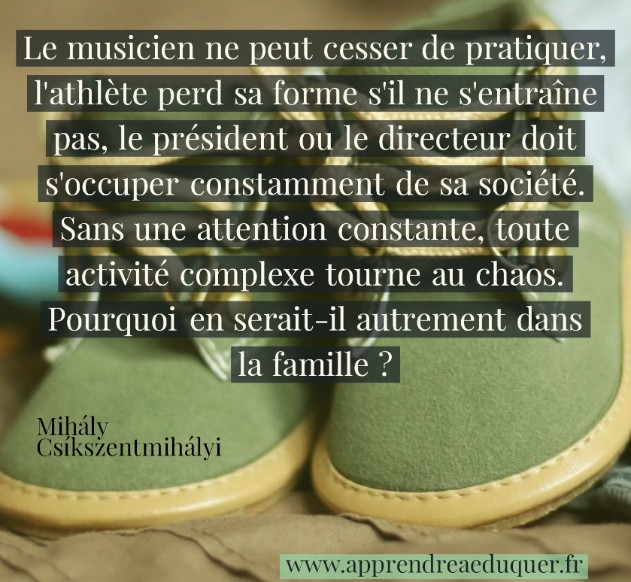
Families that create an autotelic context let their members save much of the mental energy that can then be devoted to enjoyable activities. Children know what they may or may not do, so they do not have to fight about rules, and they are neither overprotected nor left adrift. The home becomes predictable enough to be safe and open enough to be interesting.
In practice, this means clear family routines, a few well-chosen open-ended materials, and space for unstructured time. A well-organized box of bricks invites deep concentration, much like the ideas in organizing LEGO bricks, while simple toys with no fixed outcome leave room for a child's own goals. Movement helps too: children learning often describe that same absorbed, joyful state.
Protecting sleep, meals and downtime matters more than adding activities. A rested child can enter flow; an exhausted one cannot. Even a bedtime story can become a small ritual of absorbed attention, and short Christmas stories or any favorite tale read slowly and without interruption gives children a daily taste of focused pleasure.
Everyday Situations That Invite Flow
Flow rarely arrives on schedule, but some family moments make it far more likely. Cooking together, building, drawing, gardening or caring for a pet all offer clear goals, quick feedback and a challenge that grows with the child. Even a simple kitchen task, such as learning roasting chestnuts safely, combines rules, sensory feedback and a satisfying result.
Food and mealtimes can support concentration too: understanding potatoes in children's diets or knowing whether babies can have candy helps parents build routines that leave energy for play rather than digestive discomfort. Outdoors, a family walk or a longer adventure — see these long distance family trips — offers the kind of absorbing novelty that children remember.
Teenagers need a different door into flow. Rather than pushing them out of their room, offer shared projects and small responsibilities, as suggested in plans for teenagers. And when a child is deeply engrossed, the kindest thing a parent can do is quietly protect that concentration.
Choosing Materials and Places That Support Absorption
The objects around a child matter. Open-ended toys invite the clear goals and feedback that flow requires, and a few good ones often beat a mountain of gadgets; this selection of open ended toys is a useful starting point. For older children, choosing a gift that matches their current interests keeps the challenge just right, as with these toys for five year olds.
Where you shop can shape the experience too. A calm, well-organized store helps a child focus on one idea instead of drowning in noise; browsing 10 Best Toy Stores or the 10 Best Toy Stores can turn a purchase into a thoughtful family outing rather than an impulse grab.

My hands-on take
In our home, the biggest change came from doing less. I used to narrate everything my child was building, asking questions and praising each step, until I noticed the spell broke every time I spoke. Now I try to sit nearby and stay quiet, letting the tower wobble and fall without rescue. The concentration that follows is worth far more than my compliments.
I also learned to protect the boring hours. A free afternoon with a box of bricks and no plan regularly produces the deepest absorption I see all week, while a schedule full of classes produces only tiredness. When I keep routines predictable and stop negotiating every rule, my child seems to relax into play more quickly — and honestly, so do I.
Frequently asked questions
Can a child with ADHD still experience flow?
Yes. The source stresses that there is no pure fatalism, and children with ADHD can know real moments of optimal experience, especially when tasks are structured and genuinely engaging.
Do children need special toys to reach flow?
No. What matters is clear goals, quick feedback and a challenge that fits the child's skill, which simple open-ended materials often provide better than complex gadgets.
How do family rules relate to flow?
When children know what they may or may not do, they stop spending energy arguing about rules, and that freed energy can go into absorbing, enjoyable activities.
Is flow the same as being busy?
No. Flow is focused, self-chosen attention on a task, not a packed schedule. Rest and empty time actually make flow more likely.
Product Reviews
 Best Toys for Dogs With High Prey Drive |
Best Outdoor Toys for 3-4 Year Olds |
Best Outdoor Toys for 6 Year Olds |
Best Harness for Poodle |
Best LEGO Sets for Adults |
Best Travel Toys for 4 Year Olds on Airplane |
Best Toy Stores in Washington DC |
Best Potty Training Toys |
Best Toys for Tripod Dogs |
Maillot equipe de france







