


To avoid overstimulating children, the first step is to look honestly at the pace of their days rather than at the children themselves. Many families fill every hour with activities, classes and devices, believing that more input means faster development.
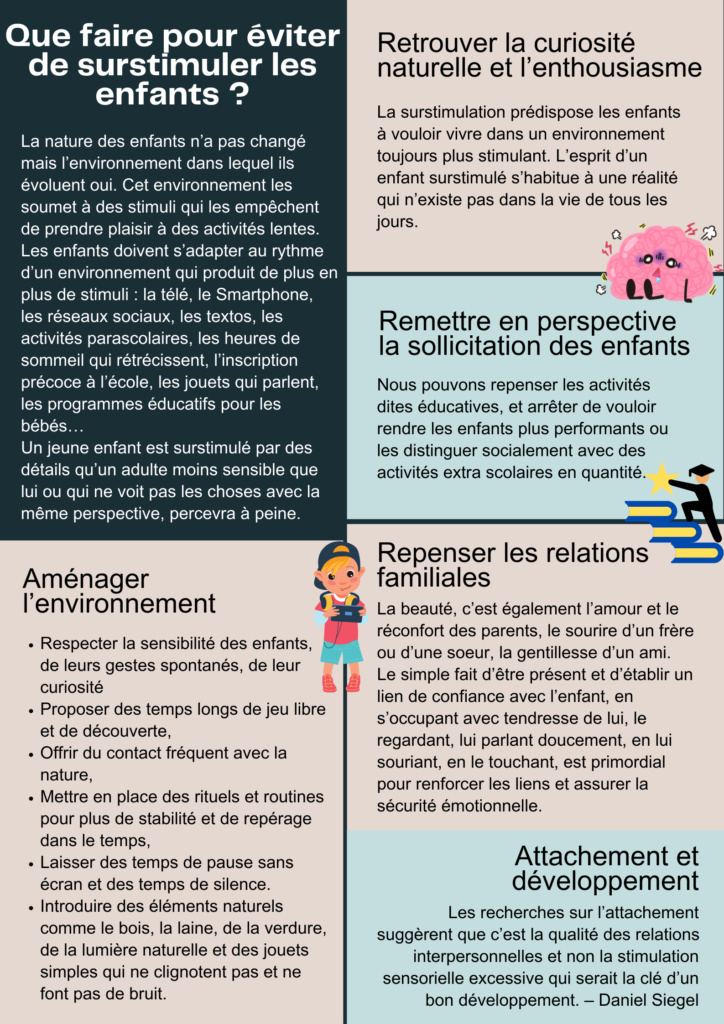
Yet constant external stimulation can replace a child's natural drive and dull the sense of wonder that sits at the root of curiosity and learning. The answer is not to do more, but to change our approach to education and to appreciate children as they are, with their own tastes and rhythm.

Quick takeaways
- Overstimulation replaces a child's natural drive and dulls wonder.
- A packed schedule and too little sleep are warning signs.
- Change your approach to education, not the child.
- Protect empty, unstructured time in the week.
- Reduce loud, fast screen content and keep routines calm.
- Appreciate children as they are, with their own rhythm.
Why overstimulation matters
A child raised in an over-enriched environment is constantly stimulated from the outside. Their schedule can look like that of a chief executive, with little of the minimum sleep they actually need, and a stream of methods and activities designed to speed up development or raise intelligence scores.
Add devices that emit loud, fast-moving content and the picture is complete. Overstimulation takes the place of children's natural momentum and wears down their sense of wonder, which is the foundation of their ability to be curious and to learn.
What actually needs to change
The problem is not the child or the teenager. What has to shift is our approach to their education: we can stop imposing activities and stop trying to make children more performant, and start appreciating them as they are.
Watch for the signs of overload
Overstimulation rarely announces itself clearly. It tends to show up as stress, a decline in creativity and less visible joy in everyday play. A child who is constantly busy may become irritable, struggle to settle, or lose interest in the simple things that once delighted them.
Sleep is one of the clearest signals. When the schedule leaves no room for rest, the effects compound, and the child has even less capacity to handle the noise and demands around them. Observing these patterns is more useful than adding another activity to fix them.
It also helps to notice how your child responds to transitions, such as the end of a screen session or the return from a busy day. For a related look at how calm, attentive moments support development, see baby bathing routine.
| Signal | What it may mean | Practical response |
|---|---|---|
| Irritability after activities | Too much input, too little rest | Cut one activity and add quiet time |
| Loss of interest in play | Wonder worn down by constant novelty | Offer open-ended, slow toys |
| Difficulty settling at night | Schedule leaves no room for sleep | Build a calm evening routine |
| Constant need to be entertained | No practice with unstructured time | Protect empty hours each week |
| Reacting to every screen | Fast, loud content dominates | Slow the content and reduce volume |
Simplify the daily schedule
The most direct response to overstimulation is subtraction. Leave empty space in the week and protect it. Children need unstructured time in which nothing is being taught, measured or optimized, because that is where their own ideas and interests surface.
This does not mean abandoning activities altogether. It means choosing fewer of them and letting the child's own rhythm set the pace. If you are looking for open-ended options, these independent play toys support exactly that kind of self-directed time.
Protect sleep and quiet
Sleep is not a luxury to be squeezed around lessons. A predictable, calm evening helps the nervous system wind down. Quiet moments during the day matter too, and simple rituals such as a teeth brushing routine can become a peaceful anchor rather than another task to rush through.
Reduce screen noise and fast content
Devices that emit loud, rapid content are one of the most common sources of overstimulation. The pace of the images and sounds does the work for the child, leaving little room for their own imagination to engage. Reducing the volume, the speed and the sheer quantity of screen time makes a real difference.
When screens are used, slower and more interactive content is easier for a child to process. Some tools even invite observation rather than passive consumption, such as augmented reality animals that encourage looking and naming rather than racing ahead.
Offline play offers a natural counterweight. Toys that require the child to build, imagine and decide keep them active rather than reactive, and good learning toys can hold attention without overwhelming it.

Feed wonder instead of performance
Wonder is the base of curiosity and learning, and it grows in slowness. A walk, a question left open, a story told without a quiz at the end: these small moments let a child stay with something long enough to be amazed by it.
Books are a gentle way to feed that appetite at a calm pace, and titles that help children learn colors do so without pressure or a timer. Creative games work the same way, giving children room to explore rather than perform.
Appreciating children as they are, with their own tastes and rhythm, is the heart of the change. That also means letting them be small and cared for, as when a newborn deals with newborn acne or a first haircut becomes a first shave milestone, without turning either into a performance.
Build calmer routines at home
Routines reduce the need for constant novelty. A predictable rhythm for meals, rest and play gives children a secure base, so they do not need to be entertained every minute. Predictability is calming, not boring.
It also helps to model the behavior you want. If adults are always reaching for a screen or filling silence with noise, children learn the same reflex. A quieter home teaches children that stillness is normal and safe.
Finally, watch your own expectations. The goal is not a perfectly calm child but a child who has enough space to be themselves. If you want to review everyday habits, these parenting behaviors offer a useful mirror.

My hands-on take
I noticed the effect of overstimulation most clearly at the end of a busy day. My child would come home from a full schedule, then ask for a screen, and any interruption triggered tears. For a while I thought the answer was more activities to keep them occupied. It was the opposite.
What helped was boring on purpose. I cleared one afternoon a week and resisted the urge to fill it. The first few times felt uncomfortable, then something shifted: my child started inventing games, drawing, and asking long questions. I also started dimming the noise at home, keeping evenings slow. None of this was dramatic, but the mood in the house changed. Wonder needs room, and room is something we have to choose to leave.
Frequently asked questions
Is overstimulation the same as bad behavior?
No. Overstimulation is a response to too much input and too little rest, and it often looks like stress or irritability rather than misbehavior. Looking at the schedule usually explains more than looking at the child.
Should we remove all activities?
Not necessarily. The point is to choose fewer activities and let the child's rhythm set the pace. Empty, unstructured time matters as much as structured learning.
How do screens fit in?
Screens are a common source of fast, loud content, so reducing volume, speed and quantity helps. Slower, more interactive content is easier for a child to process.
What is the goal of all this?
The goal is to protect the child's sense of wonder, which underpins curiosity and learning. That means appreciating children as they are rather than pushing them to perform.
Product Reviews
 Best Toys for Dogs With High Prey Drive |
Best Outdoor Toys for 3-4 Year Olds |
Best Outdoor Toys for 6 Year Olds |
Best Harness for Poodle |
Best LEGO Sets for Adults |
Best Travel Toys for 4 Year Olds on Airplane |
Best Toy Stores in Washington DC |
Best Potty Training Toys |
Best Toys for Tripod Dogs |
Maillot equipe de france







