


Tantrums for nothing can feel baffling to a parent who has just been handed a calm, smiling child by the teacher, only to watch that same child fall apart over a broken biscuit. Psychologists sometimes call this the "broken cookie syndrome": the trigger looks trivial to an adult, but it is not trivial to the child.
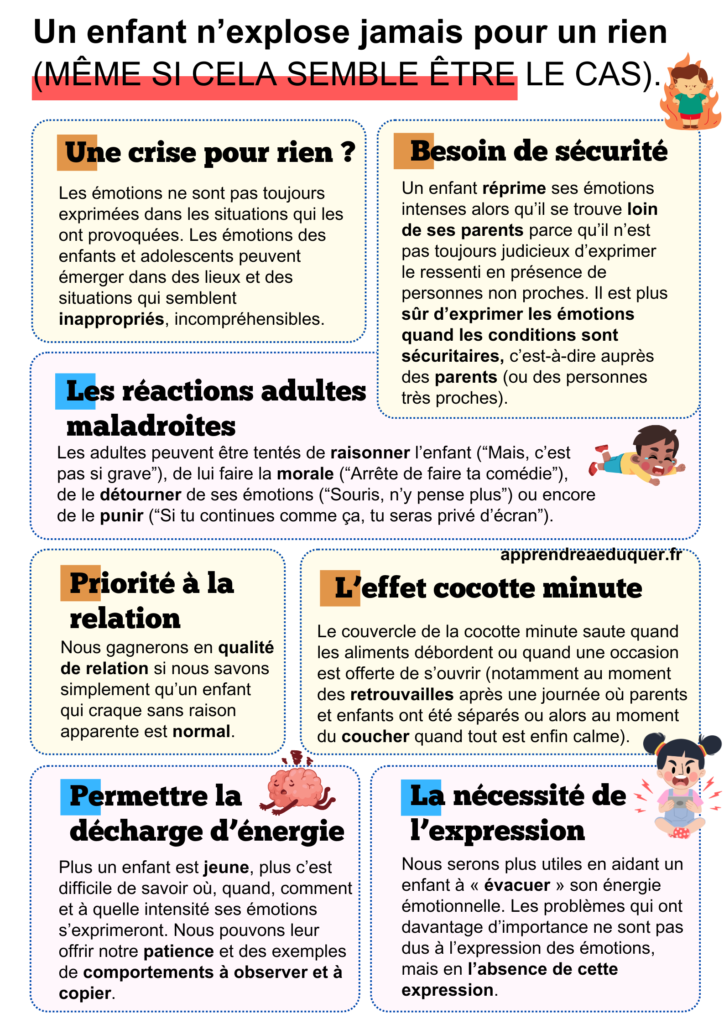
The emotional system is built to help a child hold intense feelings in check while away from their parents, because expressing raw emotion in front of people who are not close to them is not always wise. Once home, the safety of familiar faces lets all that stored energy come out.

This guide explains why children never really explode for nothing, and how to respond in ways that help rather than escalate.
Quick takeaways
- The "broken cookie" trigger is small to you but is the last straw for your child.
- Children often hold emotions together away from home and release them where they feel safe.
- Emotional energy comes out through play, crying, shouting, movement or withdrawal.
- Stay calm and keep everyone safe during the storm; teach and connect afterwards.
- A snack, movement and a quiet transition after school can prevent many explosions.
- Never dismiss the feeling with "it's nothing" or match their intensity with shouting.
Why a child never explodes for nothing
From our adult point of view, a broken biscuit, the wrong cup or a sock that will not sit straight is a "nothing". From the child's point of view, it is simply the last small weight on a load that has been building all day. The trigger is rarely the real cause.
Emotions carry energy because they exist to move the body toward unmet needs. A child who has spent hours holding that energy in will eventually release it somewhere, and home is usually where it happens. If you are curious about how young children build motivation and self-control over time, our piece on motivating children early offers useful perspective.
The safety factor
Children often keep it together at school precisely because they do not feel safe enough to fall apart there. Coming home to a parent is not a sign of disrespect; it is a sign of trust.
How children release stored emotional energy
Children and teenagers discharge accumulated emotional energy in many different ways: playing, shouting, jumping, crying, stomping, talking, withdrawing or shutting down completely. Often they do not consciously choose the method.
Two things shape how they let it out: immaturity, and the patterns they have absorbed by watching the people around them. A child who has seen adults slam doors or go silent will have those options in their toolkit too. Play is one of the healthiest outlets, and simple sensory games can help a child discharge tension through the body rather than through conflict.
For younger children still building their emotional vocabulary, baby sign language can give them a way to name a feeling before it turns into a meltdown.
| Moment | Helpful response | Avoid |
|---|---|---|
| The trigger appears | Acknowledge the feeling simply | Saying "it's nothing" |
| The meltdown peaks | Stay calm, lower your voice, keep safe | Arguing or lecturing |
| The energy drains | Offer closeness and quiet | Demanding an apology immediately |
| Later, when calm | Talk briefly about what happened | Reopening the whole conflict |
| Next day | Snack, movement, predictable routine | Stacking demands right after school |
What to do in the middle of a crisis
During the explosion itself, reasoning rarely works, because the thinking brain is temporarily offline. Your job is not to win the argument or to teach a lesson in that moment; it is to stay steady and keep everyone safe.
Lower your voice rather than raising it, get down to your child's level, and offer few words. A calm adult body is the most useful thing in the room. If siblings are present, a simple stay with grandparents arrangement during the worst moments can sometimes give everyone breathing space, though most families simply ride it out together.
After the storm
Once the energy has drained, that is the moment for connection and, later, for a short conversation about what happened and what could help next time.
Prevention: lowering the daily load
You cannot remove every frustration from a child's day, but you can reduce the pile. A snack and a quiet few minutes right after school, before any demands about homework or tidying, often prevents the explosion entirely.
Physical movement helps too: running, jumping or rough-and-tumble play gives the emotional energy somewhere to go. If you are choosing toys that support this kind of regulation, our reviews of sensory toys and metal fidget toys cover options that keep hands and bodies busy in a calming way.
Routines matter as well. Predictable transitions, such as a familiar goodbye at nursery or a set wind-down before bed, reduce the number of small shocks a child has to absorb. Our tips on adapting to nursery and potty training toys show how routine and play ease other high-pressure moments too.

What not to do when your child explodes
Avoid dismissing the feeling with phrases like "it's nothing" or "stop crying over that". To the child, the feeling is real, and denying it teaches them to bury emotion rather than manage it.
Try not to match their intensity with your own. Shouting back adds fuel and gives them a model of exactly the behaviour you are trying to reduce. It also helps to resist the urge to lecture mid-meltdown; save the teaching for the calm afterwards.
Finally, do not take the explosion personally. It is not a verdict on your parenting. Many parents find that reading about the realities of family life, from diverse family models to influencer mothers, reminds them that every household has its own version of the after-school storm.
My hands-on take
In our house, the explosion almost always arrived in the ten minutes after the school gate. For a long time I treated it as defiance and tried to reason my way through it, which never worked and usually made things worse. What changed things was simply handing over a snack and sitting quietly on the sofa for a few minutes before asking anything at all.
I also stopped calling it "nothing" out loud. Saying "that sounds really frustrating" instead of "it's just a biscuit" did not magically end the tears, but it did shorten them. The biggest shift was realising the meltdown was not aimed at me. Once I stopped taking it personally, I could stay calm enough to be useful.
Frequently asked questions
Is it normal for a child to melt down over something tiny?
Yes. The small trigger is usually the final straw after a long day of holding feelings in. The biscuit is not the real cause, just the point where the load tips over.
Does my child behave worse at home than at school?
Often, yes, and it is usually a sign of trust rather than bad behaviour. Home is where a child feels safe enough to let the stored emotion out.
Should I punish the explosion?
Punishment tends to add fuel rather than teach regulation. Staying calm during the storm and talking it through afterwards is more effective.
How can I reduce these meltdowns?
Lower the daily load with a snack, quiet time and movement right after school, and keep routines predictable. Fewer small shocks mean less stored energy to release.
Product Reviews
 Best Toys for Dogs With High Prey Drive |
Best Outdoor Toys for 3-4 Year Olds |
Best Outdoor Toys for 6 Year Olds |
Best Harness for Poodle |
Best LEGO Sets for Adults |
Best Travel Toys for 4 Year Olds on Airplane |
Best Toy Stores in Washington DC |
Best Potty Training Toys |
Best Toys for Tripod Dogs |
Maillot equipe de france







