


Child manipulation is rarely a sign of a "bad" child; it is more often a signal that something deeper is missing. Children do not arrive in the world as schemers, yet they can learn to use their emotions, and yours, to get what they need.
This article looks at why that happens, how the pattern takes hold, and what adults can change. The good news is that the root cause is usually a need for connection, not a character flaw, which means parents have real levers to pull.

Quick takeaways
- Children are not born manipulative; they learn the pattern.
- Unmet attachment needs often sit behind manipulative behaviour.
- Adults model the strategies children copy, including guilt and withdrawal of love.
- Simulated feelings can blur a child's sense of real emotion over time.
- Punishment treats symptoms; addressing needs treats the cause.
- Setting limits without withdrawing love teaches a healthier route.
Why unmet emotional needs can look like manipulation
Children have deep emotional needs: to be seen, heard, understood and loved without having to perform. When those needs go unmet, a child may start using their emotions, and those of the people around them, to obtain the satisfaction they crave.
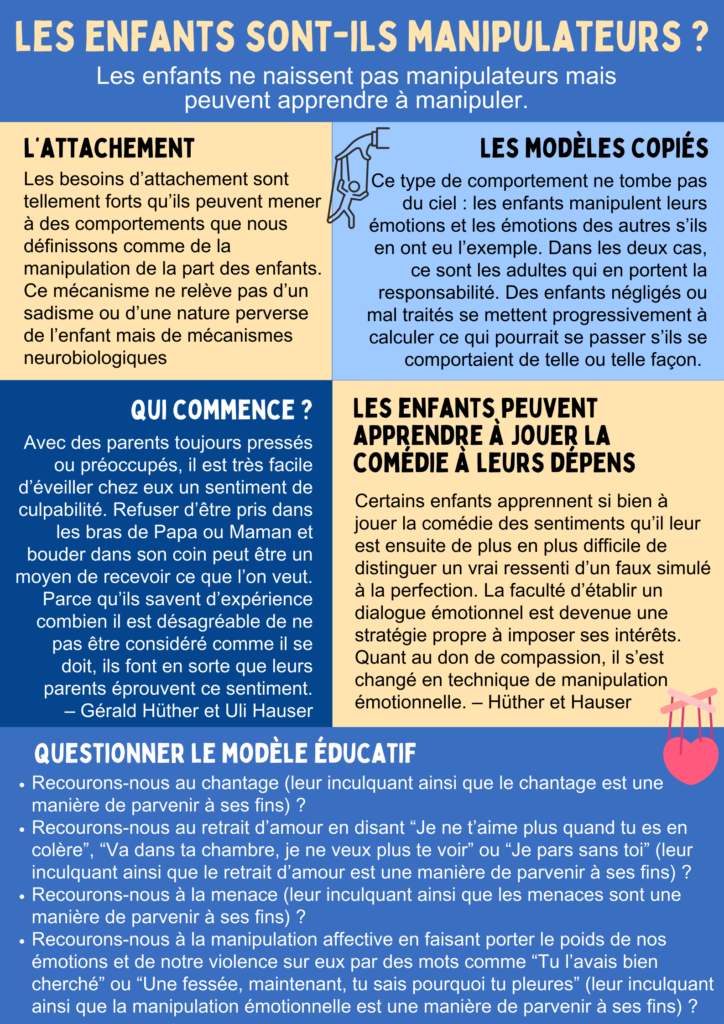
This mechanism has nothing to do with sadism or a perverse nature. It is rooted in neurobiology: the need for attachment is so powerful that it can drive behaviour adults label as manipulation. Authors Gérald Hüther and Uli Hauser explore this in their book Tous les enfants sont doués (All Children Are Gifted).
Understanding this reframes the whole problem. Instead of asking "how do I stop this behaviour?", the more useful question becomes "what need is this behaviour serving?"

Children learn strategies from the adults around them
When attachment, unconditional love and acceptance are missing, children test whether certain feelings they perceive in parents or carers can be used to push their own interests. They always have a "good" reason for acting as they do, good in the sense that it serves their life.
These behaviours do not fall from the sky. Children manipulate their own emotions and other people's if they have seen it modelled. In both cases, it is always the adults who start. Neglected or mistreated children gradually calculate what might happen if they behave a certain way, and some learn very quickly how to trigger a particular feeling in others. Just as adults shape these patterns, shared experiences can also strengthen family bonds, as with these places to visit together.
The guilt lever with hurried parents
With parents who are always rushed or preoccupied, it is very easy to awaken guilt. Refusing a hug from Mum or Dad and sulking in a corner can be a way to get what you want. Because children know from experience how unpleasant it is not to be properly considered, they make sure their parents feel that same discomfort. Understanding newborn health, such as bilirubin in newborns, can help parents feel calmer and less hurried.
| Adult behaviour | Example phrase | What the child learns |
|---|---|---|
| Blackmail | "If you don't, then I won't" | Blackmail gets results |
| Withdrawal of love | "I don't love you when you're angry" | Love is conditional |
| Threats | "I'm leaving without you" | Threats are a tool |
| Blame shifting | "You asked for it" | Emotions are weapons |
| Clear limit plus warmth | "Not now, and I still love you" | Needs can be voiced |
How a child becomes a habitual manipulator
A child who has learned that this works will keep trying to manipulate others the same way later on. These children learn to manipulate by disguising their emotions and simulating feelings. Hüther and Hauser note that they succeed all the better when their models also use this strategy, "this kind of comedy to serve their purposes and reach their goals".
Some children become so skilled at performing feelings that it later becomes hard for them to tell a real emotion from a perfectly simulated one. The ability to hold an emotional dialogue has turned into a strategy for imposing their interests, and the gift of compassion has become a technique of emotional manipulation. Building positive sleep phrases and sharing movies about respecting animals can help children name genuine feelings early.
This is where the pattern can harden into something lasting, which is why early attention to the underlying need matters so much.

Why punishment is the wrong response
None of this means these children should be punished, or that we should come down hard so they stop lying and call them little actors. Reasoning in terms of needs and attachment tackles the problem at its root rather than treating only the symptoms.
It also invites us to question the model we give children to imitate. Do we use blackmail, teaching them that blackmail is a way to get what you want? Do we withdraw love with phrases like "I don't love you when you're angry", "Go to your room, I don't want to see you" or "I'm leaving without you"? Do we use threats?
Do we use emotional manipulation by loading our own emotions and violence onto them, with words like "You asked for it" or "Now you know why you're crying"? Each of these teaches a lesson about how to reach a goal. The same principle applies to everyday choices, from choosing a good comb to the ice creams we allow.

Reasoning in terms of needs, for children and adults
When we reason in terms of needs, it means the needs of children and adults alike. The question becomes how to express my personal limits rather than limits in general, and how to respect my own dignity and integrity while respecting my child's at the same time.
This is not about abandoning boundaries. It is about setting them without withdrawing love, threatening or shifting blame. A clear "I can't do that right now, and I still love you" carries a very different lesson from "I'm leaving without you".
Children read our behaviour far more closely than our speeches. If we want them to ask for what they need rather than engineer it, our own way of handling frustration and connection has to show them how.
My hands-on take
I remember a phase when my child would go completely silent and turn away whenever I was on a deadline. My first reaction was irritation, then guilt, and I realised the guilt was doing exactly what the silence was designed to do. Once I started naming it out loud, saying something like "I think you want my attention and I'm distracted", the silence lost its power.
What helped most was separating the limit from the love. I stopped saying "I'm leaving" and started saying "I need ten minutes, then I'm all yours". It did not fix everything overnight, but the dramatic exits became rarer, and asking directly became easier for both of us.
Frequently asked questions
Are some children naturally manipulative?
No. The behaviour is learned, usually when emotional needs are not met or when adults model the strategy. It reflects a need for connection rather than a fixed personality.
Should I punish a child who fakes emotions?
Punishment treats the symptom and can reinforce the pattern. Looking at the need behind the behaviour, and at the model you provide, is more effective.
How do I set limits without withdrawing love?
State the limit clearly and separately from your affection. A phrase like "I can't do that right now, and I still love you" keeps the boundary without making love conditional.
What if I recognise my own behaviour in this?
That recognition is useful, not shameful. Changing how you handle frustration and connection shows your child a different, healthier way to get needs met.
Product Reviews
 Best Toys for Dogs With High Prey Drive |
Best Outdoor Toys for 3-4 Year Olds |
Best Outdoor Toys for 6 Year Olds |
Best Harness for Poodle |
Best LEGO Sets for Adults |
Best Travel Toys for 4 Year Olds on Airplane |
Best Toy Stores in Washington DC |
Best Potty Training Toys |
Best Toys for Tripod Dogs |
Maillot equipe de france







