


Positive words of encouragement are one of the most useful tools a parent can carry, yet they are often confused with simple praise. The most important thing for taking on and succeeding at challenges is to approach them with a growth mindset, reasoning not only in terms of effort and work but also in terms of strategies, trial, error and reassessment.
Encouraging a child is not the same as congratulating them. It asks for real attention from the adult, and children need far more than a quick "well done". This article shows how to phrase encouragement that honours their feelings, their effort and their own joy.

Quick takeaways
- Encouragement is not the same as praise; it asks for real attention.
- Notice effort, strategy and persistence rather than only results.
- Use open questions to let children reflect on their own work.
- "I" messages share your feeling without judging the child.
- Presence, a smile or your time can encourage as much as words.
- Replace "it's good" with specific, honest observations.
Encouraging is not the same as praising
An encouragement requires a real effort of attention from the person giving it. Children need much more than congratulations: they need support for their own joy, attention paid to their feelings, validation of their emotions, and admiration for the effort behind a result rather than only for the result itself.
This shift matters because praise tends to close a conversation ("good job"), while encouragement opens one. When you notice the process, you invite the child to notice it too. That habit of self-observation is what helps them keep going when a task gets hard, whether they are building something or simply exploring children's creativity.
Why effort beats outcome
Focusing on effort, strategy and persistence tells a child that ability is something they can grow. It also gives you something concrete to talk about, which is far more meaningful than a generic compliment.
How to phrase positive words of encouragement
There are several simple forms you can use, and they work best when mixed naturally into daily life. Questions invite the child to reflect: "What did you most enjoy doing today?", "What did you want to show in this drawing?", "How do you feel about your story?" This kind of curiosity also supports imaginative play, which flourishes when adults ask rather than judge, as with the imaginative play toys you might offer.
"I" messages express your own feeling without evaluating the child: "I love watching you create", "I appreciate it when you help". Empathy helps too: "I get the impression you're getting tired", "You must be proud of that". Recognising effort sounds like "That result took patience and you managed it on your own".
Presence counts as encouragement
Sometimes a smile, applause, or simply sitting beside a child and watching is enough. Giving your time to their activities is a message in itself, and it can be as valuable as words during something like custom LEGO accessories building. The same gentle encouragement applies to everyday wishes, such as when a child says https://building-blocks-toy.com/blogs/parenting/mom-i-want-long-hair-how-to-make-it-grow-strong-and-healthy and you respond with interest rather than judgment.
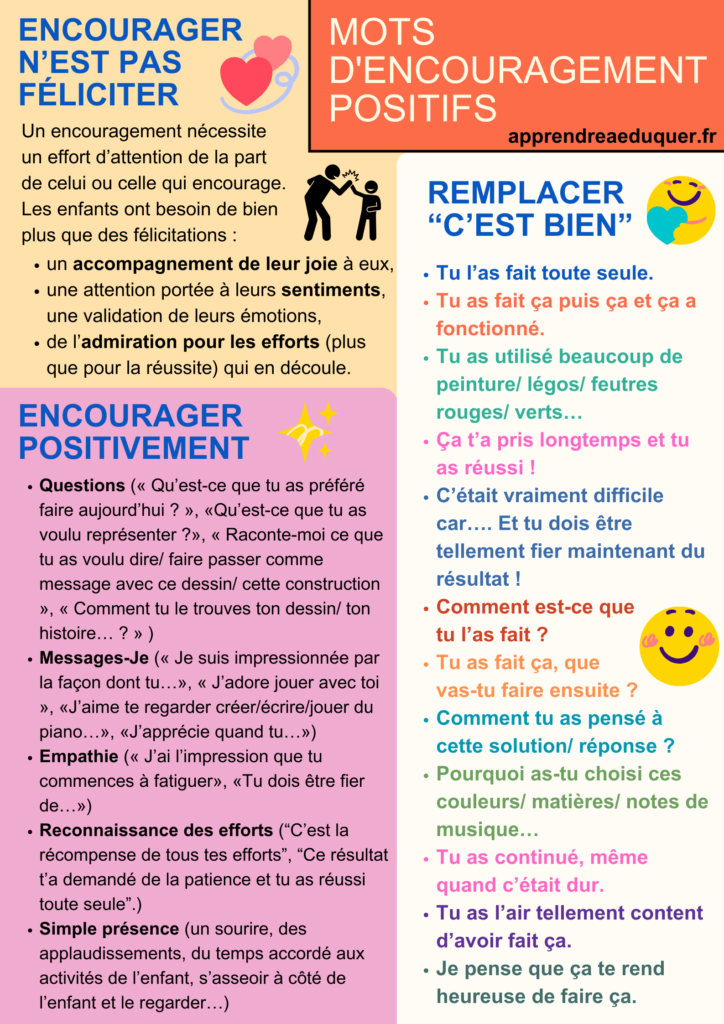
| Instead of saying | Try saying | What it encourages |
|---|---|---|
| It's good | You did it all by yourself | Autonomy |
| Well done | It took you a long time and you succeeded | Persistence |
| Nice drawing | What did you want to show in it? | Reflection |
| Good job | How did you think of that solution? | Problem-solving |
| You're clever | You kept going even when it was hard | Growth mindset |
| Perfect | You look so happy with that | Inner motivation |
Replacing "it's good" with specific language
"It's good" is easy to say and easy to forget. Specific phrases stick: "You did it all by yourself", "You used lots of red and green felt-tips", "It took you a long time and you succeeded", "That was really difficult because… and you must be so proud now".
You can also hand the reflection back: "How did you do it?", "What will you do next?", "How did you think of that solution?", "Why did you choose those colours?" These questions respect the child's own thinking. They are also handy when a child is deeply absorbed in a hobby, such as a long session with a LEGO Star Wars game.
Noticing persistence
Point out when a child kept going even when it was hard, and name the feeling: "You look so happy with that", "I think doing that makes you happy." This connects effort to a positive internal state rather than to external approval.
Using encouragement in everyday family life
Encouragement is not reserved for big achievements. It fits into ordinary routines: getting dressed, tidying up, trying a new food. The same principle applies when children are nervous about something new, like a first Disney birthday party or a school performance, where naming their effort calms them more than a rushed compliment. It also works with alternative princess stories that invite children to think beyond familiar characters.
It also helps in moments of frustration. If a child is struggling with homework or a sibling, empathy first ("I can see this is annoying you") then effort recognition ("You kept trying even when it was hard") keeps the door open. This is the same patient tone that helps when teacher and families work together on a child's progress.
Keeping it genuine
Encouragement works because it is true and specific. If you cannot find something real to notice, a quiet presence and a smile is better than an empty phrase.

Common mistakes to avoid
The main trap is turning encouragement into a disguised evaluation. "You're so clever" still judges the child rather than the process. Another mistake is over-praising every small thing until words lose their weight, which makes genuine recognition harder to hear.
It also helps to avoid comparing children, and to resist the urge to add a lesson to every moment. Sometimes a child simply wants to show you something, and the best encouragement is attention without commentary, much like the calm you might keep during a bronchitis recovery when rest matters more than achievement.
Small adjustments, big difference
Swapping one generic phrase a day for a specific observation is a realistic starting point. Over time, noticing effort becomes a habit, and children begin to notice their own effort too.

My hands-on take
I started paying attention to this after realising how often "well done" slipped out of my mouth on autopilot. When I switched to naming what I actually saw, something changed: my child began telling me about the process instead of just waiting for a verdict. "You kept going even when it was hard" landed very differently from a quick compliment, and it often led to a longer conversation about what they had tried.
What helped me most was keeping a few phrases in mind and using them naturally rather than reciting them. I still catch myself saying "it's good" sometimes, and that is fine. The goal is not perfect language but genuine attention, and children notice the difference quickly.
Frequently asked questions
Is encouragement always better than praise?
Not always, but encouragement tends to be more useful because it focuses on effort and process rather than a fixed judgement. Praise is fine occasionally; the balance matters more than avoiding it entirely.
What if I can't find anything specific to notice?
A smile, your full attention or simply sitting beside the child is a valid form of encouragement. It shows you value their activity without forcing a comment.
Does this approach work with older children too?
Yes. Open questions and recognition of effort suit teenagers as well, though they may prefer brief, low-key comments over enthusiastic ones.
Can encouragement spoil a child?
Encouragement aimed at effort and feelings does not spoil; it builds self-awareness. The risk comes from constant generic praise that teaches children to depend on approval.
Product Reviews
 Best Toys for Dogs With High Prey Drive |
Best Outdoor Toys for 3-4 Year Olds |
Best Outdoor Toys for 6 Year Olds |
Best Harness for Poodle |
Best LEGO Sets for Adults |
Best Travel Toys for 4 Year Olds on Airplane |
Best Toy Stores in Washington DC |
Best Potty Training Toys |
Best Toys for Tripod Dogs |
Maillot equipe de france







