


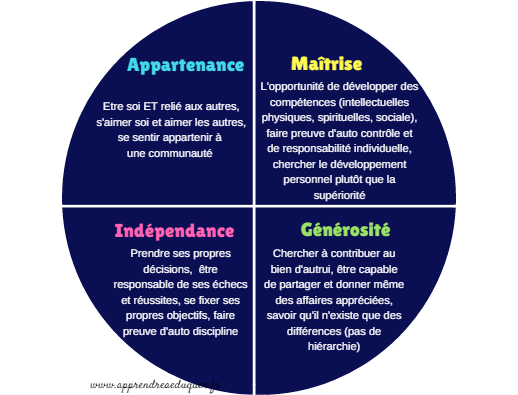
The Circle of Courage is a positive child development model inspired by Native American educational philosophy, and it rests on four universal needs every child carries: belonging, mastery, independence and generosity. Rather than focusing on correcting behaviour, it asks what a child actually needs in order to grow into someone who loves themselves, loves other living beings and cares for the land that sustains them.
These four pillars work together. When a child feels they belong, they dare to try; when they master something, they gain confidence; when they are trusted with independence, they learn self-discipline; and when they practise generosity, they discover their own worth. This article walks through each pillar in turn and shows how the model translates into everyday family life.

Quick takeaways
- Belonging means a child feels they count and has found their place.
- Mastery grows through repeated, real opportunities to try and solve problems.
- Independence is built by consulting children and letting them decide without fear.
- Generosity teaches children that they can contribute positively to someone's life.
- Combining skills with ethics prevents rivalry, domination and closing in on your group.
- The model is a lens for daily life, not a one-off programme.
Belonging: helping children find their place
In Native American cultures, the feeling of importance and of counting for others is fed by a long tradition of community belonging. Belonging is a fundamental need that drives all of us, whether it means belonging to a family, a place, an ethnic group or a set of beliefs. For children, belonging simply means finding their place.
Every member of the community is treated as family, and those deep social ties produce relationships marked by respect for every person, whatever their age or role. That is the spirit behind the saying often quoted by parents who miss the extended family: it takes a whole village to raise a child.
You do not need a village to feed this need. Children who feel judged by other parents can still build belonging at home through small rituals, shared meals and being genuinely consulted. Even the way we talk about ourselves matters, as these common self criticisms show.
Mastery: competence built through real experience
In traditional cultures, skill-building is guaranteed by the many opportunities children are given to experiment, test and gain mastery. People who have greater mastery of a valued skill are not seen as rivals but as learning models. Everyone in the community is oriented towards personal development rather than towards being superior to others.
Human beings naturally want to become competent in order to solve the problems they meet. Succeeding by yourself, while having benefited from the presence of the group, strengthens both the sense of competence and self-esteem.
Letting children practise
This means handing over real tasks, accepting imperfect results and letting repetition do its work. A child who struggles is not a badly raised child; they are simply still practising, a point worth remembering when you read that your child.
| Pillar | What the child needs | What a parent can do |
|---|---|---|
| Belonging | To feel important and find their place | Keep rituals, consult them, treat every member with respect |
| Mastery | Chances to experiment and solve problems | Give real tasks, accept imperfect results, allow repetition |
| Independence | To decide and be trusted | Ask their opinion, let them solve daily problems, give feedback |
| Generosity | To contribute to others | Invite them to share and help without expecting a reward |
Independence: from obedience to self-discipline
In Western societies, power is often based on domination, but in Native American cultures personal power runs through the right to independence. This independence, far from demanding obedience, aims to develop self-discipline and a sense of individual responsibility.
From the earliest years, children are encouraged to make their own decisions, are consulted on matters that concern them, have opinions that count and are led to solve everyday problems. Adults act as models, leading by doing and being, sharing values and giving feedback, while children get many opportunities to decide without fear of punishment or reproach.
The same idea runs through Jean Liedloff's book The Continuum Concept. It also shapes how we prepare children for new steps, such as getting ready for the school route or choosing when to start looking for a future preschool.
Generosity: teaching children to contribute
Virtue is passed on through the value placed on generosity. One of the first goals of Native American upbringing is to raise children who understand why being generous matters. By helping others without expecting anything back, and by sharing and giving possessions they hold dear, young people assert their own worth: they contribute positively to another human being's life.
This approach offers part of an answer to the question raised by education journalist Béatrice Kammerer: do we want to see standardised children grow up, or children who are secure and serene, who will bring society the singularity they have managed to develop?
Combining competence and belonging with ethics also removes the risk of closing in on your own group, of wanting to do better than others in order to humiliate them, or of using skills to seize power. Haïm Ginott's writing captures that essence well.

Bringing the four pillars into daily family life
The Circle of Courage is not a programme to apply in one afternoon; it is a lens. Belonging shows up in how a child is greeted, mastery in the tasks they are allowed to attempt, independence in the decisions they are trusted with, and generosity in the moments they are invited to help.
Play is one of the easiest places to start, because it naturally combines all four. Building sets reward mastery and patience, and choosing a first building software can extend that pleasure to the screen. Travel is another good testing ground: a few toys for the car or some travel toys give a child something to master while staying connected to the family.
Everyday care offers the same opportunities. Respecting a caregiver is part of belonging, and there are simple ways to help children respect the caregiver. Even a shared kitchen project, like a Easter cake made together, lets a child contribute something real to the family table.

My hands-on take
What changed things for me was realising how often I answered for my child. Offering an opinion, choosing between two shirts, deciding which cup to use: these tiny decisions cost me nothing and gave my child a sense of being trusted. I started small, on purpose, and the difference in confidence was noticeable within days.
The mastery pillar took more patience. I had to sit on my hands while a task was done slowly and imperfectly, and resist the urge to take over. Letting a child finish something badly, then try again tomorrow, is harder than doing it yourself, but it is where competence actually comes from. The generosity pillar surprised me most: asking my child to help someone else, without any reward, brought a calm and pride that no praise ever did.
Frequently asked questions
Where does the Circle of Courage come from?
It is a positive development model inspired by Native American educational philosophy, which rests on four universal childhood needs: belonging, mastery, independence and generosity.
Is this a discipline method?
No. It is a way of looking at what a child needs rather than at how to correct them. The four pillars describe conditions for healthy development, not a system of rewards and punishments.
Can I use it with a very young child?
Yes. Belonging and independence start early: consulting a small child on matters that concern them and letting them attempt everyday tasks are simple first steps.
Does independence mean letting children do whatever they want?
Not at all. Adults remain models who share values and give feedback; independence means children get many chances to decide without fear of punishment or reproach.
Product Reviews
 Best Toys for Dogs With High Prey Drive |
Best Outdoor Toys for 3-4 Year Olds |
Best Outdoor Toys for 6 Year Olds |
Best Harness for Poodle |
Best LEGO Sets for Adults |
Best Travel Toys for 4 Year Olds on Airplane |
Best Toy Stores in Washington DC |
Best Potty Training Toys |
Best Toys for Tripod Dogs |
Maillot equipe de france







