


Impulse control games for kids are short, playful activities that give children a safe place to practise stopping, waiting and thinking before they act. They work best when they are offered ahead of time, before a difficult moment arrives, rather than in the middle of one.
These games pair well with emotional support in the moment. A child who is told that anger is allowed but hitting is a choice is learning that the impulse can be felt and still resisted. Adults can then point back to a game: "It's like when you play... you can hold back, you've done it before."

Below you'll find group games, observation games and balance games, all easy to set up at home or in a classroom.
Quick takeaways
- Offer these games ahead of time, not as a punishment.
- Pair games with calm emotional support in the moment.
- Group games rehearse stopping, waiting and reversing instructions.
- Freeze, rhythm and observation games build focused attention.
- Card and balance games train reflexes and careful movement.
- Keep sessions short and stop before frustration builds.
Group games to practise stopping
Group games are a gentle way to rehearse self-control because everyone is watching and everyone makes mistakes. In "Neither yes nor no", one player asks questions and the other must answer without saying either word; whoever slips swaps roles. In "Simon says", players follow an instruction only when it is preceded by the magic phrase, and the faster the instructions come, the harder it is to resist.
The stubborn donkey game flips this: players do the exact opposite of what the leader says, so "turn right" means turn left, and instructions grow more complex as the game goes on. The slow-motion game asks children to perform an everyday action, like running or brushing teeth, as slowly as possible; children who tend to fight can even stage a pretend, no-contact fight in slow motion.
These games echo the kind of turn-taking children practise in # and other shared play. For a wider look at why play matters, see #.

Freezing, rhythm and observation games
"One, two, three, sun" is a classic freeze game: one player faces the wall, counts, then turns around while the others must stop dead. Anyone caught moving returns to the start line. A music-based statue version works the same way, with the adult stopping the music and gradually shortening the gaps between stops.
The rhythm game adds body awareness: clap once and everyone stands, clap twice and everyone holds their position, then vary the pattern. "What has changed" is quieter: children study an adult carefully, close their eyes, and the adult alters one detail, such as removing glasses or undoing a shoelace, before the children try to spot it.
Observation games like these build the same careful looking that supports early learning, much like the preparation described in #. Quiet focus also matters during long journeys, as parents planning # will know.
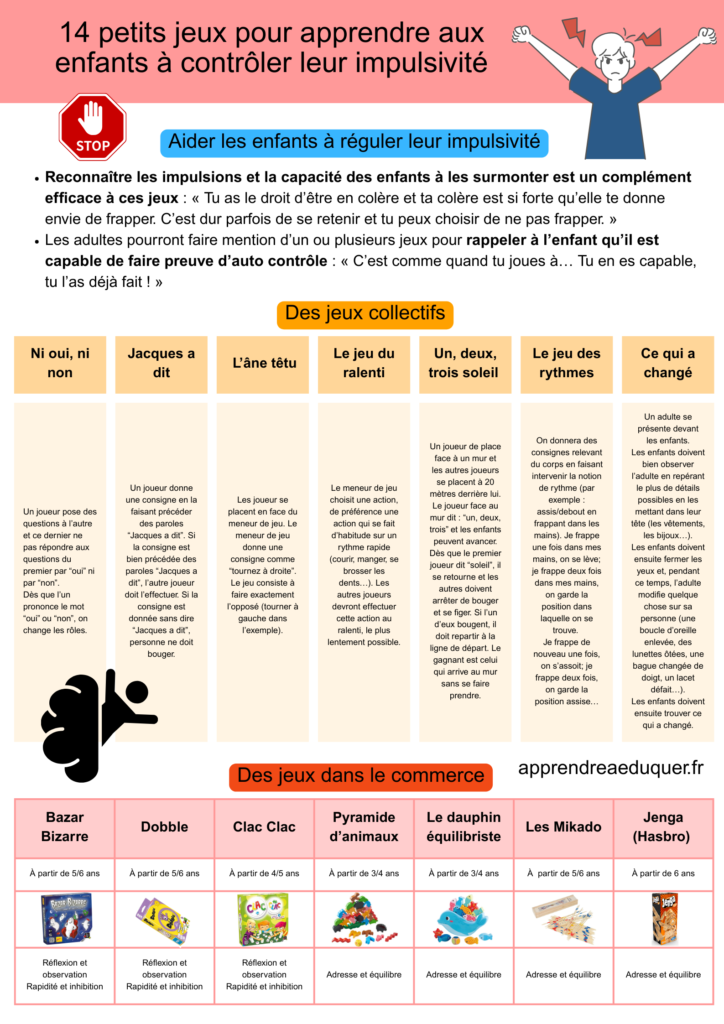
| Game | Main skill | Best for |
|---|---|---|
| Neither yes nor no | Verbal restraint | Ages 6 and up |
| Simon says | Listening and stopping | Groups |
| Stubborn donkey | Reversing a reflex | Ages 5 and up |
| Slow motion | Slowing the body | Active children |
| One, two, three, sun | Freezing on cue | Outdoors |
| What has changed | Careful observation | Quiet time |
Card and reflex games you can buy
Bazar Bizarre is a reflex and thinking game made up of cards and five pawns. Players race to grab the object shown on the card when its colour matches the pawn, and when nothing matches, they must grab the piece that shares neither colour nor object with the card. The rule sounds simple but demands real observation.
Similar observation games, such as Dobble, Pippo, Torteliki and Set for older children, work on the same principle. Clac Clac uses thirty-six discs and two dice: one die shows a colour, the other a symbol, and all players rush to collect discs with that combination, stacking them without mistakes.
These are the kind of compact games that fit neatly beside the picks in our guide to # and our roundup of #. If you are shopping in person, see our list of #.

Balance and dexterity games
Balance and dexterity games teach children to control their movements, think before acting and resist the first reflex to grab or push. Stacking a wobbly tower or balancing a figure on a narrow ledge requires a steady hand and a moment of patience, which is exactly the skill these games are quietly training.
A small selection includes first stacking games such as animal pyramids for children from around three or four, and balancing figures like the balancing dolphin. These suit younger children especially well, and pair naturally with the choices in our guide to #.
Older children who enjoy a challenge may prefer building sets, and our article on # shows how far that interest can go. For science-minded children, see #.

How to use these games well
Timing matters more than the game itself. Offer these activities when everyone is calm, not as a punishment after an outburst, and keep sessions short so they stay fun. Name the skill out loud afterwards: "You waited, you stopped, you checked first."
When a child is struggling, acknowledge the feeling before the rule. Remind them of a specific game they have already mastered, because remembered success is more convincing than adult praise. Repeat the same few games often; familiarity makes the challenge easier to tolerate.
Finally, watch for frustration and stop before it builds. A game abandoned happily is worth more than one finished in tears.



My hands-on take
I started using the slow-motion game at home almost by accident, during a rainy afternoon when my child was climbing the furniture. Asking him to cross the room as slowly as a snail changed the whole mood in under a minute, and he asked to do it again.
What I learned is that the games work best when I join in and lose gracefully. Freeze games fell flat when I treated them as a test, and worked beautifully when I played badly on purpose. I keep three or four in mind and pull them out before a difficult transition, like leaving the park or getting ready for bed, rather than after trouble starts.
Frequently asked questions
At what age can children start these games?
Simple freeze and rhythm games work from around three or four, while verbal games like neither yes nor no suit children from about six. Adjust the speed and complexity to the child rather than the age.
What if my child gets upset when they lose?
Shorten the game and praise the effort rather than the result. Remind them of a game they already handle well, and stop before frustration takes over.
Can these games replace emotional support?
No. They work best alongside calm support in the moment, helping children recognise an impulse and remember that they can choose not to act on it.
Product Reviews
 Best Toys for Dogs With High Prey Drive |
Best Outdoor Toys for 3-4 Year Olds |
Best Outdoor Toys for 6 Year Olds |
Best Harness for Poodle |
Best LEGO Sets for Adults |
Best Travel Toys for 4 Year Olds on Airplane |
Best Toy Stores in Washington DC |
Best Potty Training Toys |
Best Toys for Tripod Dogs |
Maillot equipe de france







