


Communication habits that fuel aggression are rarely dramatic; they hide in everyday phrases like "you always" or "you never". Learning to spot them is the first step towards calmer, more peaceful relationships, whether you are talking to a partner, a child, a colleague or a neighbour.
This guide breaks the main triggers into three families: generalisation, devaluation and the transfer of responsibility. For each one you will find concrete alternative strategies, so you can defuse tension before it turns into a shouting match or a silent stand-off.

Quick takeaways
- Spot the three families: generalisation, devaluation and transfer of responsibility
- Replace "always" and "never" with specific facts from today
- Avoid comparisons and labels, which lock people into roles
- Ask instead of assuming intentions you cannot know
- Use "I" statements to describe your own experience
- Repair after a slip and start again the next day
Why Certain Communication Habits Spark Conflict
Some attitudes reliably generate aggression and psychological games, and they do so almost automatically, without anyone deciding to pick a fight. The good news is that these habits can be learned, unlearned and replaced. The skill is to detect them in the moment, in yourself first of all, and then to choose a different wording.
This matters far beyond the family home. The same patterns show up at work, in friendships and between neighbours, which is why noticing them is useful for anyone who wants more peaceful relationships. Think of it as a small vocabulary of peace, built one sentence at a time.
Three families of triggers
We can group the most common triggers into three families: generalisation, devaluation and the transfer of responsibility. Each one has its own typical phrases and its own antidote, summarised in the table further down. Once you can name the pattern, you can interrupt it.
Generalisation: When "Always" and "Never" Take Over
Generalisation starts with permanent exaggeration: all, always, nobody, nowhere, everywhere, never. These words turn a single incident into a permanent verdict, and the other person immediately hears an accusation rather than a request. A child who is told he never listens has little reason to try tonight.
Amalgams are the second form: mixing unrelated problems together with a phrase like "yes, but you also did that the other day". The original issue disappears and the conversation becomes a trial. The third form is recuperation, where one example is used to prove the whole situation, as in "he didn't say hello, which proves he doesn't respect me".
What to say instead
Stick to the specific facts and the present moment: "this morning, when I asked you to put your shoes on, I had to ask three times". Describe what happened, how it affected you and what you need next time. If you want a playful way to practise turn-taking and clear expression with younger children, psychomotor skill games offer a gentle starting point. For families navigating school routines, a French school's late arrival rule and the kindergarten scholarship FAQ show how clear, specific wording prevents misunderstandings.
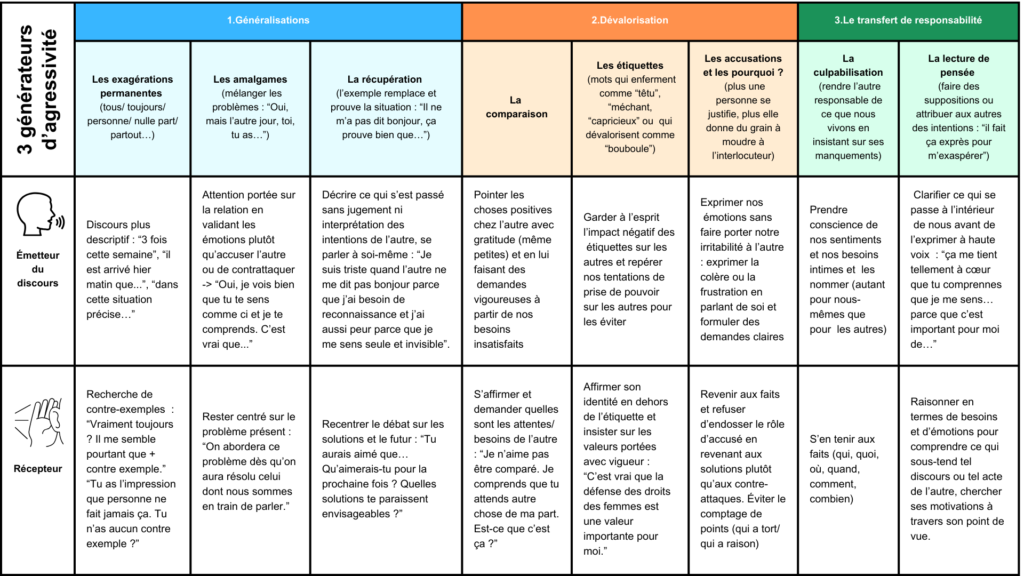
| Trigger family | Typical phrases | Alternative strategy |
|---|---|---|
| Generalisation | "You always", "nobody ever", "yes but you too" | Describe one specific fact from today |
| Amalgam and recuperation | "That proves he doesn't care" | Keep to the issue at hand |
| Devaluation | "Your sister does better", "you're useless" | Name the behaviour, not the person |
| Accusation and "why?" | "Why did you do that?" | State your need and ask an open question |
| Guilt-tripping | "Because of you I'm exhausted" | Use "I feel" and say what you need |
| Mind reading | "He does it on purpose" | Check the intention before judging |
Devaluation: Comparisons, Labels and Accusations
Devaluation works by shrinking the other person. Comparing someone with others who would do better, or would do it faster, sends a clear message: you are not enough. The comparison may be meant as motivation, but it is heard as a ranking, and rankings breed resentment.
Labels are words that lock a person into a role: stubborn, naughty, difficult, good for nothing, useless. Pet names that poke fun at a body or a personality, like "chubby" or "silly", belong here too, even when said with a smile. Over time the label becomes the identity, and the behaviour follows.
Accusations and endless "why?" questions complete the picture. The more a person justifies themselves, the more material they hand to the accuser, so the conversation spirals instead of resolving. A simple example: asking a teenager why they are so late invites a defence, while stating that you were worried invites a conversation. If you are raising several children, new family models reminds us that each child needs to be seen as an individual, not measured against a sibling.
Transfer of Responsibility: Guilt and Mind Reading
Guilt-tripping means making the other person responsible for what we are experiencing, usually by insisting on their shortcomings. "If you had listened to me, I wouldn't be exhausted" is not information, it is a verdict. The listener either collapses under the weight or pushes back, and neither response solves the problem.
Mind reading is the twin habit: making assumptions and attributing intentions, as in "he is doing that on purpose to exasperate me". We cannot know another person's intention unless they tell us, and stating it as fact closes the door to their version of events. Asking "what were you trying to do there?" opens it again. This pressure often feeds the self judgment many mothers carry.
A calmer alternative
Use "I" statements and describe your own experience: "I feel overwhelmed when the toys stay on the floor, and I need help before dinner". Then check rather than assume: "did you mean to leave it there, or did you forget?". This small pause is often enough to defuse a tense moment, and it models the same skill for children, who learn far more from what we do than from what we say, just as young children's car sickness eases with calm reassurance.

Putting It Into Practice Day by Day
Changing these habits is not about never being annoyed. It is about catching the phrase before it leaves your mouth and choosing a version that keeps the relationship intact. Start with one trigger, the one you recognise most in yourself, and work on it for a week before adding another.
It also helps to name the pattern out loud with older children, so they can recognise it too: "I just used a label, let me say it differently". This turns the whole family into a team practising a shared language. The same approach works in a car full of children, where a tense phrase can ruin the whole journey; car travel games are a practical way to keep the mood light on long drives. A good teacher relationship built on the same calm language reinforces this consistency for children.
Finally, be patient with yourself. Old habits return under stress, and that is normal. What matters is the repair afterwards: naming what happened, apologising if needed, and trying again. If you want a small ritual to support this, baby sign language shows how early, gentle communication can build a habit of understanding before frustration takes over. Knowing how to talk about sensitive topics calmly carries that same habit into every conversation.

My hands-on take
I started paying attention to these patterns after a week in which every evening ended in the same argument about shoes in the hallway. Reading back over what I had actually said, I noticed the words "you never" appearing in almost every sentence. I tried replacing them with a plain description of what I had seen that day, and the tone of the conversation changed within minutes.
What surprised me most was how often I used mind reading without noticing. Assuming my son was ignoring me on purpose made me angrier than the situation deserved. Now I try to ask a short question first, and I am often wrong about his intentions. I still slip, especially when tired, but naming the habit out loud has turned it into something we can laugh about together rather than a recurring battle.
Frequently asked questions
Are these communication habits only relevant to parenting?
No. The same patterns appear in couples, at work, in friendships and between neighbours. The wording changes slightly, but the mechanism is identical, which is why the alternatives work everywhere.
What should I do if I catch myself mid-sentence using a label?
Stop and rephrase out loud. Something like "I just called you lazy, that was unfair, let me say what I actually saw" repairs the moment and shows children how to correct themselves.
How long does it take to change a communication habit?
It varies from person to person and there is no fixed timeline. Most people find that picking one trigger at a time and practising it for a week makes the change manageable.
Does this approach mean I should never express anger?
Not at all. Expressing frustration is healthy; the goal is to describe your own experience and the specific facts rather than attack the other person's character.
Product Reviews
 Best Toys for Dogs With High Prey Drive |
Best Outdoor Toys for 3-4 Year Olds |
Best Outdoor Toys for 6 Year Olds |
Best Harness for Poodle |
Best LEGO Sets for Adults |
Best Travel Toys for 4 Year Olds on Airplane |
Best Toy Stores in Washington DC |
Best Potty Training Toys |
Best Toys for Tripod Dogs |
Maillot equipe de france







