


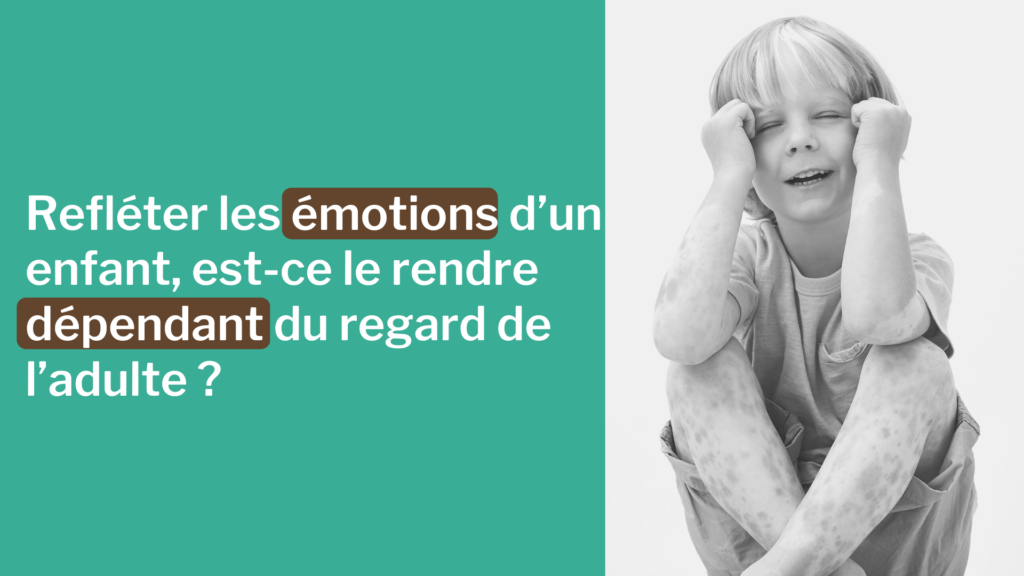
Reflecting emotions is one of the most misunderstood tools in gentle parenting, and many parents wonder whether naming a child's feelings makes them dependent on adult approval. The worry is understandable: if we always mirror what our child feels, won't they need our reaction before they can trust their own? In practice, the opposite tends to happen.
Receiving empathy is a fundamental human need at every age, not a luxury reserved for babies. When a child feels heard and understood, their heart opens, trust grows, and they settle. Over time, that experience of being accepted for who they are becomes the ground they stand on when they explore the world alone.

Quick takeaways
- Empathic listening means welcoming and reflecting feelings, not fixing or minimising them
- Feeling understood helps children release emotion fully and then move on
- Attachment is a biological need; secure attachment supports self-esteem and trust
- Attachment and autonomy grow together rather than competing
- Parents do not need to be perfect, only present and willing to repair
- A child who is heard learns to recognise their own feelings without approval
What empathic listening really means
Empathic listening is not about fixing, advising or distracting. It means welcoming the emotions moving through a child, reflecting them back, and showing understanding for their inner world. When an adult connects to what the child is living, the child's need for empathy is fed and they can calm down.
Children's emotions and behaviours are then met with curiosity, because they always tell us something and act as windows onto the child's inner life. A child whose emotions are welcomed develops healthy self-esteem: they sense they have the right to be who they are, to feel what they feel, and to trust their intuition.
The stick left at the park
Picture a child who forgets a stick at the park and sobs, insisting on going back. Adults often rush to say it is nothing, that another stick will turn up, that there is no point getting upset over a stick. Empathic listening instead welcomes the emotion and reflects it, without minimising it.
Why children need to feel understood, not fixed
Very often, when a child feels heard in this kind of situation, they discharge the emotion by crying and living it fully, like a small grieving process. Once the feeling has been experienced and released through empathic listening, they can move on. Many parents notice this shift and compare notes with others, much like swapping stories about family routines together or the small milestones of baby care tips.
A child in distress whose emotions are not minimised can open their heart without being pushed to feel better immediately. Often a child who complains, describes a problem or confides a feeling does not want a solution or advice: they need understanding and empathy, a friendly ear or a shoulder to cry on.
The parent's role is therefore not to solve every problem but to offer support, relief and empathy. This is the same patient presence that helps a newborn adapt to the world, and it remains just as valuable as children grow.
| Situation | Minimising response | Empathic response |
|---|---|---|
| Child cries over a lost stick | "It's nothing, find another one" | "You're sad you lost it" |
| Child complains about a friend | Advice and solutions offered | Listening and reflecting first |
| Child is angry about a rule | "Don't be angry" | "You really didn't want that" |
| Child cries after being heard | Told to stop crying | Allowed to cry and release |
| Child faces a new challenge | Pushed to manage alone | Secure base, then exploration |
| Parent loses patience | Ignored or brushed off | Named and repaired afterwards |
Child development and attachment theory
Attachment is a vital human need. By nature we are biologically programmed to attach to others from birth, and a human baby cannot survive without an adult meeting physiological needs (food, safety) and emotional ones (being looked at, held, rocked, reassured).
Depending on the quality of relationships with attachment figures, humans develop a certain way of being in the world, with others, and with themselves emotionally. These patterns are called attachment styles. When a child grows up in a warm, secure family environment where emotions are named and accompanied and personality is recognised, they can develop secure attachment.
What secure attachment gives a child
When attachment figures are present, sensitive and attentive, the child gradually builds positive, stable and realistic representations of self, other and world. That means solid self-esteem, a realistic view of their skills and limits, trust that others can understand and help, and a desire to explore a world full of opportunities.
The benefits of empathic listening for development
As psychotherapist Gwénaëlle Persiaux puts it, secure attachment is not the antidote to life's hardships, which spare no one, but it is a protective factor against the development of psychological difficulties. Attachment figures do not have to be perfect; they will make mistakes, but they can examine and repair them to provide an overall climate of physical and emotional safety.
Children need attachment and opportunities for autonomy in equal measure. Humans discover the world progressively, first a few metres from mum, then further afield. A secure base does not hold a child back; it gives them somewhere to return to, which is what makes confident exploration possible at every stage.
That same confidence shows up in everyday skills, whether a child is learning something new, coping with holding children during a clingy phase, or gradually taking on kitchen tasks with a little guidance.

How to reflect emotions without creating dependence
The key is to reflect the feeling, not to approve or judge it, and to leave the child space to express it in their own time. Name what you notice simply, then stay quiet. You are not telling the child how to feel; you are showing that their inner world is welcome.
Autonomy grows when children practise small decisions themselves. Empathic listening at home pairs well with patient, hands-on learning, whether that means tummy time toys for a baby or toddler toys that invite independent play. It also helps to keep routines calm and predictable, much like planning homework and rest around busy weeks.
Over time, a child who has been heard learns to hear themselves. They do not need an adult's face to know what they feel; they have practised it enough to recognise it alone.

My hands-on take
I remember the first time I tried reflecting instead of fixing. My child had lost a small stone on a walk and was inconsolable. Every instinct told me to explain how unimportant the stone was. Instead I said something like "you really loved that stone," and the crying got louder for a minute before it stopped completely. Then they took my hand and asked what was for snack, as if nothing had happened.
What surprised me most was not the calm that followed but what came later. Over the following months, my child started naming feelings themselves before I could, saying "I'm frustrated" or "I'm sad about that" without looking at me for a verdict. That is when I understood that reflecting emotions had not made them dependent on my gaze. It had given them the vocabulary to look inward on their own.
Frequently asked questions
Does reflecting emotions make a child dependent on adult approval?
No. Reflecting emotions shows a child their inner world is acceptable, which builds self-trust. Over time they learn to recognise feelings on their own rather than waiting for an adult's reaction.
What if my child cries over something trivial?
The size of the trigger matters less than the feeling it brings up. Welcoming the emotion lets the child release it fully, after which they usually move on more easily.
Should I always stay calm when my child is upset?
Not always, and that is fine. Attachment figures do not need to be perfect; what matters is noticing a rupture and repairing it afterwards so the overall climate stays safe.
Does empathy mean I never set limits?
No. You can hold a boundary and still acknowledge the feeling. "You really wanted that, and the answer is still no" respects both the limit and the child.
Product Reviews
 Best Toys for Dogs With High Prey Drive |
Best Outdoor Toys for 3-4 Year Olds |
Best Outdoor Toys for 6 Year Olds |
Best Harness for Poodle |
Best LEGO Sets for Adults |
Best Travel Toys for 4 Year Olds on Airplane |
Best Toy Stores in Washington DC |
Best Potty Training Toys |
Best Toys for Tripod Dogs |
Maillot equipe de france







