


A solutions wheel for kids who doubt and get discouraged is a simple paper tool that puts coping options right into a child's hands. Instead of hearing a long lecture about staying positive, the child spins a dial and watches one concrete idea appear at a time.
The wheel works because it turns a vague, overwhelming feeling into a small menu of choices. Children who freeze up when they feel powerless often relax once they can see that there are several things they could try, and that they get to pick which one fits.

This guide explains how to build the wheel, walks through every solution printed on it, and shows how to use it in daily family life without turning it into a reward chart.
Quick takeaways
- The wheel is a printable two-disc tool held together by a paper fastener.
- Cutting an orange window in the top disc reveals one solution at a time.
- Seven options cover naming feelings, recalling love, past wins and control.
- Permission to pause and cry is treated as a valid coping step.
- Children choose their own solution, which builds a sense of agency.
- Keep the finished wheel visible and easy to reach on hard days.
How to assemble the solutions wheel
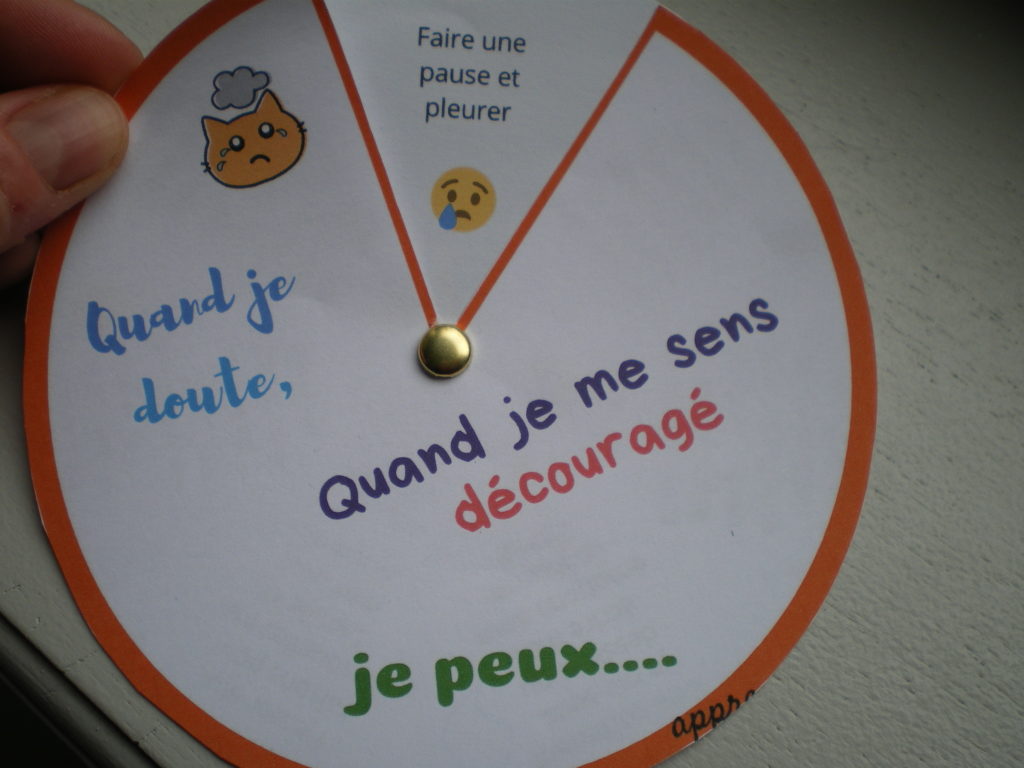
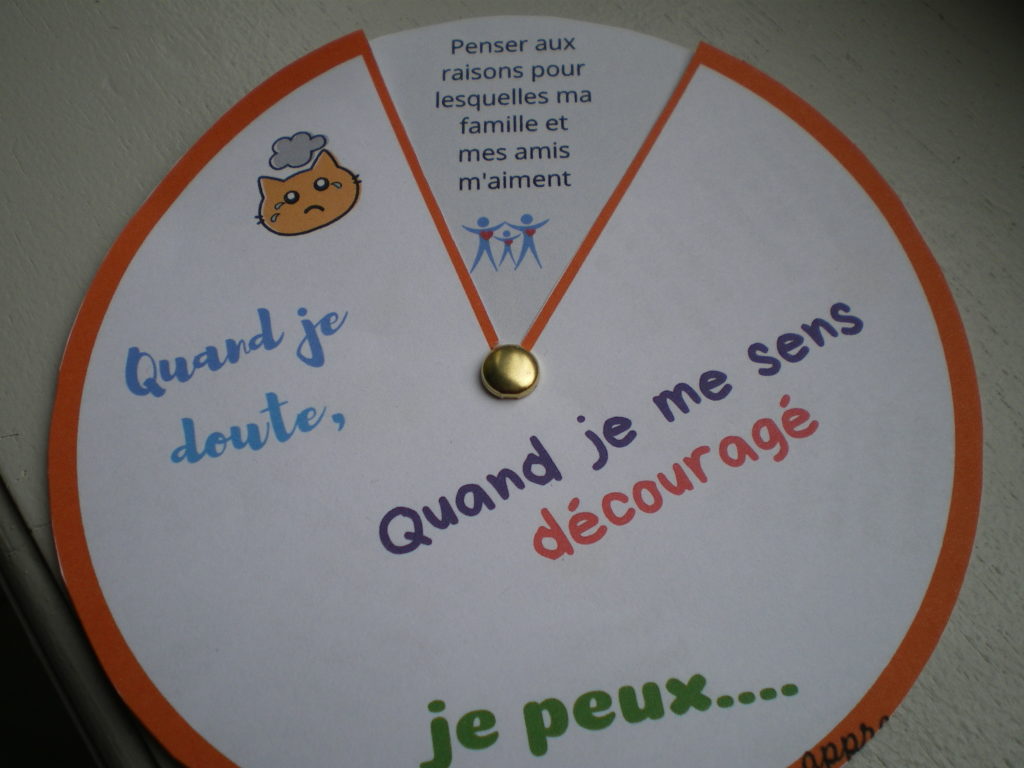
The tool is a printable document containing two circular wheels. Print both, then cut them out carefully. On the top wheel, cut away the orange quarter so that the layer underneath becomes visible through the opening.
Stack the two circles, lining up their centres, and push a paper fastener through the middle so the top disc can spin freely. Children rotate the wheel and one solution at a time shows through the window. They then choose the one or two ideas that feel most appropriate in that moment.
Laminating the circles before cutting makes them last longer, and a slightly looser fastener lets small hands turn the dial without tearing the paper. Keep the finished wheel somewhere visible, such as a kitchen drawer or a bedroom shelf, so it is easy to reach on a hard day.
Naming feelings: talk, draw or write
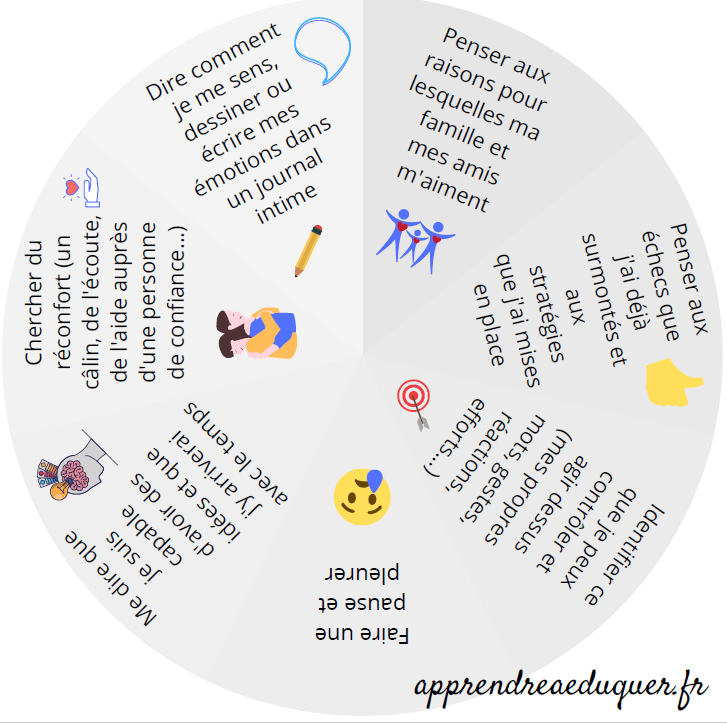
The first solution invites children to say how they feel, or to draw and write their emotions in a private journal. Putting a feeling into words, colours or sentences moves it from something swirling inside to something the child can look at from the outside.
Some children talk easily; others shut down when asked direct questions. Offering paper and pencils removes the pressure of eye contact. If your child enjoys stories, our guide on choosing a first book explains how these skills develop and why expression grows with practice. For broader debates, see these controversial parenting issues.
Keep the journal private unless your child invites you in. The point is a safe outlet, not a record you inspect. Younger children can simply draw a weather symbol for the day, which is often enough to start a conversation.
| Wheel option | What it builds | When it helps most |
|---|---|---|
| Talk, draw or journal feelings | Emotional vocabulary | Child is withdrawn or silent |
| Recall family love | Belonging and security | Child feels unlovable |
| Recall past successes | Confidence from evidence | After a fresh failure |
| Focus on what is controllable | Problem-solving | Child feels powerless |
| Pause and cry | Emotional release | Overwhelm is at its peak |
| Self-encouragement | Inner dialogue | Before trying again |
| Seek comfort from a trusted person | Trust and connection | Child feels alone |
Remembering love and past successes
Two of the wheel's options work on memory. One asks the child to think about the reasons family and friends love them; the other asks them to recall failures they have already overcome and the strategies that helped.
These prompts counter the tunnel vision that comes with discouragement, where a single setback feels permanent. A child who remembers surviving a difficult school project can borrow that same strategy now.
You can support this by retelling small family stories at dinner, the kind of everyday memory that reminds a child they belong. Grandparents are especially good at this, as this storytelling by elders piece shows, and their perspective often carries more weight than a parent's reassurance. Packing away keepsakes in a trunk can make those memories easy to revisit, much like tracking how many villagers a child has gathered in a favorite game.
Focusing on what can be controlled
Another option asks children to identify what they can control and act on it: their own words, gestures, reactions and effort. This is the practical heart of the wheel, because it converts helplessness into a next step.
Help your child sort a worry into two piles, things they can influence and things they cannot. Then pick one small action from the first pile, such as apologising, asking a question or practising a few minutes longer.
This habit of effort over outcome pairs well with creative play, where trying again is built into the activity. The guide to creativity offers age-based ideas for encouraging that mindset, and a simple building set can do the same job on a rainy afternoon.

Taking a pause, crying and self-encouragement
The wheel gives explicit permission to stop and cry. For many children this is a revelation: a pause is not quitting, and tears are a release rather than a failure. Let the crying finish before you problem-solve.
After the pause comes a sentence the child can say to themselves: that they are capable of having ideas, and that they will get there with time. Repeating it aloud at first helps it stick.
Self-talk is powerful, but it should never become pressure. If a child hears only "be positive" and no comfort, the message curdles. This is why the next option on the wheel matters so much, and why harsh tactics such as parental blackmail backfire by teaching children to hide feelings rather than name them. The same principle of patient, pressure-free encouragement applies to building together calmly.

Seeking comfort and using the wheel day to day
The final solution is to look for comfort: a hug, a listening ear, or help from a trusted person. Children need to know that asking for support is a skill, not a weakness, and that the adults around them are glad to be asked.
In daily use, resist the urge to spin the wheel for your child. Let them choose, even if the choice seems odd to you. The sense of agency is the whole point.
Keep the tool fresh by pairing it with other routines, such as calm bedtime reading or a shared hobby. The choice of activities article is useful here, and so is a quiet corner stocked with a few favourite toys for younger siblings who want to join in.
My hands-on take
I made our first wheel on a grey afternoon when my eldest was convinced a small mistake had ruined everything. Cutting the orange window took me two attempts, and the fastener was too tight at first, but the moment my child spun it and landed on "think about reasons people love me," the tone in the room changed.
What surprised me most was how often my children picked the pause-and-cry option. I had expected them to jump to problem-solving, but they needed permission to feel bad first. Now the wheel lives in the kitchen drawer, and I try to remember not to spin it for them.
Frequently asked questions
What age is the solutions wheel suitable for?
It works best with children old enough to read the options or recognise the pictures, roughly early primary school onward. Younger children can use it with an adult reading each solution aloud.
Do I need special materials to make it?
No. You need the printed document, scissors and one paper fastener. Laminating is optional but helps the wheel survive repeated use.
What if my child refuses to use the wheel?
Leave it available without pressure and model it yourself by naming which option you would pick. Children often come back to a tool once it stops feeling like an instruction.
Should I reward my child for choosing a solution?
No. The wheel is about self-regulation, not performance. Rewards can turn an honest coping tool into something a child performs for approval.
Product Reviews
 Best Toys for Dogs With High Prey Drive |
Best Outdoor Toys for 3-4 Year Olds |
Best Outdoor Toys for 6 Year Olds |
Best Harness for Poodle |
Best LEGO Sets for Adults |
Best Travel Toys for 4 Year Olds on Airplane |
Best Toy Stores in Washington DC |
Best Potty Training Toys |
Best Toys for Tripod Dogs |
Maillot equipe de france







