


Over-scheduling children has become a quiet norm in many families, and it deserves a closer look. Most parents genuinely want the best for their child, yet the pressure to achieve results from an early age is rising, and so is childhood anxiety.
That anxiety does not only touch children who struggle at school. It also reaches those who "succeed", which suggests the problem lies in the pace itself rather than in ability. This article explores why loving parents submit to this rhythm, what it costs, and what children truly need instead.

Quick takeaways
- Rising childhood anxiety affects high achievers and struggling pupils alike.
- Pressure often starts in early childhood and rarely lets up.
- Beyond a small amount, homework mostly costs children sleep.
- External rewards can smother curiosity, creativity and the love of learning.
- Free play, rest, nature and family time are genuine developmental needs.
- Missing a planned activity to follow a child's interest is often the better choice.
Why pressure starts so early
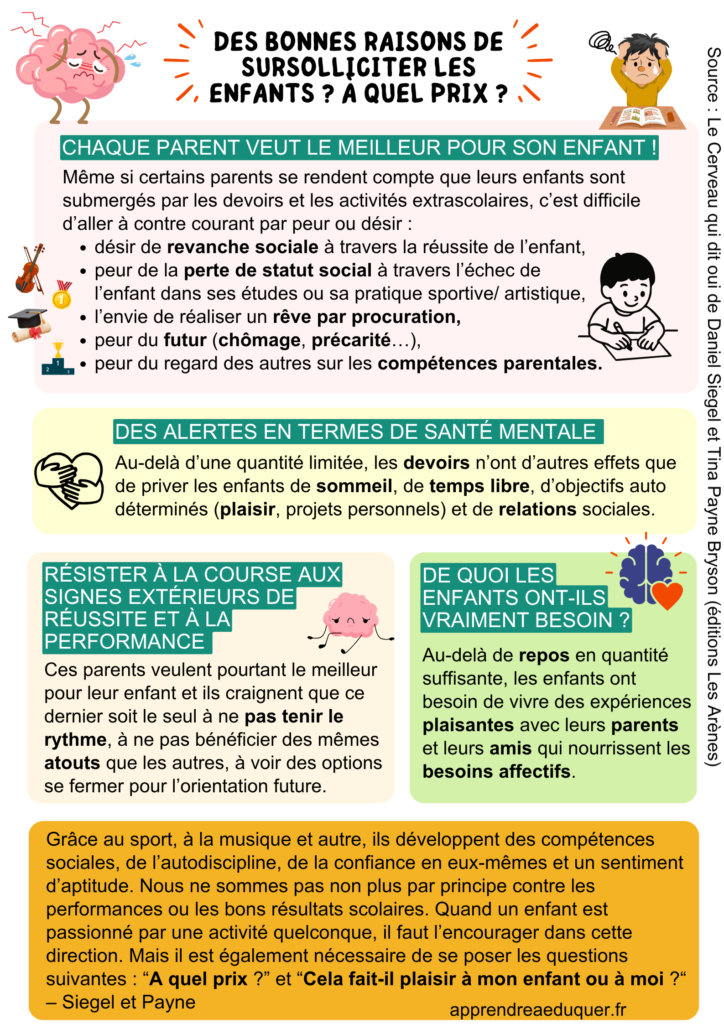
According to Daniel Siegel and Tina Payne, authors of a book on the developing brain, more and more children are affected by anxiety. They see this rise as a consequence of demanding results from early childhood onward. Many children absorb pressure, formal or subtle, to meet the expectations of family, teachers, sports coaches and music tutors, instead of enjoying a period of development and exploration without constraints.
These children end up feeling abnormal, out of step, exhausted and never quite good enough, rather than living the deep joy of simply being. Even top-of-the-class pupils are not protected from this. If you are planning family plans May, keep in mind that a busy calendar is not the same as a rich childhood. The same holds for science loving kids, who thrive on curiosity rather than a packed schedule.
The fear behind the schedule
Many parents notice that homework loads are too heavy and that their child is overwhelmed, yet going against the current feels risky. Fear of future insecurity, of social decline, of other people's judgment about their parenting, or of their child being rejected for being atypical keeps the treadmill turning. A father quoted in the book captures the tension well: he knows what the research says and would like to demand less, but sees it as a bet on his son's future he is unwilling to make. As with nursery adaptation, easing in gently often works better than pushing hard.
The hidden costs of constant achievement
Beyond a limited amount, homework mainly deprives children of sleep. Loving parents still follow the rhythm for good reasons: pressure for good grades, tutoring hours, extracurricular activities, cultural outings imposed without regard for the child's tastes, comparisons with others, late nights and ignored fatigue or physical pain. The dictatorship of outward signs of success prevents children from discovering what has meaning for them. Instead of loving to learn, many pupils feel oppressed and overwhelmed by class and activities.
Overvaluing external motivation endangers family life and smothers the inner flame that fuels curiosity, creativity and the desire to learn. When a child's worth is measured by trophies, the joy of trying something new quietly disappears. A balanced approach to daily life, much like balanced barbecue steps, is about proportion rather than excess. The same lesson applies to treats: even the industrial ice creams of childhood fit only in moderation.
What gets squeezed out
When children are pushed to excel in one field, artistic, sporting or academic, little time or space remains for free play, imagination, exploration, daydreaming, rest or contact with nature. Those are precisely the experiences that lead to genuine success, peace and inner joy. As with celebrities after giving birth, outward images rarely tell the whole story.

| Pressure-driven week | Slower family week | What it protects |
|---|---|---|
| Back-to-back classes | One chosen activity | Energy and sleep |
| Tutoring after school | Reading together | Love of learning |
| Late nights finishing tasks | Consistent bedtime | Rest and mood |
| Outings chosen by adults | Free play at home | Imagination |
| Comparison with peers | Noticing your child | Inner motivation |
What children really need
Paradoxically, this path does not give children what they actually need. Beyond sufficient rest, they need pleasant experiences with their parents that feed emotional needs: playing, reading stories together, going out into nature, cooking, making things, gardening, simply talking and resting in a slow-life spirit. These small rituals matter more than another enrichment class, and they are as essential as baby first outings are for the youngest children.
Tina Payne shares a personal anecdote in which she felt trapped in the rigidity of the achievement race. One day her two-year-old son was fascinated by a stack of plastic cups just as they were leaving for a music awareness workshop. She felt irritated because they would be late and she would have to battle him away from a game far less "useful" than the class. Then she came to her senses, realised he was already doing something useful, sat down beside him on the rug and joined his game, forgetting the music activity that time.
Learning to protect free play
Every parent misses moments like that one. Sometimes there is no time to notice a child's needs at the right moment and share the excitement of discovery. Sometimes we work so hard on their "enrichment" that we forget to pay attention to what is really happening inside them. The fix is not dramatic; it is a matter of noticing.
Try leaving small gaps in the week with nothing planned, and let your child fill them. Keep a basket of open-ended toys within reach so curiosity does not depend on a screen or a class. If you are expecting another child, it may be worth asking whether to redesign your budget so that time, not spending, becomes the family priority.
Watch for the warning signs
Irritability, sleep problems, complaints of stomach aches before activities or a sudden loss of interest in a former passion are signals worth taking seriously. They are not laziness; they are information. Reducing one commitment often restores more than adding a reward.
Rethinking the family rhythm
Reclaiming a slower pace does not mean abandoning ambition or structure. It means asking, for each activity, whether it feeds the child or only the résumé. A child who rests, plays freely and feels loved for who they are builds the inner resources that support real learning later on. Parents who model rest and curiosity teach more than any schedule can.
When siblings compete for attention and time, protecting free play becomes even more important; simple strategies for fights between siblings help keep the home calm. And when the whole family is at home together, a few ideas for working from home with young children can protect the unstructured time everyone needs.

My hands-on take
I have been the parent who filled every afternoon, convinced that an empty slot was a wasted opportunity. What changed my mind was watching my child spend forty minutes stacking cups and narrating an entire imaginary world. Nothing about it looked productive, and yet he came out of it calmer and more talkative than after most classes.
Now I try to keep one afternoon a week completely free. It is not always easy, and I still catch myself adding "just one more" activity. But when I ask whether a commitment feeds my child or only my worry, the answer is usually clear, and the slower weeks are the ones we remember.
Frequently asked questions
Is over-scheduling always harmful?
No. Structured activities can be valuable when a child enjoys them and has enough rest and free time around them. The problem appears when the calendar leaves no room for play, sleep or family connection.
How do I know my child is overloaded?
Watch for irritability, sleep trouble, physical complaints before activities or a loss of interest in things they used to love. These signs suggest the pace needs adjusting rather than more encouragement.
Does cutting activities harm future opportunities?
Protecting rest and free play supports curiosity and motivation, which matter for long-term learning. Fewer, better-chosen commitments often serve a child's future more than a packed schedule.
What can we do instead of another class?
Simple shared experiences work well: playing, reading, cooking, gardening or time outdoors. These feed emotional needs and cost nothing beyond attention.
Product Reviews
 Best Toys for Dogs With High Prey Drive |
Best Outdoor Toys for 3-4 Year Olds |
Best Outdoor Toys for 6 Year Olds |
Best Harness for Poodle |
Best LEGO Sets for Adults |
Best Travel Toys for 4 Year Olds on Airplane |
Best Toy Stores in Washington DC |
Best Potty Training Toys |
Best Toys for Tripod Dogs |
Maillot equipe de france







