


This self-confidence activity for kids invites children to become aware of their qualities and their intrinsic worth through a gentle reflection on who they are. It takes the shape of a poster filled with stars, each one standing for a positive element of the child's personality.
The stars cover talents, abilities, sources of pride, joys, the people around them, and the activities they enjoy for giving and helping. Children fill in the poster according to what speaks to them deep in their heart, so the result is personal rather than a test with right answers.

Quick takeaways
- The activity uses a poster of stars, each one for a positive part of the child's personality
- Children name qualities, talents and things others ask their help with
- Joys, happy memories and proud successes each get their own star
- Listing supportive people reminds children they are not building confidence alone
- Giving and helping stars show children their actions matter to others
- The finished poster becomes a tool to revisit whenever confidence wavers
What the Inner Stars Activity Is and Why It Works
The goal is simple: help children notice their own qualities and their value through reflection on what they are. The activity is presented as a poster covered with stars, and each star corresponds to a positive element that makes up the child's personality. This is not about performance or comparison with siblings or classmates.
By putting these elements down on paper, children turn vague feelings into something they can see and return to. The filled stars become like inner diamonds they can summon whenever they need to feed their self-confidence. If your child tends to be shy or anxious, pair this quiet activity with a warm conversation about holding a crying child, so reflection and comfort go hand in hand.
Setting the Tone
Keep the mood light and curious rather than evaluative. Sit beside your child, ask open questions, and let silence do some of the work.
Naming Qualities, Talents and Things Done Well
Children begin by listing their qualities and talents, often through adjectives that fit them. You can help by asking what they are good at, or what people recognize them for, compliment them on, or ask their help with. Concrete examples from daily life work better than abstract praise, and small back to school reward toys can reinforce the effort.
This step is also a good moment to talk about values, since qualities often grow out of them; our piece on values Thanksgiving transmits offers a natural way to connect the two. Some children find it easier to draw or dictate than to write, so adapt freely, and a trip to one of these natural swimming places can spark fresh memories to add.
Prompting Without Leading
Ask "What do your friends come to you for?" rather than "You're good at sharing, aren't you?" The child should own every word on the poster.
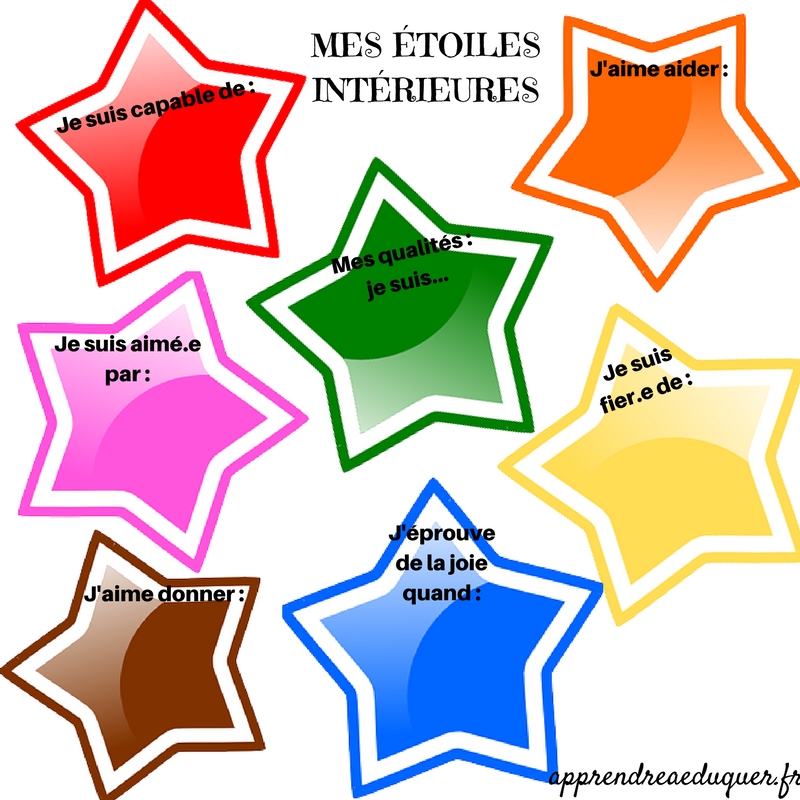
| Star category | What the child lists | Helpful prompt |
|---|---|---|
| Qualities and talents | Adjectives that fit them | What do people compliment you on? |
| Things done well | Skills and know-how | What do friends ask your help with? |
| Joys and memories | Happy experiences | What made you smile this month? |
| Support people | Those who love and help them | Who can you count on? |
| Giving and helping | How they are useful to others | Who did you help this week? |
| Proud successes | Achievements that felt good | What are you proud of lately? |
Recording Joys, Memories and Proud Achievements
Next come the experiences and memories that bring the child joy. These might be big moments or small everyday ones, and both count. Alongside them, children note the successes that have given them a sense of pride, which helps them see that effort and achievement are linked.
If your child struggles to recall proud moments, look back together at the past year and name a few. A relaxed chat about music for your child or a favorite family outing can jog happy memories that belong on a star.
Making It Visible
Once the poster is complete, hang it where the child will see it often. A bedroom wall or the inside of a wardrobe door works well.
Identifying the People Who Love and Support Them
Children then list the people who love them and are there to support them when needed, the ones they can truly count on. This reminds them that confidence is not built alone. Family, friends, teachers or neighbors can all appear on the stars.
For younger children, a simple visual reminder of these people can be reassuring, much like the comfort of a familiar toy for one year old during transitions. Talking about support also opens the door to bigger questions, such as what to do when a child wants to be popular at school and feels pressure from peers, or even whether to turn a sleeping baby onto their back.
Support Beyond the Family
Encourage your child to think of adults outside the home too, like a coach or a grandparent, so the support network feels wide.

Ways to Give, Help and Be Useful
The poster also asks how children know how to be useful and do good: by giving things, time, help or encouragement. They can note who they give to, whether friends, family or strangers, and who they help to do what. Examples might include helping a classmate with homework, teaching a little brother to tie his shoelaces, or helping a parent cook.
This part builds empathy alongside confidence, showing children that their actions matter to others. If your family talks about kindness and gratitude, the ideas in our article on Thanksgiving values can enrich the conversation.
From Poster to Practice
Pick one helping idea from the stars and try it during the week, then add a new star when it goes well.
Using the Stars When Confidence Wavers
Once filled in, these stars act as inner diamonds the child can call on whenever confidence needs nourishing. Before a test, a new activity or a social moment, invite your child to reread the poster and pick one star to hold in mind. Over time, this turns the poster into a coping tool rather than a one-off craft.
Keep the ritual gentle and never use the stars as pressure. If your child is going through a tricky phase, a calm chat about being popular at school or about everyday worries can help you connect the activity to what is really on their mind. For bigger changes, like going to work or a hip sprain, the stars can steady them too.
Revisiting and Updating
Return to the poster every few months and add new stars as your child grows, learns skills and makes new friends.

My hands-on take
I first tried this activity on a rainy afternoon with my own child, expecting it to take ten minutes. It took closer to forty, because every star turned into a story about a friend, a teacher or a small victory I had forgotten. I remember being struck by how many of the entries were about helping others rather than about achievements.
What I learned is to stay quiet and let the child lead. When I suggested a quality, it usually landed flat; when I asked a question and waited, something real came out. We hung the poster by the bedroom door, and for months afterward my child would point at a star before a swimming lesson or a spelling test. It has become less a craft and more a quiet family ritual we return to whenever confidence needs a little topping up.
Frequently asked questions
What age is this activity suitable for?
It works best with children who can reflect and write or draw, roughly early primary school and up. Younger children can take part by dictating their stars to an adult who writes them down.
Do we need to print the poster?
A printed version is convenient, but you can easily draw a large star shape on paper and divide it into sections. The reflection matters far more than the format.
What if my child cannot think of any qualities?
Offer concrete observations from daily life instead of labels, such as a moment when they shared or helped. Then let the child decide whether that belongs on a star.
How often should we revisit the poster?
Every few months is plenty, plus before challenging moments like a new school year. Adding a star each time keeps it alive and shows growth.
Product Reviews
 Best Toys for Dogs With High Prey Drive |
Best Outdoor Toys for 3-4 Year Olds |
Best Outdoor Toys for 6 Year Olds |
Best Harness for Poodle |
Best LEGO Sets for Adults |
Best Travel Toys for 4 Year Olds on Airplane |
Best Toy Stores in Washington DC |
Best Potty Training Toys |
Best Toys for Tripod Dogs |
Maillot equipe de france







