


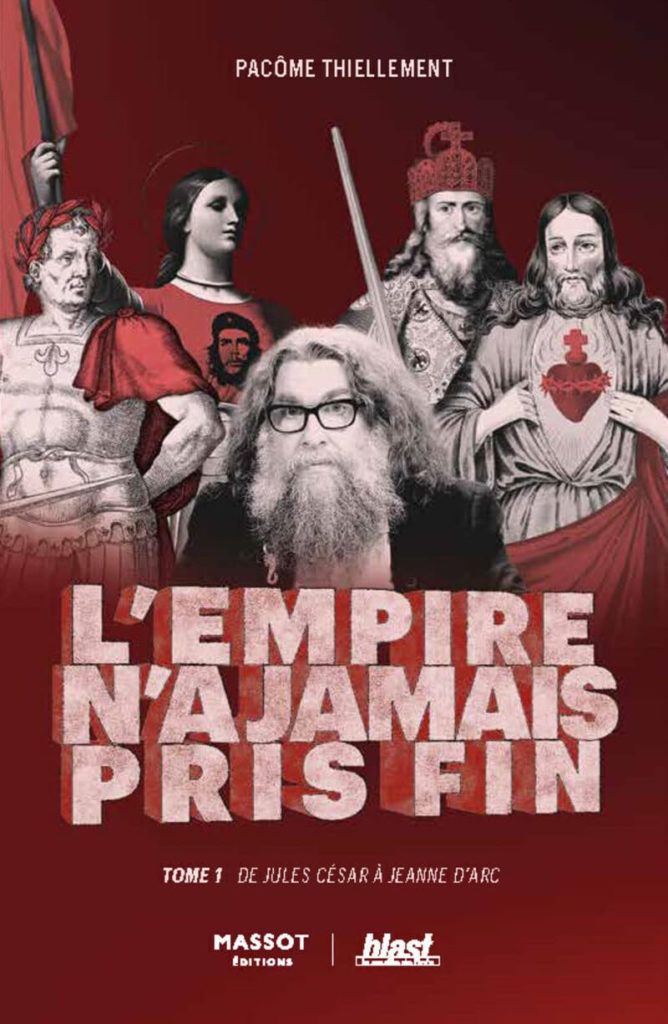
The Roman Empire in our minds is the starting point of a provocative book by Pacôme Thiellement, who argues that Rome never really ended because Julius Caesar colonised imaginations as much as territories. His claim is that our mental structures still carry traces of that violence and of a will to submission.
Thiellement does not present himself as a historian but as an exegete who explains and interprets, and he openly admits his reading is subjective. Even so, his work is sourced, drawing on ancient texts, historians and philosophers, and later literature. This guide summarises his main arguments and turns them into something parents can actually use with children.

Quick takeaways
- Thiellement argues that Rome never fell; its administrative and mental structures still shape us.
- He reads Julius Caesar as a coloniser who named and misrepresented the peoples he conquered.
- The so-called Gauls were united by courage and a shared refusal of Roman domination.
- In his reading, Jesus's emancipating message was later diverted by institutional power.
- Mary Magdalene represents voices that hierarchy pushed aside and that are worth recovering.
- Parents can turn these ideas into small talks about power, fairness and disagreement.
An Empire That Never Ended
Thiellement writes that France, yesterday and today, is the heir of the cult of Rome's greatness and keeps pursuing it. He notes that Rome seeped into human consciousness because imperial propaganda travelled alongside force and terror. Despite Rome's collapse in 476, its hierarchical, authoritarian, disciplined and centralised administrative structures survived, along with its predatory view of the world.
That survival is what makes the book feel both powerful and unsettling. The argument is not that legions still march, but that habits of obedience and admiration for strength quietly persist. Parents who want children to think for themselves can start by naming these habits out loud, the same way we name a screen time habit before changing it.
Why the Argument Matters at Home
If domination is learned, it can also be unlearned, and childhood is where that work begins. Small daily choices, from who gets to speak at dinner to how we react when a child disagrees, either reinforce or loosen the reflex of submission.
Julius Caesar, the Man Who "Invented" Us
Thiellement reminds us that Gaul and the Gauls did not exist before Julius Caesar decided to give that name to the tribes living beyond the Alps he wanted to conquer. The constructed vision of the so-called Gauls is really that of an exterminating coloniser. He calls Caesar a xenophobic "sociopath" and a disciplined "killing machine" interested only in power, while the Roman army pillaged, slaughtered and raped without mercy.
What actually united these populations, he argues, was courage and bravery and a collective refusal of Rome's project of domination. Rome won first through deadly force, then through cultural domination that erased the different cultures of the Mediterranean basin. The same pattern, he suggests, runs from Augustus to modern leaders, all of whom expect our admiration for Caesar to legitimise their own tyrannical impulses.
Bravery as a Family Value
Refusing domination is a skill, and it grows through play and stories. Imaginative play lets a child rehearse standing up for a position, and simple sensory games build the confidence to explore without constant permission. For more guidance, these parenting TED Talks and the best speech therapy toys can help.

| Idea from the book | What it describes | Parent-friendly takeaway |
|---|---|---|
| The Empire never ended | Rome's structures and mindset outlived 476 | Name habits of blind obedience at home |
| Caesar "invented" the Gauls | Naming as a tool of conquest | Ask who names things and why |
| Bravery as a shared value | Tribes united by refusal of domination | Praise standing up, not just winning |
| Jesus against the Church | Emancipation versus hierarchy | Model protective, not dominating, authority |
| Mary Magdalene | Voices pushed aside by power | Ask who is missing from a story |
Jesus Against the Church
According to Thiellement, the word of Jesus was diverted by the Church. In his reading, that word carried an emancipating, fraternal, non-violent and revolutionary potential, a life of justice in service of the poorest, the exact opposite of any hierarchy whatsoever. Jesus distrusts the rich and is unimpressed by the powerful. He takes the side of the oppressed and vulnerable: women against men in the episode of Martha and Mary, foreigners against patriots, the poor against the rich, children against adults.
His revolution is first a new relationship with the world, a different relationship to Roman occupation and to the Empire. It is a change in the way of being that gives Roman occupation no hold and makes it obsolete. Yet the Catholic Church as an institution, Thiellement argues, was built on values opposed to those Jesus carried. He points to Paul, who sides with the dominant and supports corporal punishment of children, quoting the Epistle to the Hebrews on accepting chastisement.
Two Competing Models of Authority
The contrast is useful for parents: authority that protects versus authority that dominates. Choosing the first, again and again, is quiet but real work.
Mary Magdalene and the Suppressed Voices
The book continues with Mary Magdalene and the voices that institutional power pushed aside. Thiellement reads her as a figure of direct, personal access to meaning, one that needs no hierarchy to be valid. When such figures are reduced or forgotten, something of the emancipating message goes with them.
For a parent, the lesson is about listening to the people a story leaves out. Asking a child who is missing from a tale, and why, is a simple way to practise that habit. It pairs naturally with choosing books that avoid indoctrination and letting children form their own opinions about the characters. The same habit of questioning who gets left out can shape the places we choose to explore together, as with these rural family escapes.
Reading as an Act of Freedom
Every story we hand a child carries a model of authority inside it. Naming that model, gently and without lecturing, turns reading into practice for independent thought.
Bringing the Idea Home: Practical Steps for Parents
None of this requires a lecture on late antiquity. It requires small, repeated conversations about power, courage and fairness, and a home where disagreement is allowed. Children notice quickly whether questions are welcome or treated as a challenge, and that experience teaches more than any speech about freedom.
Stories, games and open questions do most of the work. A child who has practised saying "I don't agree" over a board game or a picture book is better prepared to say it later, in a classroom or online. Building that muscle early matters, and it sits alongside other everyday habits such as managing early learning media thoughtfully rather than passively. Simple tools like classroom prize box toys can turn turn-taking and fair play into daily practice, while protecting the daily nap keeps patience and good humour within reach.
Keep the Conversation Going
You do not need answers ready for every question. Curiosity, offered honestly, is already a form of resistance to the idea that someone else should always decide what we think.

My hands-on take
I tried this with my own children after reading about the book, and the simplest question worked best: "Who decided that?" We were reading a picture book about a brave hero, and my eldest immediately said the king decided, because he is the king. That opened a short conversation about whether being in charge makes someone right, and it lasted about three minutes before someone wanted a snack.
What surprised me was how often the question came back later, at the dinner table or in the car. I did not need to explain Rome or Caesar at all. I just needed to keep asking, gently, and to let the answer be "I don't know" sometimes. That felt more honest than any lesson I could have prepared.
Frequently asked questions
Is this book a history book?
No. The author presents himself as an exegete who interprets rather than as a historian, and he acknowledges that his reading is subjective. His work is nonetheless sourced in ancient texts, historians, philosophers and literature.
What does "the Empire never ended" actually mean?
It means Rome's hierarchical, centralised and authoritarian structures, and its predatory view of the world, survived the fall of the city in 476. The claim is about mental and cultural habits rather than armies.
Why does the author call Caesar a coloniser?
Because Caesar named the tribes beyond the Alps in order to conquer them, and described them with contempt rather than any wish to understand them. The Roman army's violence is central to that account.
How can I discuss these ideas with a young child?
Keep it concrete: ask who decides, who is left out, and whether a rule is fair. Stories and games make the conversation natural without turning it into a lecture.
Product Reviews
 Best Toys for Dogs With High Prey Drive |
Best Outdoor Toys for 3-4 Year Olds |
Best Outdoor Toys for 6 Year Olds |
Best Harness for Poodle |
Best LEGO Sets for Adults |
Best Travel Toys for 4 Year Olds on Airplane |
Best Toy Stores in Washington DC |
Best Potty Training Toys |
Best Toys for Tripod Dogs |
Maillot equipe de france







