


Raising cooperative kids starts with changing how we talk to them, not with talking louder. Orders tend to trigger resistance because they ignore a child's need for autonomy, respect and a sense of contribution. Children who are simply told what to do can feel passive, attacked or belittled, and that often shows up as fear, anger or sadness.
Requests work better than commands because they offer choice, leave room for autonomy, invite play and speak to a child's intelligence. They carry more meaning and gradually build self-discipline. The five skills below turn requests into clear instructions, useful information and honest communication.

Quick takeaways
- Describe the problem instead of blaming the child, and drop the "you".
- Give one useful fact, with no added reproach or rhetorical question.
- Use a single word, a warm tone and a friendly gesture.
- Express your own feelings without judging the child as a person.
- Leave written notes to lower the volume and surprise your child.
- These skills build self-discipline over time, not instant obedience.
Describe what you see instead of pointing a finger
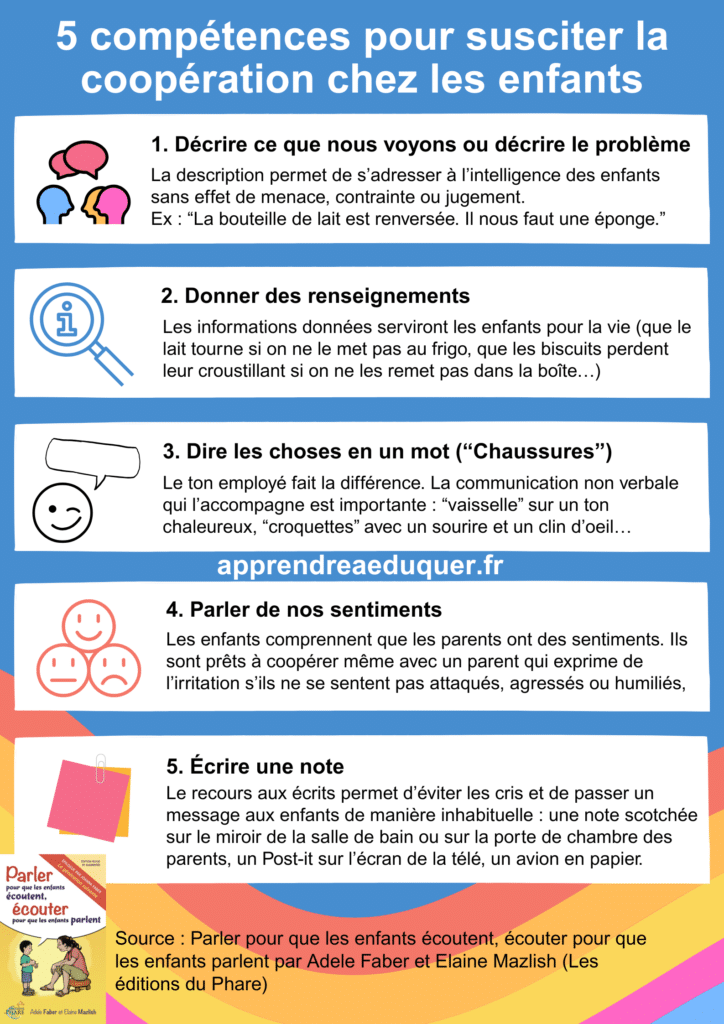
Children understand a problem far more easily when it is simply described than when someone explains what they did wrong. A plain description lets them work out the solution themselves, which speaks to their intelligence without threat, pressure or judgment. Dropping the "you" also helps: instead of feeling guilty, a child focuses on what needs doing. "You knocked over the milk, go get a sponge" does not land the same way as "The milk bottle is spilled, we need a sponge."
Sentences that begin with "I see" are especially effective for inviting cooperation. Try "I see the light is still on in the bathroom" or "I see a pair of shoes that are not put away." The child hears a fact rather than an accusation, and the next step becomes obvious. This is the same principle behind gentle approaches such as positive discipline methods, which favour guidance over blame.
Give information rather than a lecture
Receiving a piece of information is easier than receiving an accusation. The catch is that the information has to stand alone, without added remarks like "The laundry goes in the basket. Will you ever learn?" or "How many times do I have to repeat this?" or "I'm fed up." Those extra lines turn a fact into a reproach and undo the benefit.
Useful information also serves children for life: milk turns sour if it stays out of the fridge, biscuits lose their crunch if they are not put back in the box. When my daughter was jumping on the sofa, instead of saying "Don't jump on the sofa, you'll damage it," I explained in two short sentences: "The sofa is for sitting. The floor is for jumping." I added a gesture and fetched the gym mat. She stopped on her own and jumped on the mat, and her gym session ended in a roll and a big cuddle. Clear explanations like these also help myths about baby intelligence fade away.
| Situation | Order | Request-based skill |
|---|---|---|
| Spilled drink | "You always make a mess" | "The milk is spilled, we need a sponge" |
| Sofa jumping | "Stop jumping on the sofa" | "The sofa is for sitting, the floor is for jumping" |
| Shoes in the hall | "How many times must I say it?" | "Shoes!" with a smile |
| Pulled sleeve | "Stop bothering me" | "I don't like being tugged at my sleeve" |
| Messy room | Raised voice, repeated warnings | A short note taped to the door |
Facts also prevent confusion, as with the reminder that children who to cow's milk cannot drink goat's milk.
Say it in a single word
Children dislike moral lessons, sermons and theoretical explanations from parents. The shorter the reminder, the better it works. Teens who were consulted on this confirmed they prefer a single word: "The door! The dog! The dishes!" It spares them the usual lecture. Avoid using the child's name as a one-word summary, though, since that can feel like a label rather than a nudge.
Tone makes all the difference here, and so does nonverbal communication: a warm voice, a smile, a wink. A child who is sensitive to atmosphere, or one who is simply highly gifted children and quickly bored by repetition, will respond far better to a light single word than to a long speech. Keep the word neutral and friendly, and let your body language carry the rest of the message.

Talk about your own feelings
Speaking about how you feel as a parent has several advantages. It avoids comments or judgments about the child as a person, for example "I don't like being tugged at my sleeve." It also helps children understand that parents have feelings of their own: they are willing to cooperate even with a parent who expresses irritation or anger, as long as they do not feel attacked or humiliated. Being sincere and honest as a parent encourages children to behave the same way.
If your child answers that they don't care how you feel, you can reply calmly: "I do. I care about how I feel, just as I care about how you feel. And in this family, we respect each other's feelings." That statement sets a boundary without insult. It sits well alongside everyday care routines, where patience is tested, such as when a baby biting during breastfeeding or a child needs help with something uncomfortable like a childhood hip sprain. The same calm honesty helps when you explain difficult topics, such as natural abortions or which small mammals for children suit your family.

Write a note
A written note can speak for the parents. Putting things in writing avoids shouting and delivers a message in an unusual way: a note taped to the bathroom mirror or the parents' bedroom door, a sticky note on the television screen, a paper aeroplane. Even children who cannot read yet respond, because they will run to a parent to have the message decoded.
Children who were left notes said they were touched that their parents cared enough to take the trouble to write, and they liked that "the volume of their voice doesn't go up." One mother went further and wore a sign around her neck saying she was about to explode if she was annoyed and needed help tidying the house. Notes also work well for quieter topics that are hard to raise out loud, such as talking about masturbation or explaining why a fever does not always need to be brought down, which you can read about in managing childhood fever.
My hands-on take
I started with the "I see" sentences because they felt the least awkward to say out loud. The first few times, announcing that I could see a coat on the floor felt strange, but my son picked it up without the usual back-and-forth. What surprised me most was how much calmer I stayed, since I was no longer building a case against him.
The single-word reminder took more practice. My first attempts came out sharp, and the word landed like a criticism. Once I paired it with a smile and a lighter voice, it became almost a private joke between us. The written note is still my favourite: I left one on the bathroom mirror about the wet towel, and instead of arguing, my daughter came to find me laughing. None of this works every single day, but the overall tone at home has shifted, and that is worth the effort.
Frequently asked questions
Why do orders make children resist?
Orders ignore a child's need for autonomy, respect and contribution, so children feel passive or belittled. That often produces fear, anger or sadness, which shows up as opposition.
Does describing the problem really work better than explaining the fault?
Yes, because a description lets the child work out the solution instead of defending themselves. Sentences starting with "I see" keep the focus on the situation rather than on blame.
What if my child says they don't care about my feelings?
Answer calmly that you do care about your own feelings and about theirs, and that respect for feelings is a family rule. This keeps the boundary without attacking the child.
Can notes work with children who cannot read?
They can, because young children will bring the note to a parent to have it read aloud. The novelty and the effort behind the note are often what touch them most.
Product Reviews
 Best Toys for Dogs With High Prey Drive |
Best Outdoor Toys for 3-4 Year Olds |
Best Outdoor Toys for 6 Year Olds |
Best Harness for Poodle |
Best LEGO Sets for Adults |
Best Travel Toys for 4 Year Olds on Airplane |
Best Toy Stores in Washington DC |
Best Potty Training Toys |
Best Toys for Tripod Dogs |
Maillot equipe de france







