


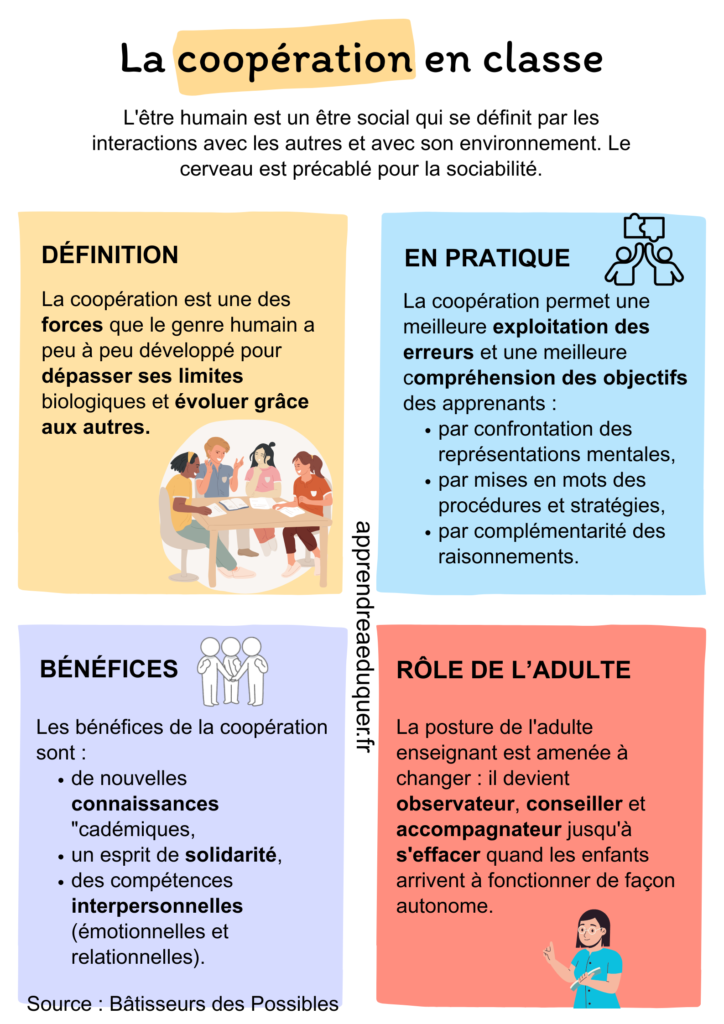
Classroom cooperation turns a room full of separate learners into a group that thinks and works together, and the benefits reach well beyond grades. Humans are social beings defined by our interactions with others and with our environment, and the brain is wired for sociability.
We are driven by two complementary aspirations: the desire to be ourselves and the desire to be with others. Cooperation is one of the forces the human species gradually developed to move past its biological limits and evolve thanks to other people.

This article looks at what cooperation in class actually delivers, how the teacher's role shifts, and simple ways to bring more of it into everyday learning.
Quick takeaways
- Peer work is generally more effective than individual work across subjects.
- Cooperation works best when pupils trust each other, including friends.
- Errors become learning tools when children explain their reasoning aloud.
- Benefits span academic knowledge, solidarity and interpersonal skills.
- The teacher shifts from instructor to observer, adviser and guide.
- Individual work and cooperation complement rather than replace each other.
Why cooperation belongs in the classroom
Peer work tends to be more effective than individual work, whatever the subject. When children cooperate, they confront their mental representations, put their procedures and strategies into words, and combine different lines of reasoning. This makes errors easier to exploit as learning moments and helps learners understand the goals of a task more clearly.
Cooperation is also stronger when friendship exists between pupils, because trust and comfort make children more willing to share half-formed ideas. That said, cooperating does not exclude individual work; the two feed each other. A child who reflects alone then explains their thinking to a partner consolidates it, much like the quiet focus a child finds with a favourite calming fidget toy before speaking up in a group.
Two aspirations, one classroom
The desire to be oneself and the desire to be with others are complementary, not opposed. Good cooperative settings respect both, giving each child a role while keeping the group goal visible.
The benefits children actually gain
The benefits of cooperation fall into three broad families. First come new "academic" knowledge, built through discussion and mutual explanation. Second is a spirit of solidarity, the sense that helping a classmate is part of the work rather than a distraction. Third are interpersonal skills, both emotional and relational, which children carry into friendships and family life.
These social muscles matter outside school too. Siblings who learn to share, negotiate and take turns at home arrive better prepared for group tasks, and parents who model patience during a childhood aggression moment show children how to handle frustration without giving up on the group. Even the way a family spends an evening together, told through the lens of shared family memories, reinforces the idea that being together is valuable. Large households, as celebrities with large families show, offer plenty of chances to practise this give-and-take, and even a parent heading off to work or to the birth of your child can model how cooperation holds a family together.
In short, cooperation builds knowledge and character at the same time, and it does so through ordinary classroom interactions rather than extra lessons.
| Teacher role | What it looks like | What children gain |
|---|---|---|
| Observer | Watching groups, noting who is stuck | Space to try without interruption |
| Adviser | Asking questions instead of giving answers | Problem-solving confidence |
| Guide | Keeping the shared goal visible | Focus on the group task |
| Stepping back | Letting groups run on their own | Autonomy and mutual reliance |
| Modelling | Showing how to disagree respectfully | Emotional and relational skills |
How the teacher's role changes
When cooperation takes root, the adult's posture is bound to change. The teacher becomes an observer, an adviser and a guide, eventually stepping back when children manage to function autonomously. The aim is for children to learn thanks to others and with others, rather than only through the teacher.
This shift takes practice. A teacher who circulates, listens and asks questions instead of answering them immediately gives pupils room to resolve problems themselves. Setting up group routines at the start of the year, much like preparing carefully for baby first outings, helps everyone know what to expect before the pressure builds.
Stepping back without disappearing
Fading out is gradual. The adult stays close enough to support a stuck group but far enough that children turn to each other first. That balance is what makes autonomy real rather than nominal.
Practical ways to practise cooperation
Start small and structured. Pair work with a clear shared goal, short and well-defined, works better than open-ended group projects at first. Give each child a role, ask partners to explain their reasoning aloud, and treat mistakes as material for discussion rather than failure.
Games are a gentle entry point, since cooperative play teaches turn-taking and mutual help without the pressure of a grade. The same logic applies at home, where a shared board game or a cooperative puzzle can echo what happens in class. Parents planning a family break can even keep the spirit going with toys for toddlers that reward teamwork, or by choosing a destination with a Fort Worth toy store nearby for a rainy afternoon. Families weighing gentler approaches to children's wellbeing may also find it useful to ask does homeopathy work for babies and children.
Consistency matters more than intensity. A few minutes of structured cooperation each day builds habits faster than an occasional big project.

Making cooperation a lasting habit
Cooperation grows best in an environment where children feel safe enough to be wrong in front of peers. That means celebrating good explanations, not just right answers, and noticing when a child helps a classmate understand something. Over time, these small recognitions shape a classroom culture.
Families can reinforce the same message. Reading together, solving a problem as a team or simply talking through a disagreement models the interpersonal skills children practise at school. Even choosing a shared activity, like picking out a wooden toy house to build together, becomes a small lesson in negotiating roles and sharing the result.
The payoff is a group that learns from its own members, where knowledge, solidarity and relationship skills develop side by side.

My hands-on take
I first tried structured pair work with a small group and quickly learned that "work together" is not an instruction children can follow without help. What changed things was giving each pair one clear goal and asking them to say their reasoning out loud before writing anything down. The first few sessions were noisy and messy, and I was tempted to step in constantly. When I held back and only asked questions, the children started correcting each other kindly and explaining things in ways I would not have thought of.
The biggest surprise was how much the quieter children contributed once they had a partner to talk to. I now treat cooperation as a skill to practise in short bursts rather than a mood that either appears or does not. Mistakes stopped feeling like something to hide and became something the group could pick apart together.
Frequently asked questions
Does cooperation replace individual work?
No. Cooperating does not exclude working alone; the two support each other. A child who thinks individually and then explains their reasoning to a partner often understands it better.
Are friends better cooperation partners?
Cooperation tends to be more effective when friendship exists between pupils, because trust makes children more willing to share ideas. Mixed pairs still work well when the task and roles are clear.
What does the teacher do during cooperative work?
The adult becomes an observer, adviser and guide, eventually stepping back when children can function autonomously. The goal is for children to learn thanks to others and with others.
Which benefits should parents watch for?
Look for new academic knowledge, a spirit of solidarity and stronger interpersonal skills. These show up in how a child explains things, helps classmates and handles disagreement.
Product Reviews
 Best Toys for Dogs With High Prey Drive |
Best Outdoor Toys for 3-4 Year Olds |
Best Outdoor Toys for 6 Year Olds |
Best Harness for Poodle |
Best LEGO Sets for Adults |
Best Travel Toys for 4 Year Olds on Airplane |
Best Toy Stores in Washington DC |
Best Potty Training Toys |
Best Toys for Tripod Dogs |
Maillot equipe de france







