


When a child opposes the requests of parents, the reflex is often to push harder, raise the voice or repeat the instruction. Yet the more an adult demands immediate obedience, the more the child tends to resist, a pattern linked to what is described as the biological mechanism of counter-will. Understanding this changes the question entirely.
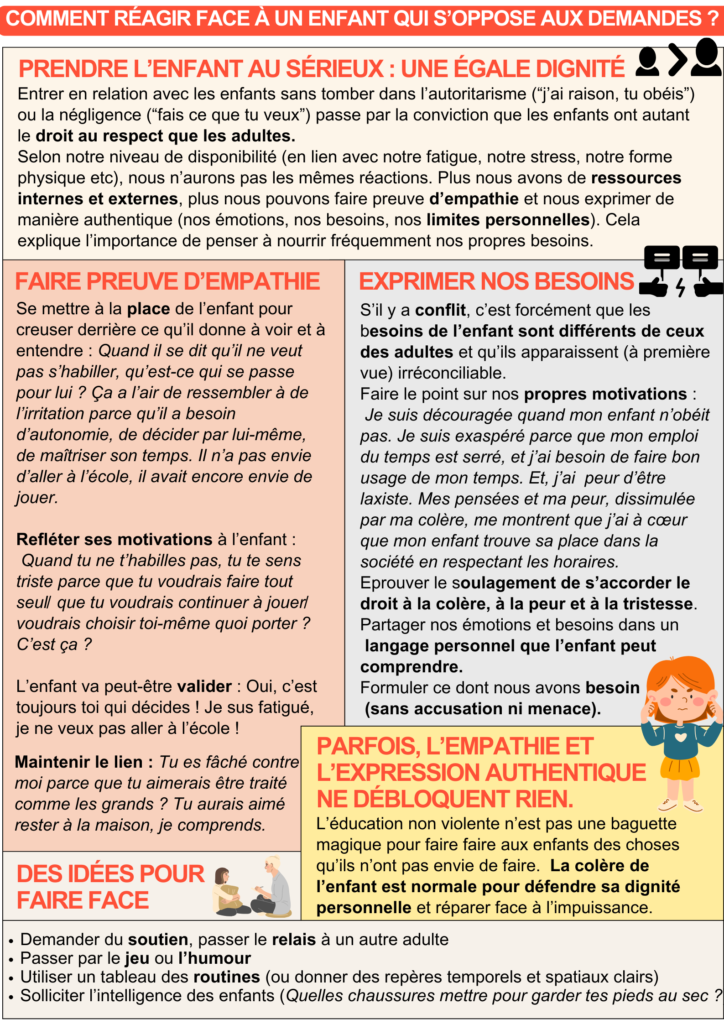
A child is first and foremost a full human being, with dignity to respect and needs as legitimate as those of adults. Building a relationship without sliding into authoritarianism or neglect starts from that conviction: children have as much right to respect as anyone else. The real question is no longer how to make my child do what I ask, but how to enter into relationship with a child who opposes requests and does not listen.

Quick takeaways
- Treat your child as a full person with dignity and legitimate needs.
- Expect resistance: counter-will is a biological mechanism, not a personal attack.
- Reframe the goal from obedience to relationship and cooperation.
- Reconcile your needs and your child's instead of declaring a winner.
- Keep adult authority firm but respectful, never humiliating.
- Look for hidden causes: fatigue, school pressure, health or routine changes.
Start From Equal Dignity, Not From Power
Before reaching for techniques, it helps to settle on a stance. A child is a whole person, with dignity to respect and needs as legitimate as those of adults. Entering into relationship without falling into authoritarianism or neglect rests on this conviction that children deserve the same respect as any other human being.
From there, the question shifts. Instead of asking how to make a child obey, we ask how to enter into relationship with a child who opposes requests and does not listen. That reframing is not sentimental: it is what makes a cooperative relationship possible. A child is often capable of hearing the language of the heart once the parent's intention sits within a relationship of equal dignity.
Understand the Biology Behind Resistance
The more an adult demands immediate obedience, the more the child resists. This is tied to the biological mechanism of counter-will, a natural pushback rather than deliberate provocation. Knowing this can take some of the personal sting out of a difficult moment.
Children's tantrums also have a biological function in the service of life: they repair the child in the face of powerlessness and of personal limits that were not respected. Seen this way, a meltdown is not a manipulation to crush but a signal to read. If you want to understand how a growing mind works, child brain development offers useful perspective on what is happening under the surface.
Responding instead of reacting
When you recognize resistance as a mechanism, you can slow down. Lower the volume, name what you see, and give the child a moment before repeating the request. This is the same patience you would apply to protecting children's backs, where small daily habits matter more than one big correction.
| Situation | Reflex reaction | Respectful response |
|---|---|---|
| Child refuses a request | Repeat louder, demand obedience | Pause, name the need, restate calmly |
| Child has a tantrum | Threaten or punish | Stay close, let the emotion repair itself |
| Conflicting needs | Adult wins by authority | Look for a solution that respects both |
| Limit must be held | Shame or humiliate | Hold the limit with steady authority |
| Daily transitions | Force the pace | Offer a choice or a playful tool |
Reason in Terms of Reconciling Needs
Nonviolent education means reasoning in terms of reconciling needs, both those of adults and those of children, and of positive intentions for the parent-child bond. Instead of asking who wins the conflict, you ask which needs are colliding and how both can be heard.
This does not mean abandoning your own limits. It means stating them without treating the child as an adversary. The adult's authority still matters, and it is vital not to take away the authority of the adult in front of the child, as long as that authority is exercised with respect rather than domination. You can explore adult authority to see how to hold a limit without humiliating anyone.
Reconciling needs also means accepting that cooperation is built over time, not extracted on demand. A father's steady presence, for instance, plays a real part in this balance, as explained in the father's role.
Build a Cooperative Relationship Day by Day
Within a relationship of equal dignity, a cooperative relationship gradually takes hold. This is not a switch you flip but a climate you maintain through small, repeated choices: listening first, explaining briefly, offering a genuine choice where one exists.
Everyday routines are a good training ground. Involving a child in simple household tasks, following the spirit of Montessori housework by age, gives them a sense of competence and reduces the need to oppose. Organizing daily life with several young children, as in organizing with two babies, also shows how much friction comes from logistics rather than defiance.
Keep your intention positive
When you approach a request with a positive intention for the link between you, the child feels it. Practical supports help too: potty training toys or outdoor toys can turn a tense transition into something the child wants to join.

Look Beyond the Behavior to the Whole Child
Behaviors that put us in difficulty are rarely the whole story. Sleep, hunger, school pressure, screen time or a changing body all shape how a child responds to a request. Reading about topics such as sports and children or even primary school notebooks reminds us that the child's day is full of demands before they ever reach us.
Health and developmental questions can also sit behind irritability or withdrawal. Knowing when a concern is medical, as with Disorders in the genitals, helps you avoid treating a physical issue as a discipline problem.
Finally, remember that connection is the soil everything grows in. Eating together, playing together, protecting routines: these ordinary moments, like the tips in 5 Useful tips, do more for cooperation than any script for winning an argument.

My hands-on take
In my own home, the hardest moments were rarely about the request itself. They came at the end of a long day, when I was tired and my child was too. I used to repeat the instruction with more volume, convinced that clarity was the missing ingredient. It never worked, and I often ended up feeling guilty and frustrated at the same time.
What helped was slowing down and asking a different question: what need is colliding with mine right now? Sometimes it was hunger, sometimes it was simply wanting a few more minutes of play. Naming it out loud, without giving up the limit, changed the tone more than any clever phrase. I still get it wrong some evenings, but the shift from winning to connecting has made family life noticeably calmer.
Frequently asked questions
Is my child manipulating me when they refuse everything?
Resistance is usually linked to the biological mechanism of counter-will rather than deliberate manipulation. Tantrums serve a function: they help the child repair after feeling powerless or having limits disrespected. Looking for the unmet need is more useful than assuming bad intent.
Does respectful parenting mean giving up my authority?
No. Nonviolent education reasons in terms of reconciling needs, not in terms of who wins. The adult's authority still matters in front of the child; what changes is that it is exercised with equal dignity rather than through domination or humiliation.
What can I do in the middle of a conflict?
Slow down, lower your voice and avoid demanding immediate obedience, which tends to increase resistance. Name what you observe, then restate the request once the emotional temperature drops. Cooperation is built over time, not extracted in the moment.
Product Reviews
 Best Toys for Dogs With High Prey Drive |
Best Outdoor Toys for 3-4 Year Olds |
Best Outdoor Toys for 6 Year Olds |
Best Harness for Poodle |
Best LEGO Sets for Adults |
Best Travel Toys for 4 Year Olds on Airplane |
Best Toy Stores in Washington DC |
Best Potty Training Toys |
Best Toys for Tripod Dogs |
Maillot equipe de france







