


Learning how to handle a different parenting vision is one of the most common challenges two caregivers will ever face, and it is rarely a sign that something is wrong. Disagreements about children and education are entirely normal. What matters far more than the disagreement itself is how the two of you handle it over time.
When these clashes drag on, they can quietly wear down the quality of the relationship, especially when both sides become rigid and dig into their positions. The good news is that a household can function far more harmoniously once parents learn to treat conflict as fertile ground for understanding each other.

Quick takeaways
- Parental disagreements are normal; what matters is how you handle them over time.
- Each parent's position reflects coherent values and life goals, not mere stubbornness.
- Criticism triggers withdrawal, which deepens conflict and leaves one parent overwhelmed.
- Raise the discussion to the level of goals and aspirations rather than positions.
- Agree on a few shared rules while leaving room for each parent's style.
- Keep children out of the middle and seek neutral help if tension persists.
Two Parents, Two Coherent Visions
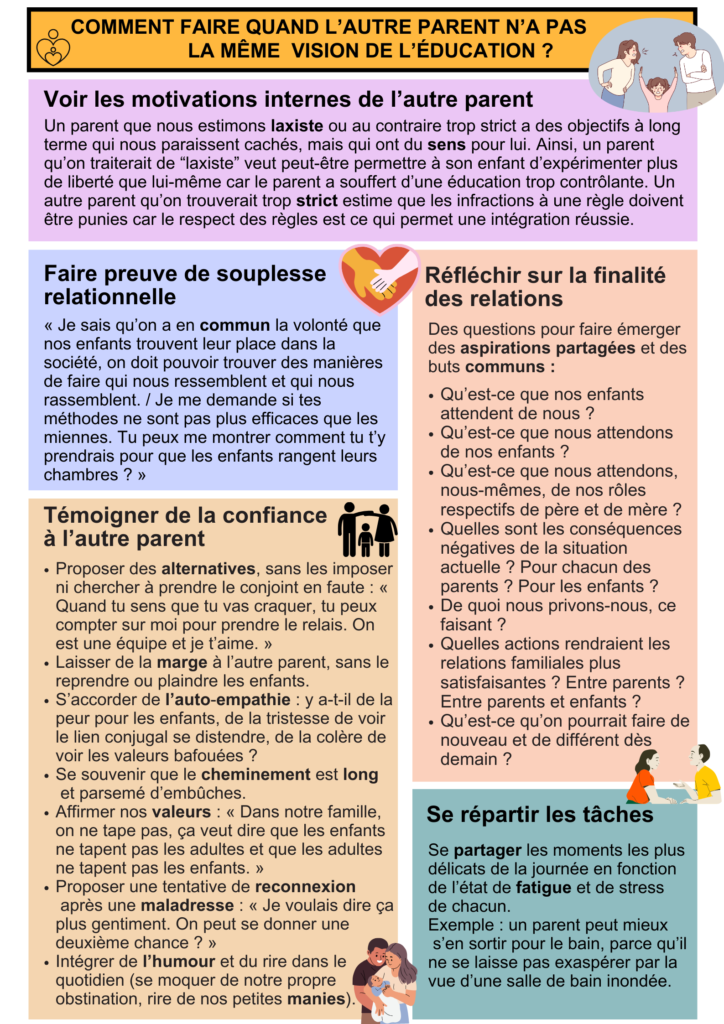
It helps to start from a simple truth: each parent's positions and behaviours are coherent with their own vision of education. Those visions are usually tied to deep values and life goals, not to stubbornness or a wish to annoy the other person. Françoise Kourilsky, a doctor of psychology, suggests in her book on the pleasure of changing that conflicts can be raised to a higher level — the level of goals and aspirations.
In practice, that means moving the conversation away from "you are doing it wrong" and toward "what are we both trying to give this child?" When you see the values behind a partner's choices, the argument often shrinks to a manageable question of method rather than a clash of identities. This shift is the foundation for everything that follows.
The Criticism Trap and Its Vicious Circle
It can happen that one parent is so focused on the child's education that they begin to criticize the other. From there, a vicious circle sets in: the criticized parent feels hurt and powerless, and gradually steps back from caring for the children. The children are then somewhat deprived of one of their parents, while the criticizing parent ends up overwhelmed by the sheer scale of the task carried alone. As one grandfather's story shows, patience and listening often teach us more than criticism.
Why the Conflict Then Doubles
Matters get worse because the first parent reads the other's withdrawal as irresponsibility or indifference, while the second quietly resigns — sometimes to the point of avoiding the home altogether. Recognising this pattern early is the best defence against it. If you notice yourself criticizing more and more, treat it as a warning sign rather than a justified reaction, much like the practical guidance in these scholarship application FAQs.
| Situation | Unhelpful reaction | More constructive move |
|---|---|---|
| Different daily routines | Criticizing the other's method | Agree on two or three shared rules |
| One parent steps back | Reading it as indifference | Ask what feels difficult for them |
| Values clash | Trying to win the argument | Name the shared goal behind both views |
| Child caught in tension | Asking the child to take sides | Keep adult talks away from the child |
| Conflict repeats | Resigning or avoiding home | Seek a neutral mediator early |
Use Conflict as a Learning Ground
A family functions more harmoniously when parents can use conflictual situations as fertile soil for learning something about human relationships. Every disagreement is a small rehearsal in listening, negotiating and repairing. Children also watch how you handle friction, and they absorb those lessons far more than any lecture on good behaviour.
Try to name the pattern out loud when things calm down: who felt judged, who withdrew, what each of you actually wanted. Keep the focus on the relationship rather than on winning the point. That habit alone can transform recurring arguments into a shared project.
Practical Steps Toward a Shared Approach
Start by choosing a calm moment, well away from the heat of a dispute, to talk about your respective visions. Ask genuine questions about what each of you values most, and listen without preparing your rebuttal. Agree on a small number of non-negotiable rules for the household, then leave room for each parent's personal style within those limits.
Daily routines are often where differences surface first, so it pays to plan them together. Agreeing on simple habits like brushing teeth or a consistent bedtime ritual gives children stability while reducing friction between adults. You may also find it useful to read up on how learning to speak unfolds, since many clashes come from mismatched expectations about what a child can do at a given age. It can also help to review ingredients to avoid when discussing care routines.
When the conversation stalls, return to the level of goals and aspirations rather than positions. Write down what each of you hopes the child will carry into adulthood, and look for the overlap. That shared ground becomes the reference point you both return to when a new disagreement appears.

Protecting the Children From the Fallout
Children are sensitive to tension between the adults who care for them, even when nothing is said directly. Keep disagreements out of shared meals and bedtime moments, and avoid asking a child to take sides or report on the other parent. A short, honest explanation that adults sometimes see things differently is usually enough.
It also helps to think about the wider context of family life. Questions such as wifi exposure, baby sunbathing or what belongs in vacation luggage can become flashpoints when parents hold different views. Treat these as practical decisions to research together rather than as tests of who cares more. Knowing the facts can defuse many arguments before they start.
When the Disagreement Runs Deeper
Some differences are not about method but about fundamental values, and those need more patience. In that case, aim for a workable compromise rather than full agreement: each parent keeps some space for their own approach while respecting a few common boundaries. Children cope well with two styles as long as the adults remain respectful toward one another.
If the tension becomes constant and wears down family life, a neutral third party — a mediator or family counsellor — can help you hear each other. Seeking support is not a sign of failure but a practical step, much like checking reliable guidance on parental love or early childbirth when you want perspective. The goal is never to erase differences, but to make them livable.

My hands-on take
In my own household, the disagreements that lasted longest were never really about bedtime or screen time. They were about what each of us thought a good childhood should feel like. Once we started asking that question out loud instead of arguing about the schedule, the daily fights lost most of their fuel.
What worked for me was picking one small routine to align first rather than trying to harmonize everything at once. We chose the evening routine, agreed on the bare minimum, and let each of us handle the rest our own way. It felt unglamorous, but it lowered the temperature at home within a couple of weeks, and the children noticed.
Frequently asked questions
Is it a problem if my partner and I have different parenting styles?
No, it is very common and not abnormal in itself. What matters is how you manage the differences, keeping respect and dialogue at the centre rather than trying to make the other parent identical to you.
Why does criticizing the other parent make things worse?
Criticism often leaves the other parent feeling hurt and powerless, so they gradually withdraw from childcare. That deepens the conflict, because the first parent then reads the withdrawal as indifference and feels overwhelmed alone.
How can we discuss education without arguing?
Choose a calm moment and talk about your goals and aspirations rather than your positions. Ask genuine questions, listen without preparing a reply, and agree on a few shared rules that leave room for both styles.
When should we ask for outside help?
If tension is constant and wearing down family life, a mediator or family counsellor can help you hear each other. Seeking support is a practical step, not an admission of failure.
Product Reviews
 Best Toys for Dogs With High Prey Drive |
Best Outdoor Toys for 3-4 Year Olds |
Best Outdoor Toys for 6 Year Olds |
Best Harness for Poodle |
Best LEGO Sets for Adults |
Best Travel Toys for 4 Year Olds on Airplane |
Best Toy Stores in Washington DC |
Best Potty Training Toys |
Best Toys for Tripod Dogs |
Maillot equipe de france







