


Stress management for kids is a skill worth teaching early, because children meet pressure in many places: at school, in everyday routines and during extracurricular activities. A child who feels overwhelmed does not need a lecture; they need a simple, visible set of options they can reach for.
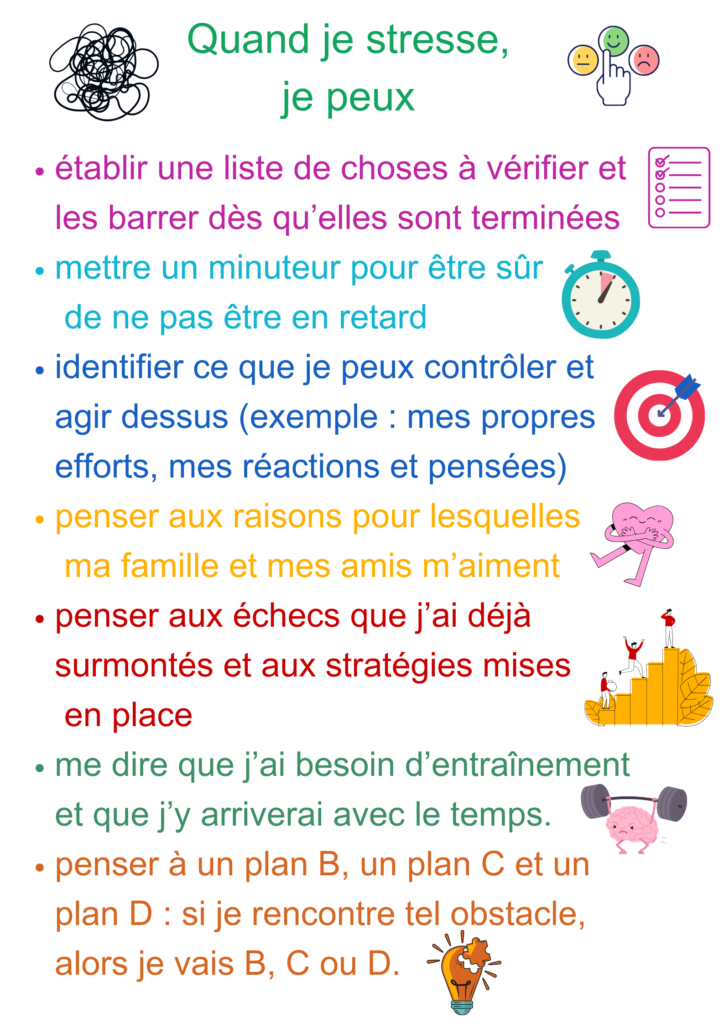
This article walks through a printable poster of calming strategies you can share with your child. The goal is to talk together about what stresses them and how to respond, so they can act from a calmer place while still listening to the messages their emotions send.

Quick takeaways
- Print the poster and keep it visible where your child can point to it.
- Use a checklist and a timer to reduce scattered, time-related stress.
- Help your child separate what they can control from what they cannot.
- Teach a practice phrase: “I need training, and I will get there.”
- Plan B, C and D in advance so obstacles feel manageable.
- Start with body-based calming before reasoning through a problem.
Why a Visual Poster Helps Children Cope
A poster works because it turns an abstract feeling into something a child can see and point to. When stress rises, thinking gets harder, so having strategies displayed on the wall removes the need to invent a solution on the spot. You can print the poster and keep it somewhere visible, like the kitchen or a bedroom door.
The poster is also a conversation starter. Sitting down together to read it opens space to ask what stresses your child and which ideas appeal to them. That shared moment matters, much like the way parental gaze helps children build confidence. You might also notice physical signs of tension, similar to how car sickness shows up more in young children whose bodies react quickly.
Keep the tone light. The poster is a menu, not a rulebook, and children should feel free to pick the strategies that fit them.
Strategies for Organising and Planning
Some stress comes from feeling scattered. A short checklist gives a child something concrete to do: write down the things to check, then cross them off as they are finished. The act of crossing out is satisfying and shows progress. For timing worries, a simple timer can reassure a child that they will not be late.
Help your child sort what they can control from what they cannot, then act on the controllable part: their own efforts, their reactions and their thoughts. This is the same principle behind giving a baby his own space: a defined, manageable area reduces friction. Planning also helps, so encourage a plan B, C and D: if this obstacle appears, then I will switch to the next option.
| Situation | Strategy from the poster | What the child does |
|---|---|---|
| Too many tasks | Checklist | Writes items, crosses them off |
| Fear of being late | Timer | Sets a timer, watches the clock |
| Feeling powerless | Control check | Lists what is in their hands |
| Fear of failing | Past wins | Recalls a difficulty already handled |
| Worry about obstacles | Plan B, C, D | Decides the next option in advance |
Strategies for Self-Talk and Perspective
Words children say to themselves shape how stress feels. Encourage them to recall why family and friends love them, which counters the sense of being alone in a problem. Remind them of past failures they already overcame and the strategies they used then; this builds evidence that they can handle difficulty.
A gentle phrase helps too: “I just need practice, and I will get there with time.” Framing struggle as training rather than failure keeps motivation alive, an idea that connects to how little donkey stories teach persistence. If tiredness or illness is adding to the load, as with a child who is always tired, check the basics before pushing harder.
Talking About Emotions Without Alarm
Emotions are messengers, not enemies. When your child is agitated, name the feeling and ask what message it carries, then think together about solutions to the problem behind it. This sends the brain the signal that the situation is under control. It also keeps the door open for future conversations.
Some parents find that their own worries set the tone, whether during pregnancy monitoring or in daily family life. Children read our calm. Practising the poster strategies yourself models them, and small comforting routines, such as cooking together with Christmas nougat, can anchor a tense week.

Pairing the Poster With Body-Based Calming
The poster focuses on thinking strategies, and it works best alongside body-based regulation. Slow breathing, stretching, movement and quiet rest all lower tension before a child tries to reason. Offer these first when agitation is high, then return to the poster once the body settles.
Quiet play supports this too: a basket of quiet toys gives a child somewhere to land. Younger children benefit from simple sensory options like baby toys with different textures. And if your child is drawn to building, sorting a box of LEGO boxes or naming pieces can be a calming, focused activity.

My hands-on take
I printed this poster and stuck it on the inside of a kitchen cupboard, at my child's eye level. The first week, nothing happened; the second week, I heard them muttering about a checklist before a school project. That small shift mattered more than any speech I could have given.
What I learned is to stay quiet and let the poster do the work. When I pointed at it mid-tantrum, it backfired; when I mentioned it later, over a snack, it landed. I now keep a timer and a small notepad nearby, and I try the strategies myself so my child sees them in action rather than hearing about them.
Frequently asked questions
What age is this poster suitable for?
It suits school-age children who can read simple phrases, and younger children can use it with an adult reading aloud. Adapt the wording to your child's level.
When should we use the poster?
Bring it out during a calm moment to talk it through, then refer to it when stress appears. A familiar poster is easier to use under pressure.
Does the poster replace professional help?
No. It is a everyday tool for common stress. If your child's anxiety is persistent or intense, speak with a health professional.
How do we choose which strategies to try?
Let your child pick two or three that appeal to them and test them over a week. Keep the ones that help and drop the rest.
Product Reviews
 Best Toys for Dogs With High Prey Drive |
Best Outdoor Toys for 3-4 Year Olds |
Best Outdoor Toys for 6 Year Olds |
Best Harness for Poodle |
Best LEGO Sets for Adults |
Best Travel Toys for 4 Year Olds on Airplane |
Best Toy Stores in Washington DC |
Best Potty Training Toys |
Best Toys for Tripod Dogs |
Maillot equipe de france







