


Responding to judgments about a highly sensitive child is a skill every parent can learn, and it starts with one simple conviction: you do not owe anyone a justification for your child's temperament. Adults sometimes comment on a child who feels things deeply, and those remarks can sting. Yet you can protect your child without attacking the person who spoke.
What matters most is what your child hears and sees in that moment. A calm, warm reply shows them that their sensitivity is accepted, not a problem to fix. The suggestions below offer phrases and attitudes you can adapt to your own style and your own family.

Quick takeaways
- You never have to justify your child's temperament to anyone.
- Reframe sensitivity as a strength: empathy and attentiveness are real qualities.
- Remind people that every child develops at their own rhythm.
- Point out that forcing a child against their temperament backfires.
- Use a short empathy question instead of a long argument.
- Trust your instinct and keep your child at the centre of your choices.
You do not have to justify your child's character
When someone makes a negative comment, you are allowed to keep your answer short. A simple statement that every child is different, and that you accept your child exactly as they are, is often enough. You are not opening a debate about your parenting; you are closing it politely.
This matters because your child is watching how you react. If you defend them with warmth rather than irritation, they learn that their temperament is welcome at home. The most important task is to support them and help them build confidence in who they are.
Some parents find it easier to prepare a few phrases in advance, the same way they might prepare for other tricky conversations, such as when family interferes with a baby's care. Having words ready keeps your tone steady when a remark takes you by surprise.
Value sensitivity as a real strength
One of the most effective replies turns the criticism around gently: yes, my child is sensitive, and that is a beautiful quality. It allows them to notice others and to feel a great deal of empathy. Said without sarcasm, this reframes sensitivity as a strength rather than a flaw.
You can add that sensitive children often pick up on moods and needs that others miss. This is not about claiming superiority for your child; it is about refusing the idea that they must be tougher to be worthwhile. Acknowledging feelings out loud also models healthy emotional expression, something children absorb from the adults around them.
If you want to nurture that side of your child, look for activities that let them thrive rather than forcing them into a mould. Many parents find that nervous children benefit from sports chosen with care, where the pace and the atmosphere suit their temperament.
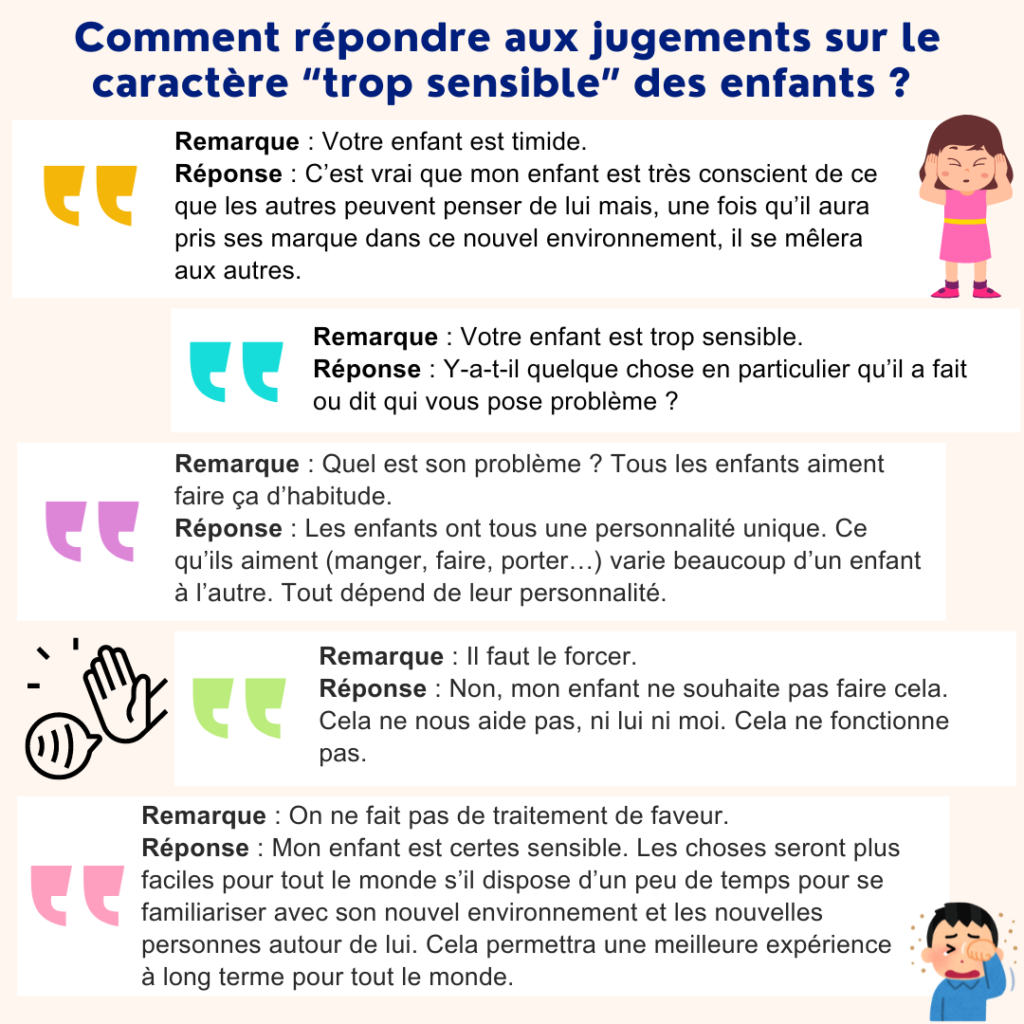
| What was said | Your goal | A phrase you can use |
|---|---|---|
| "He cries over nothing" | Reframe sensitivity | "He feels deeply, and that is a lovely quality." |
| "He should be tougher by now" | Refuse social pressure | "Every child develops at their own rhythm." |
| "Just push him a bit" | Challenge the idea | "Forcing a child against his temperament backfires." |
| "You are too soft with him" | Appeal to empathy | "Imagine being forced into something uncomfortable." |
| Any repeated remark | Set a boundary | "We are handling it, thank you." |
Refuse social pressure and rigid norms
Another useful approach is to name the pressure calmly: every child develops at their own rhythm. Your child needs time to feel at ease, and that is entirely normal. This reminds the other person, and your child, that there is no rigid standard a child must meet on schedule.
You can also point out that forcing a child to act against their temperament tends to backfire. It is better to accompany them gently than to push them into a performance they are not ready for. This is the same principle behind respectful discipline, which is why blackmail is not a strategy you want to rely on at home either.
Grandparents and relatives often mean well but carry their own habits from another era. Explaining your approach once, kindly, is usually more effective than arguing. It helps to remember that love grandparents bring real value even when their comments need gentle redirection.
Appeal to empathy instead of arguing
Sometimes the quickest way to end a judgment is a question: imagine being forced to do something that makes you deeply uncomfortable. Most adults recognise that feeling immediately. The point is not to shame the speaker but to invite them to think about the effect of pressure on a child.
This kind of reply works best when it stays short and calm. A long lecture rarely changes anyone's mind, while a single honest question can stay with them. The same empathy-first approach helps in many family situations, from managing visitors to handling control visits without turning the house into a battlefield.
Keep your child at the centre
After the conversation, check in with your child about how they felt. A few reassuring words from you carry more weight than any adult's opinion, and they reinforce the idea that home is a safe place to be exactly who they are.

Build confidence through everyday choices
You are the person who knows your child best, so trust your instinct and follow your own path in education. Encourage them to explore their emotions and to express them in a healthy way. Help them find activities they are passionate about, where they can flourish on their own terms.
Play is one of the simplest tools here: open-ended materials let a sensitive child set the pace and feel in control. Building with foam block toys or similar quiet toys gives them space to experiment without pressure. For children who need to keep their hands busy while they calm down, fidget toys can also be a practical option.
Physical activity helps too, provided it suits the child rather than the parent's ambitions. Climbing and balancing at home, for example with Montessori climbing toys, builds confidence gradually. Small, repeated successes are what grow self-esteem, far more than any comment from a critical adult.
Set boundaries while staying kind
Being kind does not mean accepting every remark. You can affirm your position firmly and still keep the relationship intact. A short sentence such as "we are handling it, thank you" signals that the topic is closed without starting a conflict.
It also helps to decide in advance which remarks you will let pass and which ones you will address. Not every comment deserves your energy, and choosing your battles protects your own peace of mind. If a relative repeatedly crosses the line, a calm conversation away from the child is usually better than a public correction.
Finally, look after your own morale. Parenting a sensitive child takes patience, and the same empathy you offer your child is worth offering yourself. A steady, warm parent is the best protection a sensitive child can have against the judgments of the world.

My hands-on take
I remember a family lunch where a relative told my daughter, in front of everyone, that she cried far too easily. My first instinct was to snap back, and I am glad I did not. I simply said that she feels things deeply and that we like her that way, then changed the subject. Later, in the car, she asked me if being sensitive was bad. That question told me the reply had mattered more than I expected.
Since then I prepare two or three short phrases before family gatherings, so I am not caught off guard. I also try to check in with her afterwards rather than analysing the adult's remark. It is not always easy to stay calm, but seeing her relax when I take her side makes the effort worthwhile.
Frequently asked questions
Should I defend my child in front of them when someone criticises their sensitivity?
Yes, briefly and calmly. Your child needs to see that their temperament is accepted at home, and a short, warm reply does more than a long argument with the other adult.
What if the person making the comment is a close relative?
Keep your reply gentle in the moment, then talk with them privately if it keeps happening. Most relatives mean well and simply carry habits from another era.
Does accepting sensitivity mean never encouraging my child to try new things?
No. You can encourage gently while respecting their pace. The point is to avoid forcing them against their temperament, not to avoid all challenges.
How do I help my sensitive child build confidence day to day?
Offer activities they can master at their own rhythm, let them express emotions openly, and check in after difficult moments. Small repeated successes matter more than any adult's opinion.
Product Reviews
 Best Toys for Dogs With High Prey Drive |
Best Outdoor Toys for 3-4 Year Olds |
Best Outdoor Toys for 6 Year Olds |
Best Harness for Poodle |
Best LEGO Sets for Adults |
Best Travel Toys for 4 Year Olds on Airplane |
Best Toy Stores in Washington DC |
Best Potty Training Toys |
Best Toys for Tripod Dogs |
Maillot equipe de france







