


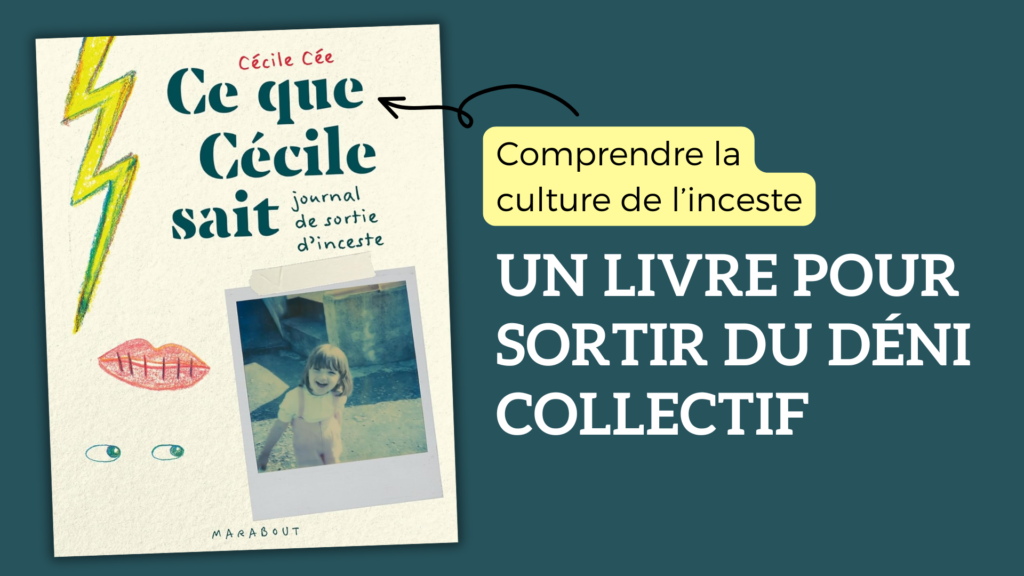
Understanding incest means looking far beyond the image most people carry in their heads. Cécile Cée, an artist and activist, has written an illustrated notebook that mixes personal anecdotes with theoretical content, and it offers a clear-eyed account of what she calls the incest system. It is not simply a story of sex between two members of the same family.
From the first pages, she makes her central point: incest is above all a relationship to truth and to silence. The book is not an easy read, but it is a useful one for anyone who wants to grasp the scale of the problem and the mechanisms that keep it hidden.

Quick takeaways
- Incest is a family system built on silence, domination and denial, not a private act between two people.
- The "incestuous climate" includes non-genital behaviours that still harm a child's integrity.
- Sexual violence between minors is never a game, because a game requires reciprocity and the freedom to stop.
- Legal systems often punish acts without penetration less severely, regardless of trauma.
- Parents can help by naming bodies, boundaries and consent early and calmly.
- Reading survivor accounts and theory together builds the ability to think and speak.
Seeing incest in its full scale
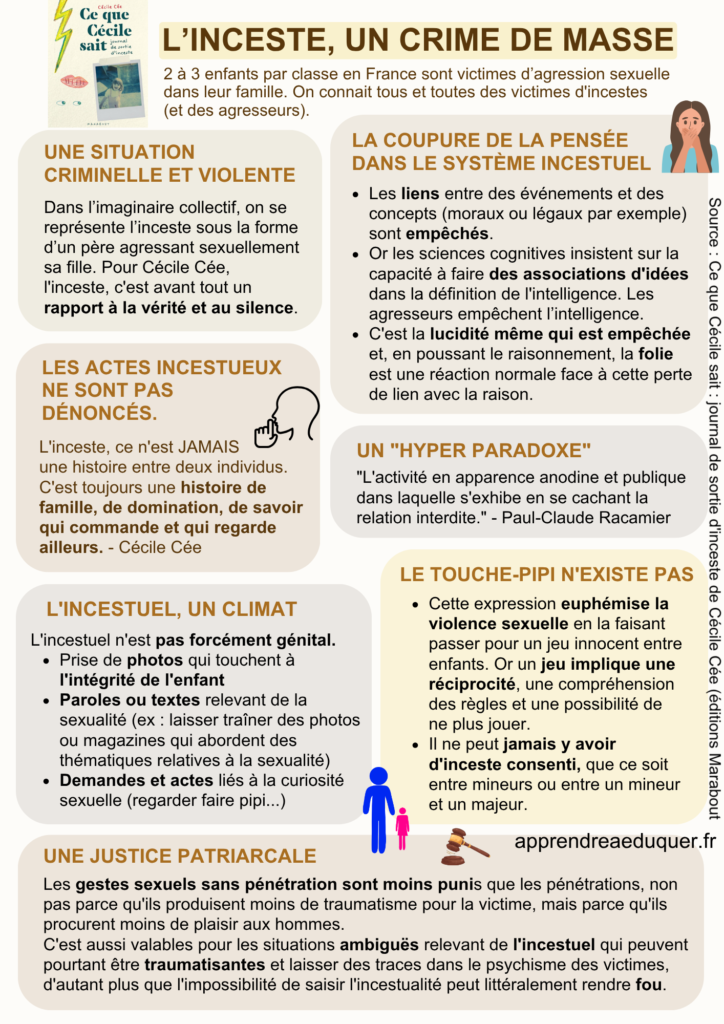
In the collective imagination, incest usually takes the shape of a father assaulting his daughter. Cécile Cée reminds readers that two to three children per class in France are affected by sexual violence within families, and she cites the figure of 99.07% of sexual violence against children going unconvicted. These numbers matter because they show this is not a marginal story.
Her key sentence is that incest is never a story between two individuals. It is always a family story, a story of domination, of who commands and who looks away. That framing changes how we read everything else, much as we might rethink forms of aggression that adults quietly normalize in daily life. It also reminds us how much children need safe places to grow, which is why we should visit with our children the places that let them feel protected.
Why silence is never simple
The silences around incest are paradoxical: everything is often known, sometimes even spoken, yet the acts are not denounced as criminal and violent. One feature of the incestuous system, she writes, is a "cutting off of thought," which prevents links between events and moral or legal concepts.
The incestuous climate and the public sphere
The psychiatrist Paul-Claude Racamier described an "hyper paradox": apparently harmless public activity in which the forbidden relationship shows itself while hiding. Cécile Cée uses the Gainsbourg example, where public incestuous displays passed as art, making it impossible to think about the unacceptable and the regime of terror imposed on the vulnerable.
This mechanism operates inside homes but also at the level of society. Racamier's concept of the incestuous climate covers open manipulation whose intimacy stays secret; it is not necessarily genital, but it does not stop at fantasy either. It can include suggestive words or texts in front of children, or leaving sexual material lying around.
It also includes requests driven by the adult's sexual curiosity: showing a part of the body, being touched intimately, watching a child urinate. Recognising these smaller signals is part of protecting children, in the same spirit as knowing what to do when children catch adults in a private moment. The same care applies to everyday learning, as with home science experiments that teach boundaries and respect.
| Signal | Why it matters | What a parent can do |
|---|---|---|
| Suggestive talk or images in front of children | Blurs boundaries and normalises exposure | Keep adult material private, name what is inappropriate |
| Requests to see or touch intimate areas | Driven by adult curiosity, not child need | Refuse, explain privacy, believe the child's discomfort |
| "It was just a game" between children | Hides coercion and unequal power | Ask about consent and rules, take it seriously |
| Family silence around a known event | Prevents thinking and protecting | Break the silence with a trusted adult |
| Minimising non-penetrative acts | Ignores real trauma | Treat all boundary violations as serious |
Abuse between minors in the same family
The book addresses sexual aggression between minors. Drawing on anthropologist Dorothée Dussy, Cécile Cée states that "touche-pipi" does not exist between siblings or cousins: using that expression euphemises sexual violence and passes it off as an innocent game between children.
A game, after all, implies reciprocity, an understanding of the rules, and the possibility of stopping. For researchers of incest, there can never be consensual incest, whether between minors or between a minor and an adult. The phrase "happy incest" only serves to silence victims and blur the conscience of onlookers.
This is exactly why calm, honest conversations matter early, and why parents wonder is he old enough to talk about bodies, boundaries and consent. Children need words for what is happening to them before they need to use them.

Consequences and the patriarchal justice system
Cécile Cée lists the many consequences visible in incestuous families: physical, psychological and verbal violence, coercive control, recurring sudden or accidental deaths, mental illness such as schizophrenia, and tangled family trees that testify to blurred filial relationships. According to Juliet Drouar, author of The Culture of Incest, 80 to 85% of sexual assaults are incest.
She also points to a patriarchal justice system: sexual acts without penetration are punished less than penetration, not because they cause less trauma, but because they provide less pleasure to men. The same logic applies to ambiguous situations belonging to the incestuous climate, which can still be deeply traumatic.
Understanding this helps us read the news and our own circles with more care, and it connects to wider questions about always together family dynamics that hide harm behind closeness. It also echoes the tension explored in pregnancy monitoring, where care and control can become hard to tell apart.

What this book asks of parents and readers
The value of this illustrated notebook is that it refuses to let the reader stay comfortable. It weaves personal narrative, literary quotations from writers such as Neige Sinno, Camille Kouchner and Vanessa Springora, and theoretical references into a single argument: there is no incest without taboo and without lies.
For parents, the practical lesson is to build a family culture where truth is allowed, where a child's "no" is respected, and where bodies and privacy are named without shame. That culture starts young, through play and everyday language, much like the lessons in importance of play that teach children to recognise their own limits.
It also means paying attention to the adults around us, and to the small moments where a boundary is quietly crossed.
My hands-on take
I read this book slowly, in short sittings, because it asks you to sit with uncomfortable truths rather than move past them. What stayed with me most was the idea of "cutting off of thought": the way a family can know something and simultaneously be unable to connect it to the words "crime" or "violence." I found myself reviewing small habits at home, like how quickly I brush off a child's hesitation about a hug from a relative.
Since then, I try to slow down in those moments and let the hesitation be spoken. I name privacy out loud, I let a "no" stand without negotiation, and I remind myself that being the adult who listens is a form of protection I can practise every day.
Frequently asked questions
Is incest only about sexual acts?
No. The book describes an incestuous climate that includes suggestive words, exposure to sexual material and intrusive requests, even when no genital act occurs. These behaviours still damage a child's sense of integrity and safety.
Can incest ever be consensual between minors?
According to the researchers cited in the book, no. A genuine game requires reciprocity, shared rules and the freedom to stop, and those conditions are absent when power is unequal.
Why are some acts punished less severely?
The author argues that acts without penetration are punished less because they give less pleasure to men, not because they cause less trauma. Victims of these acts can be deeply affected.
What can parents take from this book?
Build a family culture where truth is allowed, privacy is respected and a child's "no" is honoured. Naming bodies and boundaries early gives children the words they need.
Product Reviews
 Best Toys for Dogs With High Prey Drive |
Best Outdoor Toys for 3-4 Year Olds |
Best Outdoor Toys for 6 Year Olds |
Best Harness for Poodle |
Best LEGO Sets for Adults |
Best Travel Toys for 4 Year Olds on Airplane |
Best Toy Stores in Washington DC |
Best Potty Training Toys |
Best Toys for Tripod Dogs |
Maillot equipe de france







