


Positive cards for kids are a simple way to hand a child a few encouraging words at the start of the day, and they work best when they arrive out of the blue rather than as a reward for good behaviour. A small card with a loving phrase or a gentle message carries its force precisely because the child was not expecting it.
The idea is easy to set up: keep a stack of cards with short, warm sentences and draw one at breakfast, in the car, or tuck one somewhere surprising. Below you will find a set of encouraging phrases to borrow, plenty of practical ways to use them, and a printable card set you can print at home for free.

Quick takeaways
- Positive cards work because they are unexpected, not because they are earned.
- Keep phrases short, warm and specific so they sound genuine.
- Mix messages of love with messages that reframe mistakes as learning.
- Draw a card at breakfast or leave one in a pocket, lunchbox or mirror.
- Handwritten notes work just as well as printed cards.
- Adapt the ritual to your child's age and watch which words they keep.
Why Encouraging Words Matter More Than Rewards
Words of affection are not prizes. They do not depend on a clean room, a good grade or a calm afternoon, and that is exactly what gives them their strength. When a child hears a kind sentence for no reason at all, the message lands differently: it says "I value you" rather than "I value what you did."
This distinction matters for how children build self-esteem. A reward teaches a child to look outward for approval, while an unexpected kind word teaches them that they are appreciated simply for being themselves. If you want to go further on this, our guide on # looks at how encouragement works at different ages, and our piece on # explains how children slowly build their sense of self from the messages they hear.
Keep the sentences short, warm and specific enough to feel true. A phrase that sounds like a slogan will bounce off; a phrase that sounds like you will stay with them.

20 Encouraging Phrases to Offer Your Child
These sentences can be copied onto cards, written by hand or simply said out loud. Mix the affectionate ones with the ones that build resilience, so your child hears both "I love you" and "you can handle this."
Messages of love and presence
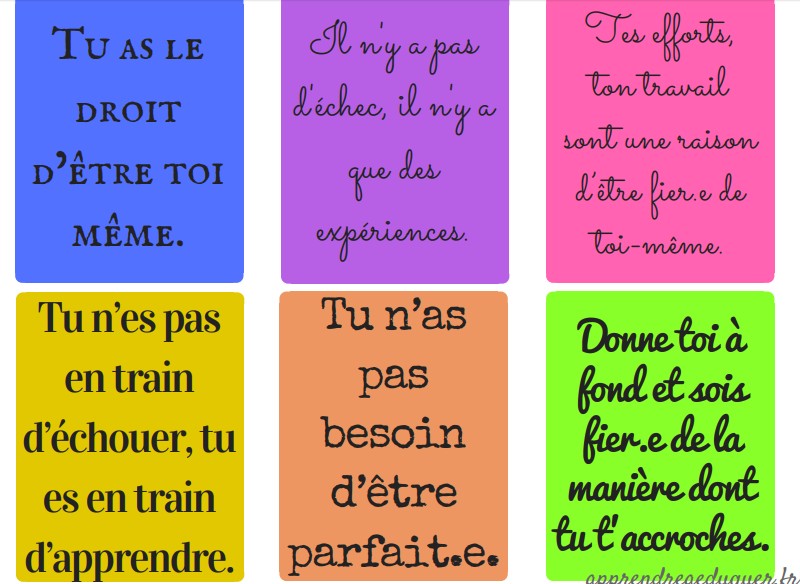
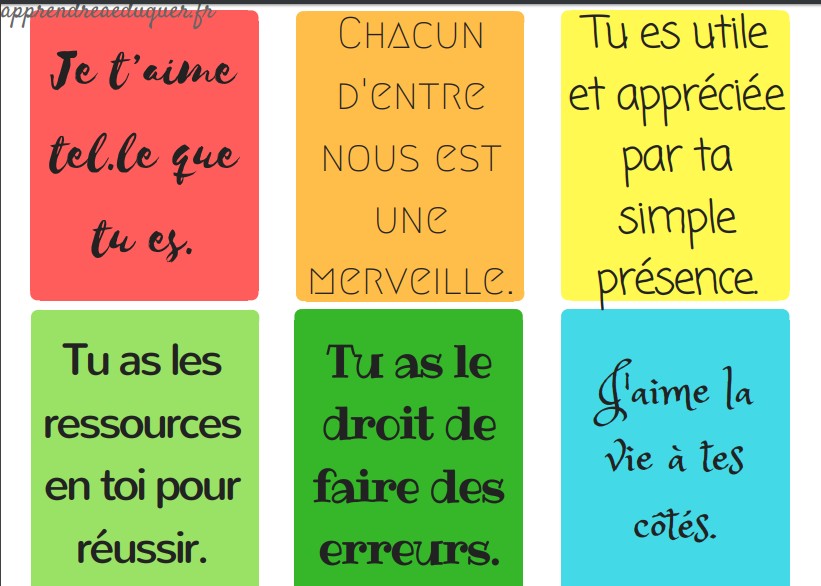
You are a ray of sunshine. I love living with you. I love taking care of you. Spending time with you is a real pleasure. I love it when we laugh together. You are unique and precious. You have the right to be yourself. I love you just as you are. Each of us is a wonder. You are useful and appreciated simply by being here. It is a joy to be your father. It is a joy to be your mother.
Messages that build resilience
There is no failure, only experiences. Your efforts and your work are a reason to be proud of yourself. You are not failing, you are learning. You do not need to be perfect. Give it everything and be proud of how you keep going. You have the resources inside you to succeed. You have the right to make mistakes.
Notice how the second group reframes difficulty rather than praising an outcome. That wording is worth keeping, because it gives a child something to fall back on when a task gets hard.
| Placement | Best moment | What it adds |
|---|---|---|
| Breakfast bowl | Morning | A warm start to the day |
| Bathroom mirror | Morning routine | A message seen again and again |
| School bag | Before school | Comfort during the day |
| Trouser pocket | Any time | A private, unexpected surprise |
| Front door | Leaving home | A calm send-off |
| Bedside table | Evening | A gentle end to the day |
How to Use the Cards Day to Day
The easiest routine is to draw a card at breakfast or in the car on the way to school, so the day starts with a warm sentence. You can also leave cards where they will be found later: taped to the bathroom mirror, on the front door, inside a school bag, in a trouser pocket, or slipped under the breakfast bowl.
Cards are not the only option. A few words written by hand on a scrap of paper work just as well, and many children keep them. For younger children who cannot read yet, pair the message with a simple gesture or sign, as explained in our article on #, or read the card aloud together.
If you are looking for other low-effort ways to bring play and warmth into the day, our ideas on # and our selection of # fit naturally alongside this little ritual.

Adapting the Ritual to Your Child's Age
A toddler will enjoy the tone of your voice more than the words themselves, so read the card with a smile and a cuddle. A school-age child can read the card alone and may want to keep a small collection in a box. An older child might prefer a note left on a desk to a card handed over in front of everyone.
Watch for what your child does with the cards. Some children stick them on a wall, some hide them away, some ask for a specific sentence again. That is useful information: it tells you which words matter most to them. Our article on # is a reminder that children also have their own words to offer back, and those are worth collecting too.
If your child is going through a demanding phase, keep the cards going even when the days are tense. A calm, familiar sentence can do more than a long conversation.
Free Printable Positive Cards to Download
To make this easy, the set of encouraging cards described above can be downloaded and printed for free, then cut out and kept in a small box or jar. Printing on thicker paper makes them last longer, and children often enjoy decorating the back of each card themselves.
You can also use them as small display cards around the house rather than as something to hand over. Either way, the point is the same: a child should come across these words unexpectedly, not earn them. For families who like screen-based learning too, our round-up of # and our guide to # offer other gentle ways to add encouragement to the day.
Finally, remember that the cards are a support, not a script. The best sentence is often the one you make up on the spot, in your own words, for that particular child on that particular morning.

My hands-on take
I started leaving short notes for my own children almost by accident, after writing one on the back of a shopping list and tucking it into a coat pocket. What surprised me was not the reaction that morning but the fact that the note was still in the pocket weeks later, folded and unfolded many times. That told me more than any enthusiastic thank-you would have.
In practice, I have found that the simplest sentences work best, and that a card left somewhere unexpected beats one handed over formally. I keep a small stack in a kitchen drawer and add to it whenever a phrase feels right for one particular child. Some weeks I forget entirely, and that is fine too. The ritual only needs to be occasional to feel genuine.
Frequently asked questions
Are positive cards a reward system?
No. They are not tied to behaviour, chores or results. Their value comes from arriving unexpectedly, which tells the child they are appreciated for who they are rather than for what they achieved.
At what age can I start using them?
You can read a card aloud to a toddler long before they can read it themselves. For older children, a card they can read alone or a handwritten note left on a desk often works best.
Do I need to print the cards?
Not at all. Handwriting a sentence on a piece of paper works just as well and often feels more personal. Printing simply makes it easier to build a reusable set.
What if my child does not react much?
Some children show little in the moment but keep the cards anyway. Pay attention to whether they stick them up, save them or ask for a particular phrase again.
Product Reviews
 Best Toys for Dogs With High Prey Drive |
Best Outdoor Toys for 3-4 Year Olds |
Best Outdoor Toys for 6 Year Olds |
Best Harness for Poodle |
Best LEGO Sets for Adults |
Best Travel Toys for 4 Year Olds on Airplane |
Best Toy Stores in Washington DC |
Best Potty Training Toys |
Best Toys for Tripod Dogs |
Maillot equipe de france







