


Learned helplessness is the discouragement that settles in when repeated failure convinces a child that effort no longer changes anything. The term was proposed in the 1970s by the American psychologist Martin Seligman to describe what happens when someone keeps trying to complete a task and keeps failing anyway.
It is that flat feeling of thinking that whatever you do, it will make no difference. The pattern can affect adults as well as children, and at school it often hides behind the label of a pupil who simply "does not try hard enough".

Quick takeaways
- Learned helplessness grows when effort repeatedly fails to change the outcome.
- Negative school feedback can blame a child who is already trying hard.
- Unrecognised difficulties such as ADHD or dyslexia feed the pattern.
- Naming the real obstacle rebuilds trust between child and adult.
- Treating mistakes as part of learning keeps reflection and progress alive.
- An optimistic style links failure to causes the child can control.
What the original experiment showed
Seligman's concept grew out of an experiment in which a group of men and women were exposed to a loud noise they had no way of stopping. The next day, a second test took place with the same group and a control group whose members had not heard the uncontrollable noise the day before.
Both groups now faced the same noise, but this time the environment offered ways to interrupt it. The control group used those means and silenced it, while the first group gave up passively, marked by the earlier experience in which every effort had been useless.
Learned helplessness produces behaviour guided by discouragement and sadness, and when these last, they can lead to depression. In other words, believing your efforts are pointless removes your motivation to act, and passing painful emotions harden into a permanent negative mood.

How it appears in the classroom
At school, a pupil may want to meet an adult's expectations, and may redouble effort to get there, yet still fall short. The feedback that follows is often negative: "he or she makes no effort", "must do better", "must work more".
Yet that pupil has worked and made efforts, but lacks the right learning methods, the right mindset or the necessary psychological conditions, such as low self-esteem or a block on thinking. Neurological particularities such as ADHD or dyslexia can also prevent the child from doing more.
When a pupil fails despite trying, and the adult does not recognise the difficulty responsible for that failure, the child lands in a learned helplessness situation. Confidence in their own ability to succeed through effort fades, and worse, they lose faith in adults' capacity to spot their needs and respond. A child who is simply wired differently, like the genius children who think far ahead of their age, can slide into the same trap when nobody names the gap. The same care applies to the words adults choose, as these harmful phrases remind us, and to the tools placed in a child's hands, including the most damaging toys that shape how children learn to cope.
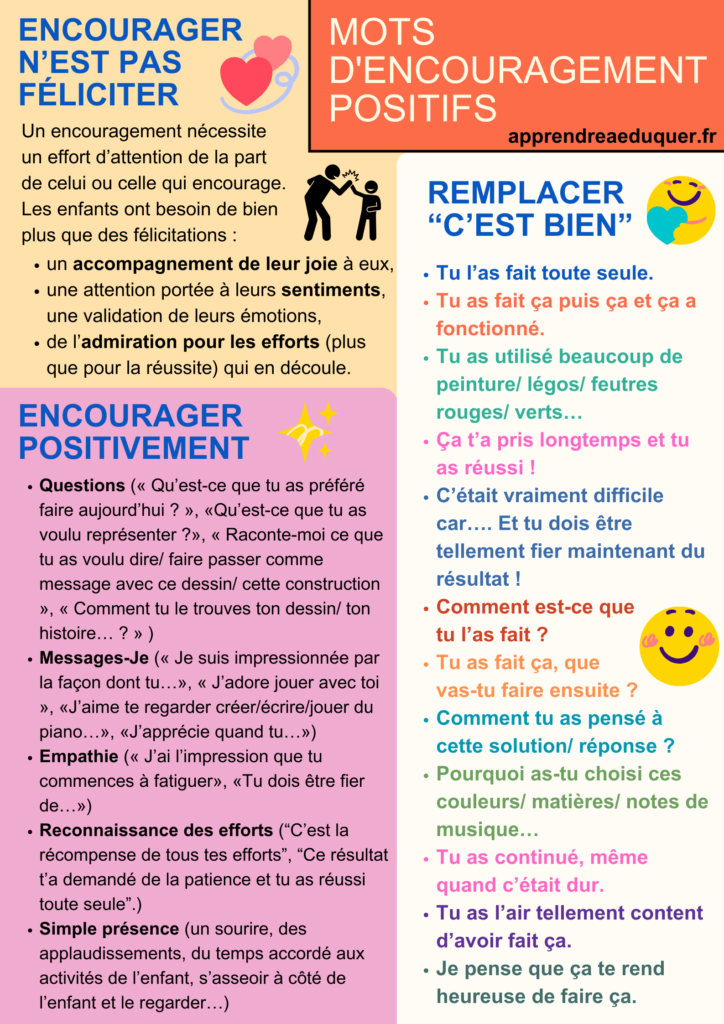
| What you say | Focus | Effect on the child |
|---|---|---|
| "You're so clever" | Fixed judgement of the person | Depends on others' evaluation |
| "You worked hard on that" | Effort the child controls | Builds self-evaluation |
| "Must do better" | Verdict without a path | Feeds discouragement |
| "What were you trying to do?" | The child's reasoning | Opens reflection |
| "I need help on this point" | A controllable cause | Keeps motivation alive |
Levers to move past learned helplessness
When a child senses that the adult has understood they wanted to succeed, that they tried, but could not concentrate or sit still (ADHD), or struggled to read and spell correctly (dyslexia and dysorthographia), or to take notes quickly (dyspraxia), something shifts. Once the child feels understood, the alliance forms and investment in school becomes possible again.
Learning means understanding why you get something wrong. Only when the error is accepted on both sides, by children and adults, does everything become possible: reflection, learning, progress, creation, innovation, invention. Adults therefore carry the task of taking the drama out of mistakes and explaining that error is part of the learning process: it is precisely because I get it wrong that I am learning.
In this approach, the adult is more interested in having the child explain what they meant to do than in what they did badly or left undone. That way the adult can try to identify the knowledge the child's reasoning rests on and work out where it came from. A calmer climate at home, of the kind described in family life balance, supports this patiently. Hands-on play can help too, as with these cause and effect toys and foam block toys.
A quote worth keeping in mind
"Error is not only the effect of ignorance, uncertainty or chance, but the effect of prior knowledge that had its interest and its successes, and that now proves false or simply unsuitable." This remark from G. Brousseau, a mathematics didactician, reminds us that a wrong answer usually has a logic behind it.

Encouragement rather than compliment
Jane Nelsen invites us to distinguish encouragement from compliment. In her book Positive Discipline, she offers several questions that help tell the two apart: does what I say push the child to self-evaluate, or make them dependent on someone else's evaluation? Am I being respectful, or condescending? Am I seeing things from the child's point of view, or only from mine? Would I say this to a friend?
Nelsen sums it up: effective encouragement reaches the heart before it reaches the head. The same respectful tone matters when you guide daily habits, as in teaching tooth brushing without turning it into a judgement of the child.

Building an optimistic style
An optimistic style increases self-confidence. Optimists attribute their failures to a controllable cause: "I didn't work enough", "I skipped that topic", "I hadn't quite understood", "I need help on this point", "it was difficult", "I was tired then, I can do better, things can change if I adopt other habits", "with practice I'll improve". They also recognise their strengths elsewhere: "there are plenty of other things I succeed at".
Optimists credit success to an internal cause, their work and effort, rather than luck. Success is seen as stable ("I have a talent for this subject") rather than unstable or time-limited ("I was lucky, it won't last"). Helping a child find that stable ground often starts with play and stories, where effort and progress are visible and low-stakes, much like the discovery offered by sensory toys for younger children. Thoughtful stories about art can nurture this outlook too, as can the example of authors like Julia Donaldson.
This outlook does not remove difficulty, but it keeps the door open. A child who learns to say "I need help on this point" instead of "I can't do anything" keeps their motivation intact and stays willing to try again.

My hands-on take
I have watched this pattern up close with a child who spent an entire evening on a worksheet and still came home with a note saying the work was insufficient. The frustration was not about the subject; it was about being told, once again, that the effort did not count. What changed things was not a new reward chart but a simple conversation in which I asked what they had been trying to do, step by step.
Once we named the actual stumbling block, the mood lifted and the next attempt felt possible. I now try to catch myself before I deliver a verdict and ask a question instead. It takes practice, and I still get it wrong, but the child is far quicker to say "I need help here" rather than going quiet.
Frequently asked questions
What is learned helplessness in simple terms?
It is the discouragement that comes after repeated failure despite real effort, leading a person to believe nothing they do will change the result. In children it often looks like giving up or refusing to try.
How can I tell it apart from simple laziness?
A child in learned helplessness usually wanted to succeed and did make efforts before giving up. The clue is often that a real obstacle, such as a learning difficulty or low self-esteem, was never recognised.
What can parents do first?
Start by showing the child you have understood that they tried and that something specific got in the way. Then treat mistakes as information about what to work on rather than as a verdict.
Does encouragement mean praising everything?
No. Encouragement focuses on effort, choices and progress the child controls, and invites them to evaluate themselves. Blanket praise of the person tends to make children dependent on outside judgement.
Product Reviews
 Best Toys for Dogs With High Prey Drive |
Best Outdoor Toys for 3-4 Year Olds |
Best Outdoor Toys for 6 Year Olds |
Best Harness for Poodle |
Best LEGO Sets for Adults |
Best Travel Toys for 4 Year Olds on Airplane |
Best Toy Stores in Washington DC |
Best Potty Training Toys |
Best Toys for Tripod Dogs |
Maillot equipe de france







