


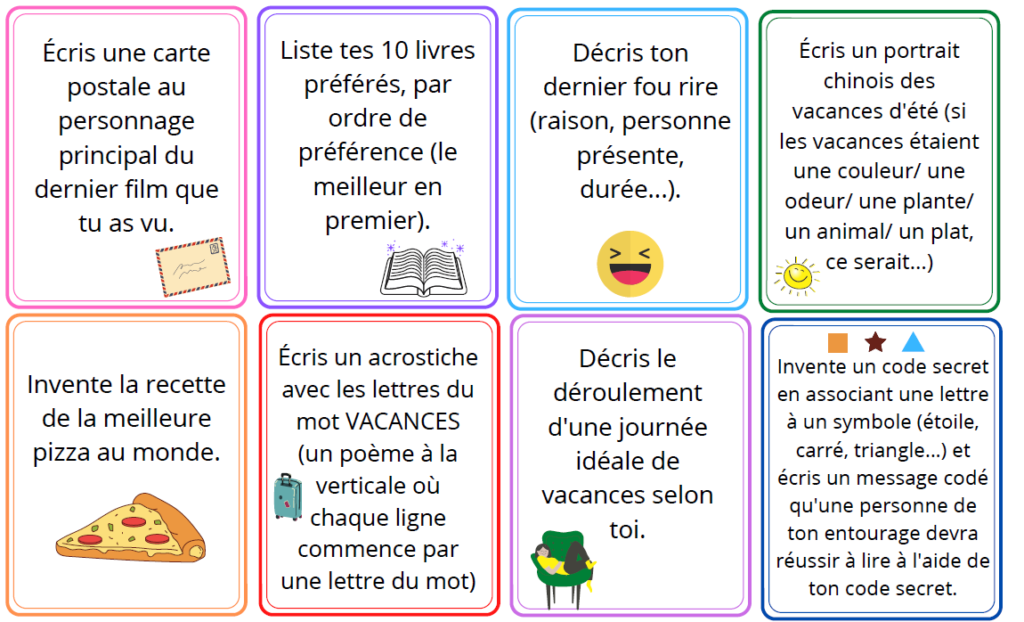
Fun writing ideas can turn a rainy holiday afternoon into something children actually look forward to. The twenty prompts below ask for a few lines, a list or a whole story, and you can set a minimum number of words or simply leave the brief open.
They work just as well at home as they do in a classroom, where teachers often use short daily writing warm-ups at the start of term. Print the prompts as cards, lay them face down and let a child draw one at random.

Quick takeaways
- Offer twenty prompts as draw-at-random cards to add an element of chance
- Set a minimum number of lines only if your child needs a clear target
- Mix quick lists with longer story prompts across the week
- Use word constraints and acrostics to build vocabulary painlessly
- Read the finished piece aloud so the writing has a real audience
- Keep sessions to about ten minutes and stop while it is still fun
Postcards, lists and laughing out loud
Start with something familiar. Ask your child to write a postcard to the main character of the last film they saw, which nudges them to retell a story from a new angle. Then have them list their ten favourite books in order of preference, best first, and talk through the ranking afterwards.
Memory prompts work beautifully too. Ask them to describe their last real fit of laughter: what caused it, who was there and how long it lasted. Children who love inventing characters may enjoy theimaginative play toys angle here, turning a funny moment into a mini scene.
Portrait chinois and pizza
A “portrait chinois” asks what the summer holidays would be if they were a colour, a smell, a plant, an animal, a book or a dish, and children can add their own categories. Finish the session by inventing the recipe for the best pizza in the world, complete with ridiculous ingredients and cooking times.
Acrostics, ideal days and secret codes
An acrostic uses the letters of VACANCES written vertically, with each line beginning with one letter. It is a gentle way to practise vocabulary and rhythm without the pressure of a full poem. Follow it by describing a perfect holiday day from morning to night.
Secret codes are a favourite. Have your child match each letter to a symbol, such as a star, square or triangle, then write a coded message that someone in the family has to decode using the key. Pair this with a tongue twister invented in the style of familiar ones, and thelearning toys shelf often supplies letter cards or stamps for younger siblings writing alongside.
Animated objects and kindness
Ask them to imagine the adventures of a living plate going through the dishwasher, then to list ten ways of being very kind to a brother, sister or cousin. For children who like dressing up their ideas, thesuperhero toys crowd usually loves inventing a hero’s secret code first.
| Prompt type | Example | Best for |
|---|---|---|
| Quick list | Ten favourite books in order | Low-energy afternoons |
| Memory | Describe your last fit of laughter | Reluctant writers |
| Wordplay | Acrostic on VACANCES | Building vocabulary |
| Constraint story | Include cauliflower, whale, purple, manure | Confident storytellers |
| Absurd logic | Three things a lamp and a banana share | Group or family play |
Rewriting songs and topsy-turvy stories
Take a well-known playground chant and rewrite the words while keeping the rhymes, swapping in new body parts, animals and clothes. It teaches rhythm and wordplay at once. Then move to the “fortunately, unfortunately” structure: one happy event, one unhappy event, and so on, alternating until the story ends happily.
This pattern is easy to model aloud before writing. Children who need a warm-up can dictate their first two lines while you write, then take over the pen. A small reward chart withschool reward toys can keep a reluctant writer going across several days.
Word constraints
Give a story four mandatory words, such as cauliflower, whale, purple and manure, and see what happens. Then try a tautogram, where every word in a sentence starts with the same letter, working through L, E, C and U in turn.
Comparisons, small joys and what-ifs
Ask for at least three things a lamp and a banana have in common, then a saucepan and a light bulb, then a bed and a dolphin. Absurd comparisons build flexible thinking. Follow with a list of the day’s three best moments, a simple gratitude habit that doubles as writing practice.
Riddles keep the mood light: how many answers can they find to “what is purple and flies?” Silly answers are allowed and encouraged. If your child is stuck, a short break withoutdoor toys often resets the mood before the next prompt.
Consequences and qualities
Imagine that everyone can read your thoughts because they appear on your forehead, and write the consequences. Then list at least five personal qualities, each with a situation where your child showed it. This one pairs well with thesingle father story for a conversation about how adults see themselves too.

Making the prompts stick
Cards work because they add an element of chance. Keep them in a small box, draw one at breakfast and let the writing happen whenever suits. A notebook per child, kept in the same place, removes the friction of hunting for paper.
Short and regular beats long and rare. Ten minutes a day is plenty, and reading the result aloud gives the writing a purpose. For families juggling work and children, thevirtual babysitters approach to scheduling can free up a quiet half hour for writing together.
Building a writing corner
Stock pens, coloured pencils, sticky notes and a few envelopes for postcards. A small bag ofsummer bag essentials can hold a notebook and pencil for writing on trains, in cafés or in the garden. Keep the tone playful: no marking, no corrections unless the child asks.

My hands-on take
I have used these prompts with children who claimed they hated writing, and the cards made the difference. Drawing a card felt like a game rather than a task, and the silly ones, especially the purple flying riddle and the living plate, got the first laugh and then the first sentence.
My practical tip is to write alongside them. When I scribble my own answer to the same prompt, the silence in the room changes completely, and children stop watching me for approval. I also keep a small notebook in my bag, because holiday writing happens in odd places: a train seat, a park bench, a kitchen table while dinner cooks.
Frequently asked questions
What if my child refuses to write at all?
Start with a prompt that needs only a list or a single sentence, and let them dictate while you hold the pen. Drawing the answer first often makes the writing step feel smaller.
How long should each writing session last?
Around ten minutes is enough for most children. Short, regular sessions build the habit far better than one long sitting that ends in frustration.
Can these prompts be used in class?
Yes. Teachers often use short daily writing warm-ups at the start of term, and the prompts work well as a five-minute morning task.
Do I need to correct spelling and grammar?
No. Keep the focus on ideas and pleasure, and only correct if your child asks. Saving corrections for a separate moment protects the playful mood.
Product Reviews
 Best Toys for Dogs With High Prey Drive |
Best Outdoor Toys for 3-4 Year Olds |
Best Outdoor Toys for 6 Year Olds |
Best Harness for Poodle |
Best LEGO Sets for Adults |
Best Travel Toys for 4 Year Olds on Airplane |
Best Toy Stores in Washington DC |
Best Potty Training Toys |
Best Toys for Tripod Dogs |
Maillot equipe de france







