


Empathy is political, argues neuroscientist Samah Karaki, and that idea changes how we read our own reactions as parents. In her book Empathy Is Political: How Social Norms Shape the Biology of Feelings, she defines empathy and then shows that it is both limited and selective.
Depending on how we define it, empathy can lead to avoidance and withdrawal, or to genuine altruism. Karaki also explains why empathy cannot serve as a moral compass on its own, and why it wears down under stress and constant exposure to suffering.

Quick takeaways
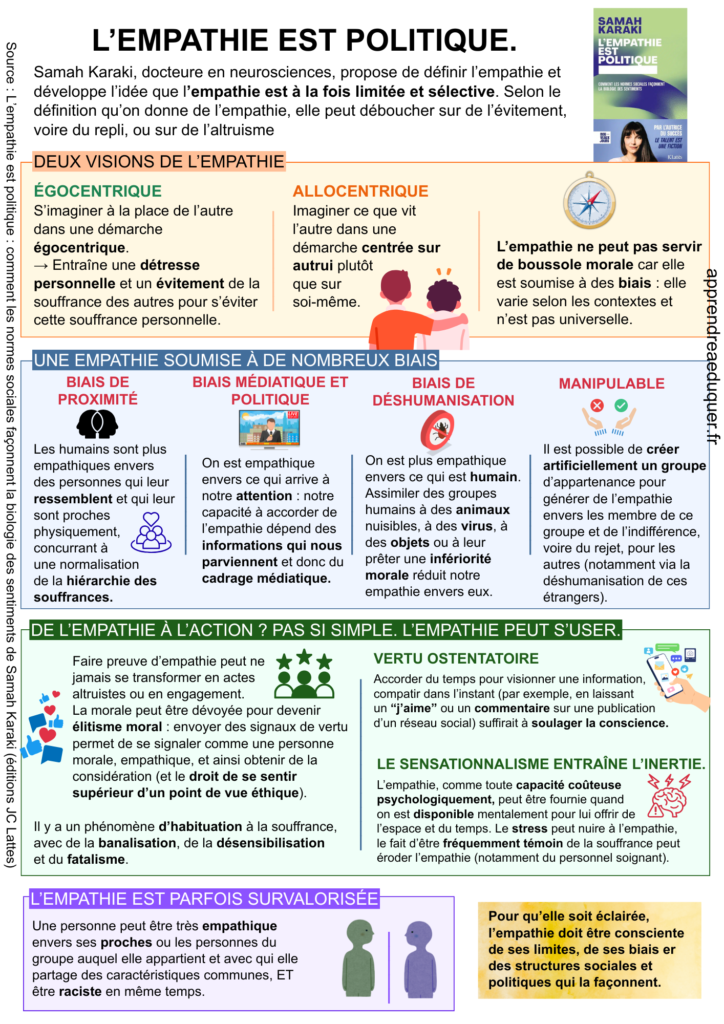
- Empathy can be egocentric (personal distress and avoidance) or allocentric (altruism)
- Empathy is selective: we favour people who resemble us and are close to us
- Media framing and dehumanisation can manipulate who receives our empathy
- Virtue signalling can replace real commitment with a like or a comment
- Stress and repeated exposure to suffering erode empathy over time
- Empathy needs historical and sociocultural knowledge to challenge domination
What Empathy Really Means
Karaki starts with a definition, because everything else depends on it. If empathy means imagining yourself in another person's place, the process is egocentric: you feel personal distress, and to escape that distress you may turn away from the other person's suffering. If empathy means imagining what the other person is actually living through, the process is allocentric, and it tends to produce altruistic behaviour.
That distinction matters at home. When a child cries, I can either flood myself with "how would I feel" or step into their world and ask what this moment is like for them. The first reaction often pushes me to silence the crying quickly; the second invites me to stay present. This is the same shift that underpins gentle parenting and the refusal to hurt a child even when we are exhausted.
Two roads from the same feeling
Karaki does not claim empathy is useless. She claims it is not automatic, and that the direction it takes depends on how we practise it.
Empathy Is Biased and Selective
Because empathy varies with context, it is not universal, and Karaki insists it cannot be used as a moral compass. Humans are more empathetic towards people who resemble them and who are physically close, which quietly normalises a hierarchy of suffering. Empathy is also sensitive to media and political framing: we feel for what reaches our attention, so our capacity to care depends on the information we receive.
We are also more empathetic towards what we perceive as fully human, which is why Karaki devotes a whole chapter to dehumanisation, the habit of likening human groups to pests, viruses or objects, or granting them moral inferiority. It is possible to manipulate empathy by creating an artificial in-group, generating care for its members and indifference or rejection for outsiders. Parents can notice these patterns in the stories children absorb, and labelling children is one small place where the habit begins. The books and toys we choose, from toys for tummy time to classic children's literature, quietly shape whose perspective a child learns to take.

| Empathy pattern | What it looks like | Practical response |
|---|---|---|
| Egocentric empathy | "How would I feel?" leads to distress and avoidance | Ask what the moment is like for the child |
| In-group bias | More patience for people who resemble us | Notice who is harder to be patient with |
| Virtue signalling | A like or comment replaces action | Choose one concrete gesture |
| Empathetic fatigue | Stress and constant exposure wear care down | Protect rest and name your overload |
| Dehumanisation | Groups framed as pests, viruses or objects | Question the stories children hear |
Virtue Signalling and Moral Elitism
Feeling empathy does not guarantee altruistic action or commitment. Morality can be diverted into moral elitism: sending signals of virtue lets a person present themselves as moral and empathetic, earning consideration and the right to feel ethically superior.
Karaki calls this ostentatious virtue. Spending time watching a piece of news and sympathising in the moment, perhaps by leaving a like or a comment on a social media post, is enough to soothe the conscience and to count oneself as an empathetic person. Sensationalism produces inertia. For parents, the practical lesson is to notice the gap between the feeling and the act, and to choose one concrete gesture rather than a dozen silent reactions.
The Wearing Down of Empathy
Karaki stresses the exhaustion of empathy. Like any psychologically costly capacity, it can be offered when we are mentally available to give it space and time. Stress damages empathy, and frequently witnessing suffering erodes it, which is well documented among hospital and care staff. There is a phenomenon of habituation to suffering, with normalisation, desensitisation and fatalism.
This explains a lot about family life. Our lifestyles generate empathetic weariness, which partly explains why it can be so difficult to be a parent who shows empathetic concern. Small daily habits help: naming our own overload, protecting sleep, and accepting that we cannot be equally available at every hour. The same logic applies to children's wellbeing, from iron-rich foods to protecting children's feet in cold weather and the routines that keep them steady.
Why Empathy Needs Context and Knowledge
Karaki deplores the overvaluation of empathy as a solution to every problem. A person can be deeply empathetic towards their relatives and their in-group while being racist at the same time. Empathy cannot do without information about the sociocultural context, nor without historical and anthropological awareness.
The book takes a firmly antiracist, antisexist and postcolonial stance, with strong political positions. Its grids for reading domination help us understand why empathy alone is not enough to dismantle it. Adult-child relationships are themselves marked by domination, and recognising that asymmetry is a first step towards calming fidget tools for children who regulate big feelings through their hands.
What This Means for Non-Violent Parenting
Reading this book fits naturally into a journey towards educational non-violence, because it extends the reflection by giving it a social and political dimension. Empathy is not sufficient, but it is a starting point that becomes more reliable when paired with knowledge, context and concrete action.
In practice, that means asking who we find easy to be patient with and who we find harder, and why. It means noticing when tiredness, not character, is driving our reactions. It also means building environments that support calm, whether through tummy time play for babies, science toys that nurture curiosity, or through honest conversations with older children about fairness and difference. A thoughtful newborn collection can also help create that calm from the very first days.


My hands-on take
I noticed the egocentric version of empathy in myself long before I had words for it. When my child was crying at night, my first instinct was to make the noise stop, which was really about relieving my own discomfort. Reading about the allocentric shift gave me something concrete to try: instead of asking how I would feel, I started asking what the moment was like for them.
The chapter on empathetic weariness also landed. On days when I had slept badly and handled three small crises before lunch, my patience was not a measure of my love. Naming that aloud, to myself and to my partner, made it easier to step back and return calmer rather than push through and snap.
Frequently asked questions
Does this book say empathy is bad?
No. It says empathy is limited, selective and biased, so it cannot serve as a moral compass on its own. It works best alongside context, knowledge and concrete action.
Why is empathy called political?
Because social norms shape who receives our empathy and who is excluded from it. Framing, media attention and group belonging all influence how feelings are distributed.
How does this relate to parenting?
Adult-child relationships involve a power imbalance, and daily stress wears empathy down. Recognising both helps parents respond with more patience and less guilt.
Can empathy be worn out?
Yes. Karaki describes habituation to suffering, with normalisation and desensitisation, especially among people frequently exposed to distress.
Product Reviews
 Best Toys for Dogs With High Prey Drive |
Best Outdoor Toys for 3-4 Year Olds |
Best Outdoor Toys for 6 Year Olds |
Best Harness for Poodle |
Best LEGO Sets for Adults |
Best Travel Toys for 4 Year Olds on Airplane |
Best Toy Stores in Washington DC |
Best Potty Training Toys |
Best Toys for Tripod Dogs |
Maillot equipe de france







