


Empathy games for kids are a gentle way to help children step outside their own point of view and imagine how someone else sees the world. The capacity to "decentre" — to shift away from yourself — is at the heart of empathy, and it can be practised through play rather than lectured about.
These four activities come from the tradition of philosophy workshops for children. They need no materials beyond a little curiosity and a few minutes of quiet conversation, and they work just as well at the kitchen table as on a long car journey.

Quick takeaways
- Thought experiments test an idea by following its consequences in an invented world.
- The Chinese portrait uses metaphor to make abstract words concrete.
- "When I say… I see" turns a mental image into a philosophical dialogue.
- The recipe and inventory game breaks a feeling into imagined ingredients.
- Answer first as a parent to model the exercise, then hand over the floor.
- Keep sessions short and repeat often rather than aiming for depth once.
Thought experiments: inventing a world to test an idea
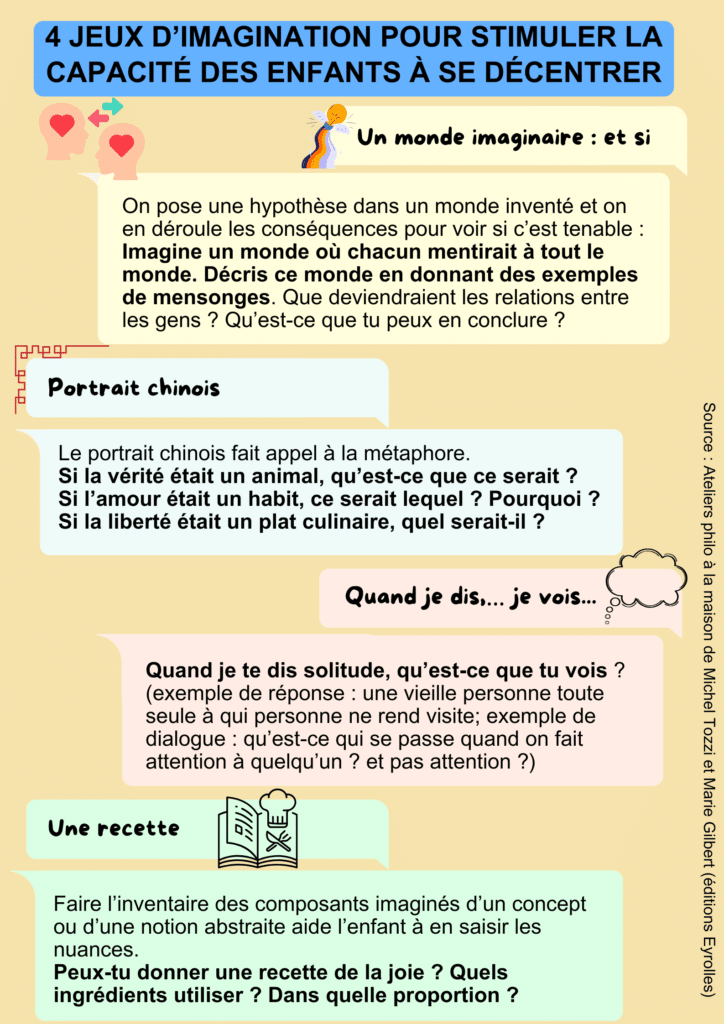
A thought experiment starts with a hypothesis set in an invented world, then follows the consequences to see whether the idea holds up. Ask your child to imagine a world where everyone lied to everyone else, to describe it with examples of lies, and to say what would happen to relationships between people. Then invite them to draw a conclusion.
You can also use the senses to question perception itself. Ask them to close their eyes and ask whether the outside world still exists, or show them a stick half-submerged in a bucket of water and ask whether it is really broken. These small puzzles lead naturally to the question of whether we can trust our senses, much like the left side baby hold shows how our bodies sometimes act before we reason.
Keeping the discussion open
Resist the urge to supply the "right" answer. A child who argues that the world disappears when they close their eyes is reasoning, not being silly, and that reasoning deserves to be heard before it is gently tested. If you are planning a long drive and want conversation starters ready, these family car routes give you hours of talking time.

The Chinese portrait: thinking through analogy
The Chinese portrait uses analogy and metaphor, comparing an abstract notion to a person, an object, a plant or an animal. The value lies in the follow-up question: why that comparison, and which characteristic does it highlight? A parent can answer first to model the exercise — for instance, justice could be a set of scales because it weighs the pros and cons before judging.
Try questions such as: if justice were an object, what would it be and why? If truth were an animal, what would it be? If love were a piece of clothing, which one and why? If freedom were a dish, what would it be? Each answer opens a small window onto how your child understands the idea.
Why metaphor helps
Abstract words are slippery for young minds, and a metaphor gives them something concrete to hold. It also reveals assumptions you might never hear otherwise. If your child is heading off on a school exchange, the same skill of imagining another person's viewpoint is exactly what they will need, as these exchange abroad explain. The same imaginative thinking can also make back to school reward toys more meaningful, and it pairs well with the questions in our scholarship application FAQ.
| Game | What it trains | Example prompt |
|---|---|---|
| Thought experiment | Consequence-thinking and logic | Imagine a world where everyone lies |
| Chinese portrait | Analogy and metaphor | If justice were an object, what would it be? |
| When I say… I see | Mental imagery and dialogue | When I say solitude, what do you see? |
| Recipe and inventory | Nuance and vocabulary | What is the recipe for joy? |
"When I say… I see": mental images as a starting point
Here the child expresses, through a mental image, their representation of an abstract word or concept. You can then use that image to open a philosophical dialogue. Ask, for example: when I say solitude, what do you see? A common answer is an old person alone whom nobody visits.
From there, follow the thread with open questions: what happens when we pay attention to someone, and when we don't? The image becomes a doorway into the concept rather than the end of the conversation. Keep your tone curious rather than corrective, and let silence do some of the work.
Good moments to try it
These exchanges fit naturally into quiet routines — bath time, the walk to school, or the wind-down before bed. If bedtime is already a delicate operation in your house, the twins sleep routine ideas show how a calm, predictable ritual leaves room for a short chat. For families with a new baby, the postpartum care basics are worth reading so that older siblings still get their moment to talk. Even a simple question about making a LEGO can spark the same kind of wondering.
A recipe and an inventory: finding the ingredients of a feeling
Listing the imagined components of a concept helps a child grasp its nuances. Ask them to give you the recipe for joy: which ingredients, in what proportions, and how would you mix them? Then try the inventory: what might you find at a shop that sells happiness?
The same structure works for almost any abstract word — courage, friendship, patience, anger. The playful frame lowers the pressure, and the answers often surprise you. It is a good game for a rainy afternoon, and it pairs well with a calm activity such as the quiet toys that keep hands busy while minds wander.
Building the habit
None of these games needs to last long. Five minutes of genuine exchange is worth more than a forced half-hour, and repetition matters more than depth on any single occasion. Over time, children start bringing their own questions to the table, which is the real sign that the habit has taken root.

My hands-on take
I started trying the "when I say… I see" game on the walk to school, mostly because it filled an awkward ten minutes. The first few attempts got one-word answers, and I nearly gave up. What changed things was answering first myself and being honest about my own image — mine for solitude was a phone that never rings, which my child found funny and then wanted to argue with.
The recipe game has become our favourite on rainy afternoons. I have learned to keep my own answers short and to ask "why that?" rather than correcting anything. Some sessions go nowhere at all, and that is fine; the ones that work tend to be the ones where I am genuinely curious rather than steering toward a lesson.
Frequently asked questions
What age are these games suitable for?
They work best once a child can hold a short back-and-forth conversation, roughly from the early school years onward. Younger children can join in with the simpler image questions, and the prompts can be adapted as their vocabulary grows.
Do I need any materials?
No. All four games run on conversation alone, which makes them ideal for car journeys, mealtimes or the walk to school. A bucket of water and a stick are optional extras for the perception experiment.
What if my child gives a silly answer?
Treat it as a real contribution and ask a follow-up question about why they chose it. The goal is not the correct answer but the habit of considering another point of view, and gentle curiosity keeps that habit alive.
How long should a session last?
A few minutes is plenty, especially at first. Short, frequent exchanges build the habit far better than a long forced discussion, and children will often return to the topic on their own later.
Product Reviews
 Best Toys for Dogs With High Prey Drive |
Best Outdoor Toys for 3-4 Year Olds |
Best Outdoor Toys for 6 Year Olds |
Best Harness for Poodle |
Best LEGO Sets for Adults |
Best Travel Toys for 4 Year Olds on Airplane |
Best Toy Stores in Washington DC |
Best Potty Training Toys |
Best Toys for Tripod Dogs |
Maillot equipe de france







