


The Sun of Qualities is a confidence-building exercise that helps girls identify their strengths and resist the stereotypes that quietly shape how they see themselves. It asks each participant to fill a circle with eight qualities that describe her, then decorate it as a bright, personal sun.
It takes only a sheet of paper or a cardboard plate, some markers and a little honesty. The exercise is not a magic fix, but a gentle starting point for conversations about self-worth, media messages and the kind of person a girl wants to become.

Quick takeaways
- The Sun of Qualities asks girls to name eight personal strengths in a decorated circle.
- The exercise counters marketing that reduces women's value to appearance and weight.
- Girls as young as six can already doubt their abilities, so early practice matters.
- Sharing aloud is optional but builds courage; acknowledge how hard it feels.
- Adults benefit too: mothers often notice their own unconscious stereotypes.
- Revisit the sun regularly through conversation, role models and media education.
Why girls need to name their qualities
Girls learn early that their value is measured by appearance. Marketing that objectifies women's bodies sends the message that a woman's worth depends on how she looks and what she weighs. That message is absorbed long before adolescence, and it narrows the way girls imagine their own futures.
Reports circulating online have highlighted that girls begin to doubt their abilities at around age six, while a US study found that girls as young as six already see themselves as less naturally gifted than boys. The cause is cultural, not biological: children are taught that talent and genius are masculine attributes. Naming real qualities is a small way to push back against that idea.
Not arrogance, just self-knowledge
Knowing your strengths is not boasting. It is the foundation for informed choices about studies, friendships and goals, and it helps a girl see what she can genuinely contribute to the world.
How the exercise works
Give each participant a cardboard plate or a sheet of paper and ask her to divide it into eight equal parts, like the rays of a sun around a central circle. In each section she writes one quality that describes and defines her. Younger children can draw or dictate instead of writing, and the plate can be decorated afterwards as a reflection of her personality.
Prompts make the task easier. Ask how friends and people who love her would describe her, in which situations she does things well, what she enjoys doing, and what she has already been praised or rewarded for. She can also add qualities she would like to develop, turning them into goals. For quieter moments afterwards, a simple creative activity such as homemade finger paint lets younger girls keep decorating without pressure. If you are curious how a first building set became a collector's item, read how much, and for recurring throat troubles see why tonsillitis keeps returning.
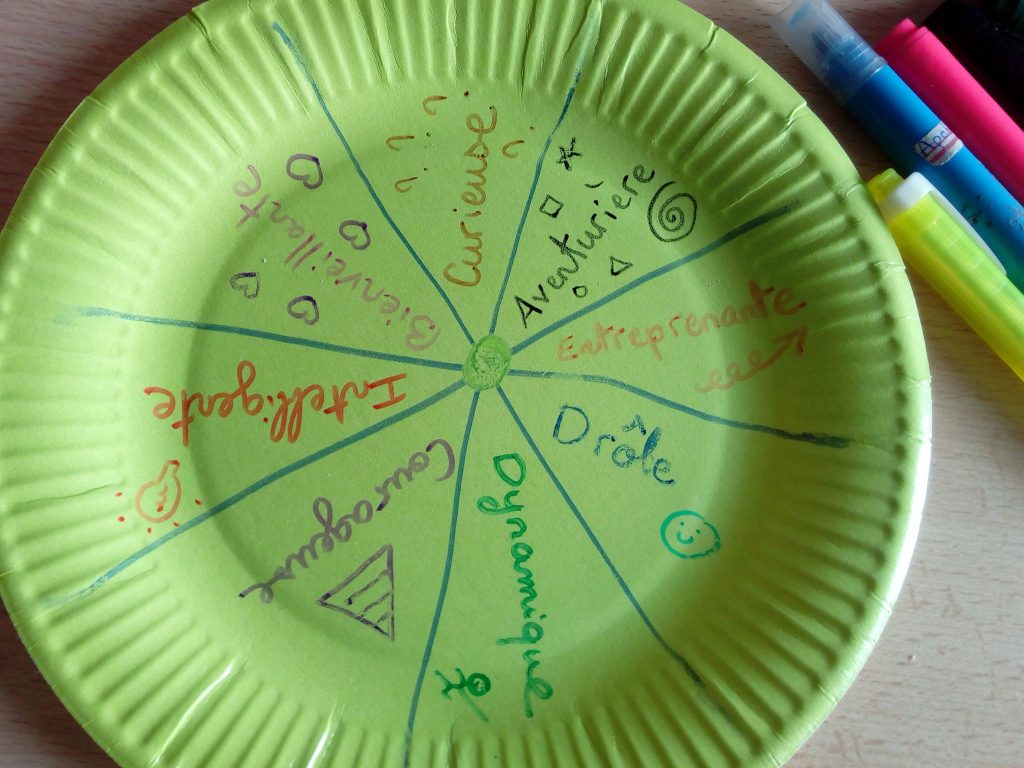
| Element | What it is | Why it matters |
|---|---|---|
| Central circle | The girl herself | Keeps the focus on identity |
| Eight rays | One quality per section | Builds a concrete list of strengths |
| Prompts | Questions about friends, successes, wishes | Helps when words do not come |
| Decoration | Colours, drawings, symbols | Makes the sun personal and motivating |
| Sharing | Optional group or family talk | Turns self-knowledge into confidence |
Questions to guide the eight rays
Good questions do most of the work. Keep them concrete and warm, and let silence do its part: many girls need a minute before the first word lands. You can ask what a friend would say about her, which moments of the week she felt proud of, and what she would like to be better at by next year.
If a girl struggles, offer observations rather than labels: "You always notice when someone is left out" is easier to accept than "you are kind". A short list of creativity in children activities can also help a child who thinks best with her hands rather than a pen.
Keep the tone light
This is not a test. There are no right answers, and a half-filled sun is still a good sun.
Sharing the suns with the group
Participants are then invited to share what they wrote. In practice, eyes drop to the floor and few volunteers appear. Nobody should be forced, but the difficulty can be acknowledged out loud, along with the courage the exercise requires. Speaking in front of others is itself a quality, and it builds the audacity that later helps break through barriers, much like the confidence children gain from mindful screen habits.
At the end of a workshop, the facilitator asks how it felt. Most participants admit the exercise was hard, and that they rarely think about what is good in them, focusing instead on flaws, especially physical ones. Interestingly, when the same exercise has been offered to boys, they reported far less difficulty finding eight qualities and presenting them publicly.

What to do when a girl cannot find eight qualities
Blank sections are information, not failure. Sit beside her and offer a few gentle observations from everyday life: a moment she helped without being asked, a task she stuck with, a friend she defended. Let her accept, reject or reword each one so the final list stays hers.
You can also widen the frame: qualities include patience, curiosity, a good sense of humour or the ability to listen. A child who takes on household chores for children often discovers reliability and care for others without naming them as strengths.
Make it a habit, not an event
One session is a start. Revisit the sun regularly, in a quiet conversation, through stories with enterprising female role models, or through media education that unpacks advertising stereotypes and the early sexualisation of girls.
Doing the exercise alongside your daughter
At home, mothers can fill in their own sun at the same time. It quickly reveals how much adult women are also shaped by cultural stereotypes, often without realising it. The exercise is harder than it looks, and doing it together keeps it honest.
If she agrees, your daughter can show you her sun, and that can open a genuinely philosophical conversation about media influence, stereotypes and the place of women in society. Pair it with short Christmas stories featuring brave girls, or with a calm chat about travels without parents and the worries that come with growing independence. It also helps to know the signs of thrush symptoms and why blood pressure control matters, so health worries never get in the way of these talks.
Keep the conversation going
Confidence grows through repetition: regular encouragement, inspiring models and honest talk about what girls see online and on screen. The sun is one tool in a broader education, not a one-off cure.

My hands-on take
I tried the Sun of Qualities with my own daughter on a rainy afternoon, expecting it to take ten minutes. It took closer to forty, and most of that time was silence. She filled four rays quickly, then stalled, and I realised I was about to fill them for her. I stopped, put my own plate on the table and started writing instead.
That was the useful part. Struggling with my own eight qualities in front of her said more than any explanation. We ended up trading prompts and laughing at how hard it is to say good things about yourself out loud. Her sun hangs on the kitchen wall now, half decorated, and we add a ray every few weeks when something new shows up.
Frequently asked questions
What age is the Sun of Qualities suitable for?
It works best with children old enough to describe themselves in words, roughly from early primary school upwards. Younger children can draw their qualities or dictate them to an adult.
What if my daughter only writes one or two qualities?
That is common and still useful. Offer gentle observations from daily life and let her decide which ones fit, then return to the sun another day.
Is this exercise only for girls?
It was designed for girls and young women because they face particular stereotypes, but boys can do it too. Boys tend to find it easier, which is itself worth discussing.
Does praising qualities make children arrogant?
No. Knowing your strengths supports better decisions and a clearer sense of what you can offer. Arrogance is about comparison; self-knowledge is about clarity.
Product Reviews
 Best Toys for Dogs With High Prey Drive |
Best Outdoor Toys for 3-4 Year Olds |
Best Outdoor Toys for 6 Year Olds |
Best Harness for Poodle |
Best LEGO Sets for Adults |
Best Travel Toys for 4 Year Olds on Airplane |
Best Toy Stores in Washington DC |
Best Potty Training Toys |
Best Toys for Tripod Dogs |
Maillot equipe de france







