


Helping children sensitive to touch or noise starts with a few simple attitudes that any parent can adopt at home. A child whose nervous system reacts strongly to textures, seams, hugs from behind or sudden sounds is not being difficult; they are responding to sensations their body cannot easily process.
These strategies focus on recognition, respect and calm conversation rather than discipline. They help you understand what your child is experiencing and give them language and tools to cope with everyday sensory overload.

Quick takeaways
- Name and validate what your child feels with concrete, non-judging words.
- Share your own sensory sensitivities to normalise the experience.
- Ask open questions so your child learns to describe preferences.
- Never force a sensation their nervous system cannot process.
- Avoid surprise touch and approach from behind to prevent alarm.
- Solve problems together when calm, not in the heat of the moment.
Recognising and Naming the Sensitivity in Words That Make Sense
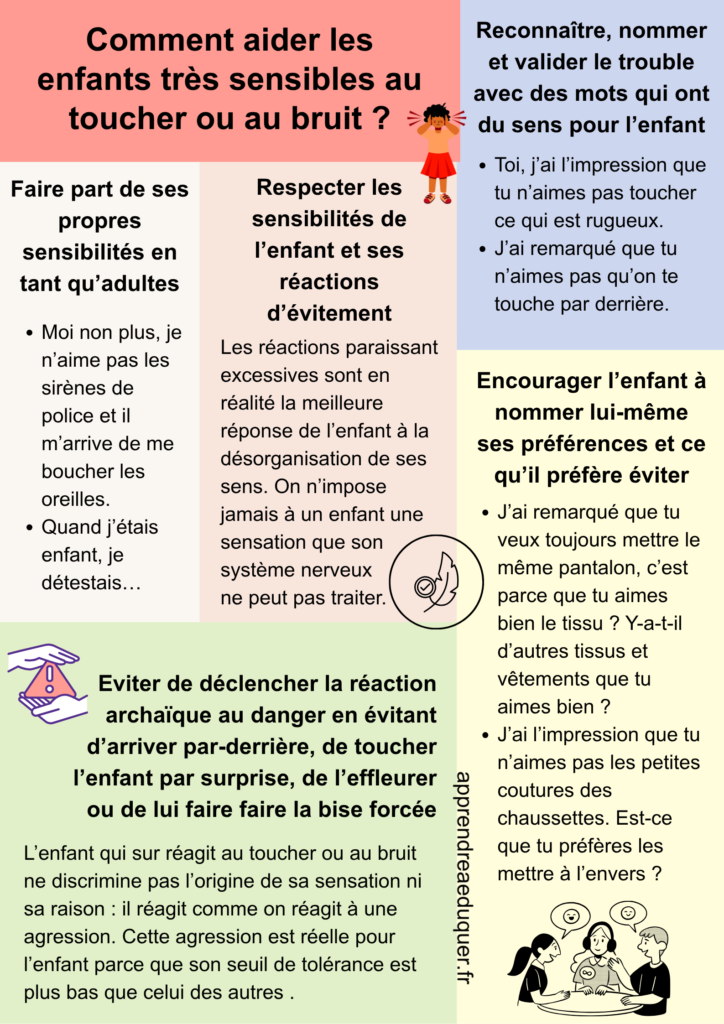
The first step is to observe and reflect back what you notice, using concrete language a child can grasp. Instead of a vague "you're too sensitive", try: "You don't like touching rough things, do you?" or "I've noticed you don't like being touched from behind." This validates the experience without judging it.
Naming the difficulty turns it into something shared and manageable rather than a mystery. It also signals that you are paying attention, which builds trust. Children who feel understood are far more likely to accept help and to explain what bothers them next time.
Why wording matters
Precise, neutral words avoid shame. A child hearing "you hate that jumper" may feel blamed; hearing "that fabric feels scratchy to you" feels like a fact you both can work with. This small shift is the foundation for everything that follows.
Sharing Your Own Sensitivities as an Adult
Adults can model self-awareness by admitting their own sensory limits. "I don't like police sirens either, and sometimes I cover my ears," or "When I was little, I hated scratchy labels," shows your child that sensitivity is normal and not a flaw.
This kind of honesty removes the pressure to "just get over it". It also gives your child permission to name their own reactions without embarrassment. You become an ally who understands rather than an authority who dismisses.
Modelling calm self-regulation, such as covering your ears or stepping away from a loud room, teaches a practical skill by example. If you are exploring gentle approaches to daily routines, our guide on baby sleep methods shows how environment and timing shape a child's comfort. For more everyday support, see these tips to learn English and our picks for the best toys.
| Situation | Common trigger | Kinder approach |
|---|---|---|
| Greeting relatives | Forced cheek-kiss | Offer a wave or high-five instead |
| Getting dressed | Scratchy seams and labels | Try inside-out socks, soft fabrics |
| Crowded places | Sudden loud noise | Warn ahead, bring ear defenders |
| Being approached | Touch from behind | Move into view and announce yourself |
| After a meltdown | Adult anger or blame | Discuss calmly later and plan together |
Encouraging Children to Name Their Own Preferences
Ask curious, open questions that help your child become an expert on their own body. "I've noticed you always want the same trousers. Is it because you like the fabric? Are there other fabrics you like?" This turns a habit into a conversation.
You can also offer practical experiments: "I think you don't like the little seams in your socks. Would you prefer to wear them inside out?" Small choices like this give the child control and reduce daily friction.
Over time, children learn to identify and articulate what they prefer to avoid, which is a valuable life skill. For younger children, choosing comfortable clothing from the start matters too; see these tips on newborn clothes for how fabric and fit affect comfort.
Respecting Sensitivities and Avoidance Reactions
Reactions that look excessive are often the child's best available response to a disorganised sensory system. The guiding principle is simple: never impose a sensation that the child's nervous system cannot process. Forcing a hug, a food or a texture teaches distrust, not tolerance.
Respect does not mean avoiding the world entirely; it means pacing exposure and letting the child lead where possible. You can offer alternatives, warn before transitions, and create a calm corner when things get too much. If you want to build a soothing, predictable environment, these ideas on conscious parenting complement this respectful approach. Small practical routines, such as using labels and stamps to reduce morning friction, can also lower daily stress.
Play can also be a safe way to explore sensation gradually. Toys with varied textures let a child experiment on their own terms; our reviews of toys for 1 year olds highlight options that are gentle on the senses. Even school routines can respect a child's pace, as when a school asks that children not be thrown over the fence if they arrive late.
Avoiding the Primitive Danger Response
The reaction to danger comes from deep within us. This spontaneous response from the more primitive part of the brain takes the form of fight, flight or freeze, and it once helped humans survive in a wild world. When danger is perceived, the nervous system goes on alert and reacts instantly.
A highly sensitive child's brain over-reacts and switches into danger mode far more often, because they perceive many everyday situations as threatening, cannot modulate sensations effectively, and over-interpret certain stimuli. A child who over-reacts to touch or noise does not distinguish the source of the sensation; they react as if to an attack, and that attack is real to them because their tolerance threshold is lower.
Practical habits that help
Avoid approaching from behind, touching the child by surprise, light brushing, or forcing cheek-kisses. Announce your presence, move into their line of sight, and ask before physical contact. These small habits prevent many meltdowns before they begin.
Practising "Cold" Problem-Solving Together
Discussing what happened later, when everyone is calm, lets you acknowledge the child's experience and give them a chance to express themselves and find an alternative for next time. This is far more effective than getting angry, punishing or shaming a child who only reacted to a danger they perceived.
Keep the conversation curious rather than accusatory: "What was hard about the party? What could we try next time?" Write down ideas together so the child feels ownership of the plan. Over time this builds problem-solving skills they can use independently.
A calm, predictable home rhythm supports this work. If you are thinking about the wider family atmosphere, these keys to a happy family offer useful perspective, and our guide to family stages helps you anticipate how needs shift as children grow.

My hands-on take
In my own home, the biggest change came from small habits rather than big conversations. I started announcing myself before entering a room and asking "can I have a hug?" instead of swooping in. My child visibly relaxed once touch stopped being a surprise.
I also learned to talk things through the next day, when the storm had passed. Sitting together and asking what felt hard about a birthday party gave us both a plan for the next one. It took patience, and I still get it wrong sometimes, but naming feelings out loud has made our days calmer and far more connected.
Frequently asked questions
Is my child just being difficult?
No. A highly sensitive child reacts to sensations their nervous system struggles to process, and the reaction feels real to them. Their tolerance threshold is genuinely lower, so what looks like over-reaction is a genuine response to perceived danger.
Should I force my child to tolerate hugs or textures?
It is better not to impose sensations the child cannot yet handle. Forcing contact teaches distrust, while gentle, gradual exposure on the child's terms builds confidence over time.
How can I prevent meltdowns in public?
Warn your child before noisy or crowded situations, avoid surprise touch, and offer a calm exit when needed. Discussing what happened afterwards, when everyone is calm, helps you plan together for next time.
Does sensitivity ever go away?
Sensitivity is part of how a child's nervous system is wired, so it usually stays but becomes easier to manage. With validation and coping strategies, children learn to recognise their limits and ask for what they need.
Product Reviews
 Best Toys for Dogs With High Prey Drive |
Best Outdoor Toys for 3-4 Year Olds |
Best Outdoor Toys for 6 Year Olds |
Best Harness for Poodle |
Best LEGO Sets for Adults |
Best Travel Toys for 4 Year Olds on Airplane |
Best Toy Stores in Washington DC |
Best Potty Training Toys |
Best Toys for Tripod Dogs |
Maillot equipe de france







