


Setting rules and limits for children under three works best when the message is short, positive and delivered at eye level. Toddlers cannot yet juggle several instructions at once, so the way you phrase a limit matters as much as the limit itself.
This guide walks through simple, practical adjustments: moving close to your child, acknowledging what they feel, replacing "no" with "stop", breaking tasks into steps and giving them a few seconds to respond. It also explains why the room itself often does half the work.

Quick takeaways
- Move close and crouch below your child's eye level before speaking.
- Name the feeling first, then hold the limit.
- Say what to do ("come down") instead of what not to do.
- Choose "stop" over "no" to avoid a power struggle.
- Give one precise instruction at a time and wait a few seconds.
- Childproof the room so fewer limits are needed.
Go to Your Child and Speak Face to Face
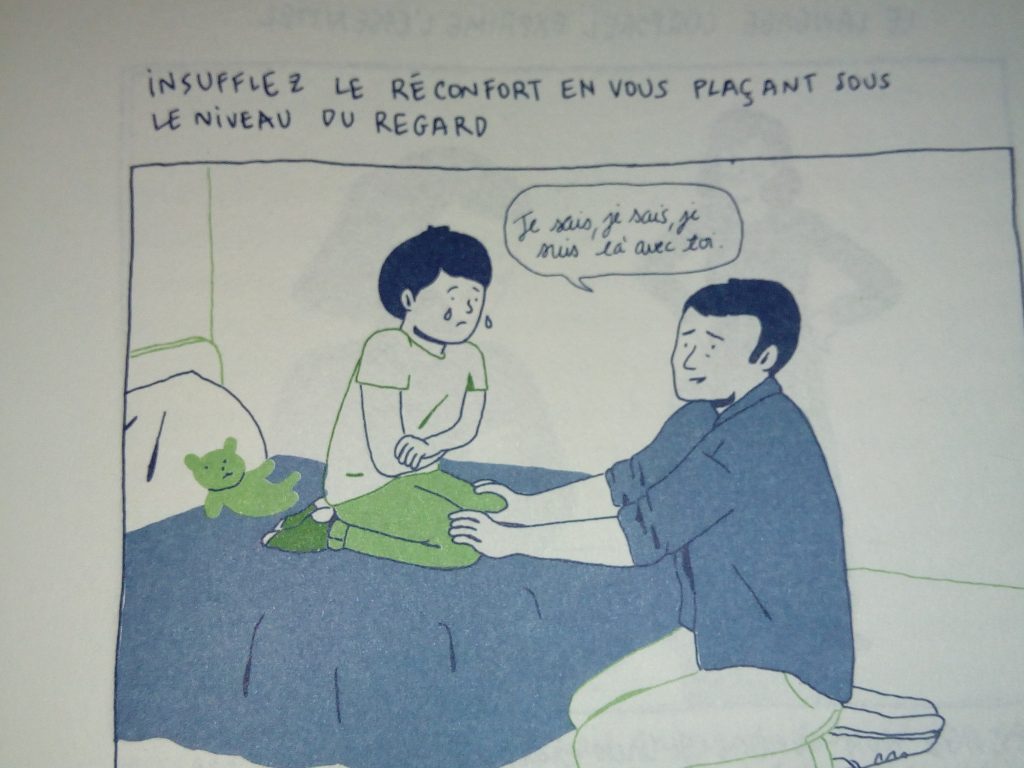
Rather than calling an instruction across the room or up the stairs, walk over to your child and deliver the message in person. Kneel or crouch so your face is level with theirs, ideally slightly below their eye line, and keep your body relaxed and calm.
Child-brain specialists Siegel and Payne point out that positioning yourself under the child's eye level, with a loose and soothing posture, is one of the fastest ways to inspire trust and remove any sense of threat. Before you even open your mouth, your body has already said a great deal.
This is also why a quiet, low voice beats a raised one. When you are close, you do not need volume to be heard, and a calm tone keeps the exchange from turning into a contest of wills.

Acknowledge Feelings Without Allowing the Behaviour
Adults sometimes dismiss a toddler's emotions as exaggerated or unfounded, yet those feelings are entirely real to the child. Connection comes first: a child who feels understood is far more likely to listen to what comes next.
Validating an emotion is not the same as permitting hitting, shouting, breaking things or hurting someone. Think of it as tuning your instrument to your child's so you can make something harmonious together. It takes effort, because the easy reflex is to deny or minimise what they are going through, which breaks the connection. The same principle applies when you choose playroom toys that invite calm, cooperative play.
Phrases that help
"It really seems to have hurt your feelings. I would have felt left out too." "I can see how furious you are, and no wonder." "You wanted to climb the slide, you missed the step, you fell and banged your knee. That was scary and it hurt."
| Instead of | Try | Why it works |
|---|---|---|
| Don't climb on the chair | Come down | Positive wording is easier to process |
| No! | Stop | Halts behaviour without a power struggle |
| Tidy your room | Pick up the toys on the floor | One clear step at a time |
| Stop crying | That really hurt, didn't it | Names the feeling and keeps connection |
| Calling from the kitchen | Kneel beside your child | Face-to-face contact builds trust |
For older siblings, open ended STEM toys can channel big feelings into focused, hands-on play.
Say What To Do, Not What To Avoid
Linguistically, a young child processes a negative sentence with more difficulty than a positive one, because negation requires a more complex mental gymnastic. Simply saying "Come down" is more effective than "Don't climb on the armchair."
Where you need to halt something, prefer "stop" to "no". "Stop" interrupts an unsuitable behaviour, while "no" tends to feed a power struggle and a more conflict-driven dynamic. You may have noticed your own face is more closed, with furrowed brows, on "no", whereas "stop" tends to produce raised brows and a state of alert attention, as child psychologist Héloïse Junier observes.
Positive phrasing also gives your child something to do rather than something to resist, which keeps the moment calmer for both of you. These everyday parenting values grow through small, repeated exchanges like these, and they pair well with the best toys that invite cooperative, hands-on play.

Give One Instruction at a Time
Young children cannot hold several pieces of information in mind at once, rank them or plan their actions, because the prefrontal brain is still immature. Break instructions into stages and pass them on step by step. A specific, precise instruction also works better, since naming what is expected helps the child move into action.
"Tidy your room" can become three separate requests: "Pick up the toys on the floor," then "Put them in the toy chest," then "Put the books on the shelf." If you are choosing learning toys for a two-year-old, keep the same logic in mind and offer only a few at a time so the choice stays manageable. The same step-by-step approach applies when picking out screen free toys for older children.
Once the instruction is out, wait a few seconds. Junier reminds us that young brains are slower than adult ones: the axons linking neurons are not yet well myelinated, and myelin, the sheath that lets the electrical signal travel faster from cell to cell, builds up gradually as the brain matures. Patience is part of the instruction, just as it is when treating skin bumps calmly and without rushing.

Step In Gently and Use Your Body
Children live more in action, in the concrete and the physical, than in the mental, so they struggle to connect words with gestures. If a child cannot carry out "Come down from the armchair," you can accompany them physically and gently down to the floor.
Keep in mind that the most precious link is non-verbal. A touch with a loving, caring intention, whether discreet like holding a hand or stroking the head, or more demonstrative like a hug, can quickly bring the emotional temperature down. The same calm presence helps when sibling fights flare up and you need to separate two children without shouting.

Adapt the Room Instead of the Child
It is not the child's job to adapt to the adult environment; it is the adult's job to offer a safe space suited to the child's needs. Young children need to physically explore their surroundings to develop well, and they cannot yet inhibit their impulses, as Junier points out. Montessori pedagogy leans heavily on this principle.
In practice, that means putting breakables out of reach, securing shelves, and offering a yes-space where climbing and grabbing are allowed. A few outdoor toys in the garden, or a low basket of pretend play items indoors, give a toddler legitimate things to explore instead of constant corrections.
Rotating what is available keeps novelty high without clutter, and it reduces the number of limits you have to enforce in a day.
My hands-on take
I learned the eye-level trick almost by accident. After weeks of repeating "don't touch" from across the kitchen, I started kneeling down, saying "stop" once and then waiting. The change was not instant, but the shouting dropped noticeably, mostly because I had stopped shouting.
What surprised me most was how much the room mattered. Once I moved the breakable things up a shelf and left a low basket of toys within reach, half of my daily "no" simply disappeared. I still forget to wait those few seconds before repeating an instruction, but when I do remember, my child usually gets there on their own.
Frequently asked questions
Why does my toddler ignore me when I give an instruction?
Young brains process language more slowly, because the nerve fibres are not yet fully insulated. Move close, say one short positive instruction and then wait a few seconds before repeating yourself.
Is validating emotions the same as letting bad behaviour slide?
No. You can accept the feeling while still stopping the action. Name what your child seems to feel, then gently hold the limit, for example by moving them away from the person they hit.
What should I say instead of "no"?
Try "stop" for behaviour you need to interrupt, and a positive instruction for what you want instead. "Stop, the wall is not for drawing, here is paper" gives your child a clear next step.
Do I really need to change my home for a toddler?
It helps enormously. Children under three cannot yet hold back impulses, so removing temptations and creating a safe yes-space means fewer corrections and calmer days for everyone.
Product Reviews
 Best Toys for Dogs With High Prey Drive |
Best Outdoor Toys for 3-4 Year Olds |
Best Outdoor Toys for 6 Year Olds |
Best Harness for Poodle |
Best LEGO Sets for Adults |
Best Travel Toys for 4 Year Olds on Airplane |
Best Toy Stores in Washington DC |
Best Potty Training Toys |
Best Toys for Tripod Dogs |
Maillot equipe de france







