


Mirror play is one of the simplest Reggio-inspired activities you can set up at home, and it opens up a surprising number of possibilities for young children. The Reggio Emilia approach, named after the Italian town where it began, treats art, light and reflection as real languages children use to think and express themselves.
You do not need special training or expensive equipment. A large mirror, a few natural materials and some building blocks are enough to start. Here is how the approach works and how to try it with your own child.

Quick takeaways
- A large mirror works as a sorting surface, an art canvas and a reflection tool.
- Natural materials such as wood, pebbles and shells suit the Reggio approach best.
- Reflections introduce symmetry, height, perspective and angles through play.
- Offer attractive material, then step back and let your child lead.
- Rotate materials instead of presenting everything at once.
- Malaguzzi’s “hundred languages” remind us to value play, art and imagination together.
What the Reggio Approach Adds to Playtime
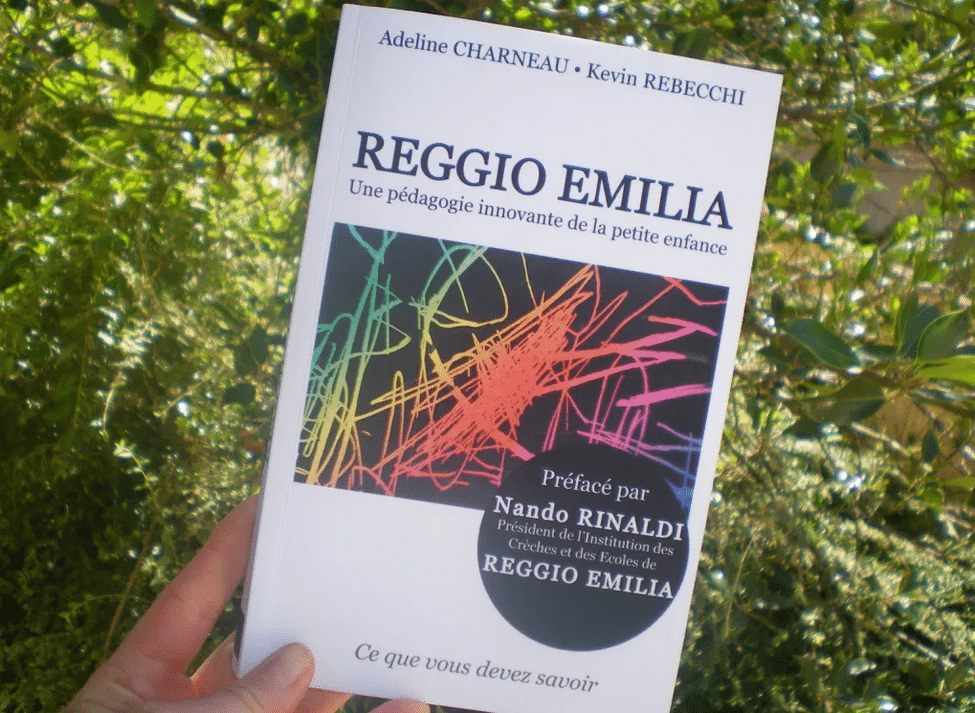
Loris Malaguzzi, the founder of this educational model, stressed artistic activities because children gain many “symbolic languages” through painting, music, puppets, theatre and other creative disciplines, including construction play and games of shadow and light. Much of the documentation is in English, so the approach is still little known in some countries, yet several elements are easy to set up at home.
These include working on a light table, mirror games, shadow and light games, building blocks, puppets and pouring activities. If this way of approaching education interests you, a dedicated discussion group or a good introductory book can help you go further.
Start with one simple material
The philosophy is not about buying more. It is about offering attractive, well-thought-out material and then stepping back. A single large mirror is a perfect first step, and if you want to extend the idea to building play later, these best toys for four year pair naturally with a reflective surface.
A Mirror as a Work Surface
The first and most straightforward use is to treat the mirror as a table. Children can sort buttons, beads, marbles or shells by colour or by size directly on the glass, and the reflection doubles every piece, which makes counting and comparing more interesting.
Natural materials work especially well here. Smooth pebbles, wooden pieces and shells invite handling, and the doubled image encourages children to look from different angles. Any small object can go on the mirror, so the activity grows with whatever you already have at home, much like the best outdoor toys that reward open-ended exploration.
Keep it open-ended
One Reggio principle is that children do not always need directions. They need material that is attractive and flexible enough not to limit imagination. Set out the objects, show your child that the mirror can be used for play, and then let them decide what happens next. For older children, a mirror can even become a base for building a LEGO ornament and watching its reflection.

| Setup | What you need | What children explore |
|---|---|---|
| Sorting surface | Beads, buttons, shells | Colour, size, counting |
| Building base | Wooden blocks, arches | Symmetry, height, perspective |
| Art canvas | Finger paint, markers | Mark-making, self-portrait |
| Light play | Mirror, torch, window | Reflection, shadow, direction |
| Multi-mirror play | Two or more mirrors | Angles, repetition, viewpoint |
Exploring Dimensions and Perspective
A mirror is also a discovery tool. When a child builds on top of it, the construction is reflected below, and the image changes with every block added. This is a gentle, hands-on introduction to perspective, height and symmetry.
Wooden construction sets are ideal for this. A rainbow arch, for example, becomes a full circle once its reflection appears, which is visually striking and invites repetition. Combining a mirror with building toys lets children meet geometry concepts without a single worksheet, and the same logic applies to any lego brick height comparison they make while stacking.
You can also play with an image or a light source repeated across several mirrors to see the same object from different angles. Even one mirror placed upright behind a small construction changes the whole scene.

A Mirror as an Art and Light Canvas
Beyond building, the mirror can be a creative surface. Children can paint directly on it with finger paint, draw on it with suitable marker pens, or trace their own reflection. The smooth surface feels different from paper and encourages bold, experimental marks.
It can also bounce light. Placed near a window or a lamp, it sends reflections across the room and lets children chase and catch them. Games of shadow and light belong to the same family of activities and need nothing more than a torch and a dim corner.
Choose colours and materials with care
In Reggio-inspired practice, bright colours and natural materials such as wood are preferred, ideally combined with light. If your child enjoys small construction figures alongside the mirror, a few transformers movie toys or similar characters can be reflected and rearranged too, though natural materials remain the core of the setup.

The Hundred Languages of Children
Malaguzzi described the child as made of a hundred: a hundred languages, a hundred hands, a hundred thoughts, a hundred ways of thinking, playing, speaking, listening, wondering and loving. In his poem, he argues that school and culture often take ninety-nine of these away, separating head from body and telling children to think without their hands and listen without speaking.
The poem insists that play and work, reality and fantasy, science and imagination, reason and dream are not opposites. Mirror play sits exactly at that crossroads: it is playful and mathematical, artistic and physical at the same time.
That is why the adult’s role is mostly to prepare and observe rather than instruct. The same spirit shows up in practical life tasks, such as the housework by age children can genuinely handle, where doing rather than being told is what builds understanding.

Setting Up Your First Mirror Invitation
Choose a large, safe mirror and place it flat on the floor or on a low, stable surface. Explain simply that it can be used for playing on. Then offer one category of material at a time: beads one day, wooden blocks the next, finger paint on another.
Rotate the materials rather than piling everything out at once, and photograph what your child creates so the play can be revisited. Keep the setup accessible so it can be returned to independently, much as you would arrange a small shelf of cause and effect toys that a child can reach without help. For families with twins, these twins sleep routines can help you plan calm, predictable play sessions.
If you are building a wider play area, a reflective corner fits well beside other open-ended options, and browsing ideas for outdoor toys for toddlers can help you extend the same philosophy beyond the mirror. For fresh inspiration on guiding your child's development, explore these parenting TED Talks.


My hands-on take
I started with one large mirror and a short explanation: this is for playing on. My child needed no more than that. The first session was mostly about touching the glass and watching her own hand move, and only later did the beads and wooden blocks come out.
What surprised me was how long the mirror held attention compared with a plain table. The reflection gave every object a second life, and I found myself saying far less than usual, which is exactly the point. If you try one thing this week, make it a mirror on the floor and a small bowl of natural objects.
Frequently asked questions
Do I need special Reggio materials to try mirror play?
No. A large mirror plus objects you already own, such as beads, shells or wooden blocks, is enough. The approach values natural materials and open-ended possibilities more than specific products.
Is a mirror safe for a young child to play on?
A large mirror should be flat, stable and supervised, and edges should be protected. Place it on the floor or a low surface rather than propping it loosely against a wall.
What age is mirror play suitable for?
It adapts to a wide range, from toddlers sorting objects to older children exploring symmetry and perspective. Simply adjust the materials and the amount of guidance you offer.
Can mirror play support maths learning?
Yes, indirectly. Sorting, comparing, stacking and observing reflections all build early ideas about size, symmetry, height and angles without formal instruction.
Product Reviews
 Best Toys for Dogs With High Prey Drive |
Best Outdoor Toys for 3-4 Year Olds |
Best Outdoor Toys for 6 Year Olds |
Best Harness for Poodle |
Best LEGO Sets for Adults |
Best Travel Toys for 4 Year Olds on Airplane |
Best Toy Stores in Washington DC |
Best Potty Training Toys |
Best Toys for Tripod Dogs |
Maillot equipe de france







