


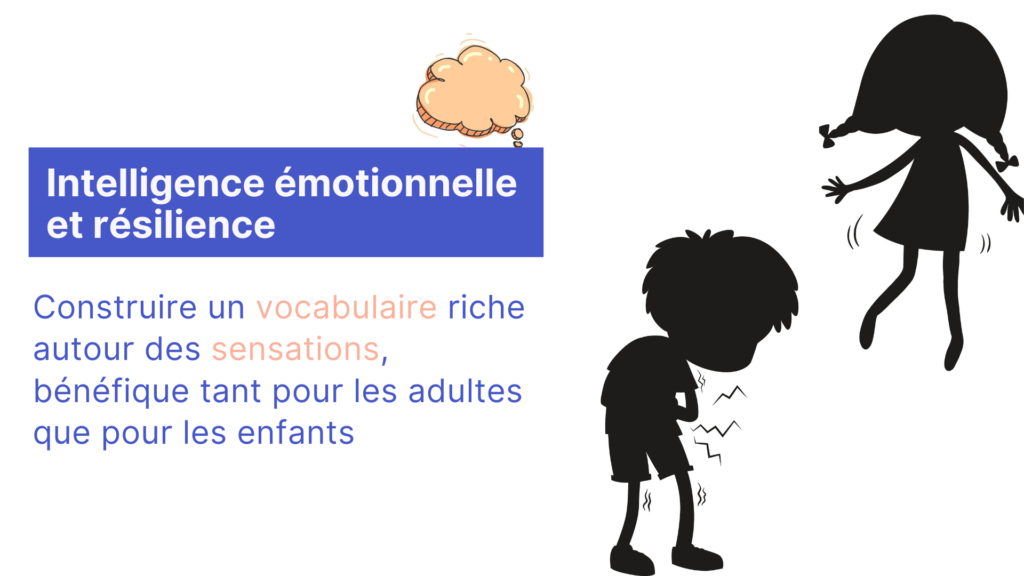
Building a sensation vocabulary is one of the most practical ways to support emotional skills in adults and children alike. The words we use for what happens inside the body shape how well we understand ourselves and how clearly we communicate with others.
Naming sensations supports emotional health, creative expression and learning. A richer word list makes it easier to navigate complex feelings and to build deeper, more authentic connections with ourselves and with the people around us.

Quick takeaways
- Sensations can be neutral, pleasant or unpleasant, and all three carry useful information.
- Naming body sensations is the first step of emotional intelligence.
- Unpleasant sensations alert us to danger, loss, injustice or loss of control.
- Pleasant sensations show us where our energy and enthusiasm come from.
- Guiding questions help a frightened child describe what is happening in the body.
- Pointing out changes afterwards teaches that sensations pass.
Why Body Awareness Comes Before Emotional Skills
Emotional skills and resilience grow from work on the body, on sensations and on the words we attach to them. A rich sensation vocabulary makes us more aware of ourselves, and self-knowledge depends on listening to the body: recognising, identifying and naming the sensations that accompany emotions.
Sensations can be neutral, pleasant or unpleasant, and all three kinds are useful. Unpleasant sensations alert us to possible danger, to a threat to our integrity, to loss, injustice or a sense of losing control. Pleasant sensations help us identify our sources of energy and enthusiasm.
Having precise words for sensations lets us read the messages the body sends, understand their influence and use them wisely when making decisions. People of every age benefit from being able to express exactly what is happening in their body. Parents who practise this often find it easier to conscious parenting in daily life, because they notice their own state before reacting.
A Vocabulary List for Unpleasant Sensations
Unpleasant sensations deserve names too, because ignored sensations can settle in the body and harden into trauma. The list below is neither exhaustive nor prescriptive; it is meant to be enriched and adapted to your own family. For children who process the world differently, knowing how to interact on the Autism spectrum can make this naming work gentler.
Temperature words come first: icy, freezing, frozen, cold, cool, damp, clammy, hot, boiling, burning, scorching. Then come instability words such as unsteady, restless, bubbling, wobbly, swaying, and heaviness words such as dark, dull, heavy, hard.
Words for the Body’s Alarm Signals
Other entries describe emptiness, loneliness, weariness, weakness, feeling stuck or glued, tense, tight, compressed, tired, irritable. Physical signals are especially useful: knotted stomach, clenched jaw, choppy breathing, blocked breath, tight throat, goosebumps, tears in the eyes, cold sweats, nausea, a sinking feeling, feeling on alert, prickly like a hedgehog, wanting to disappear, flee or hide, feeling like you are sinking, dizziness, blurriness, numbness, paralysis, pain, sharp or stinging sensations, itching and tingling. Hands-on play with foam block toys can give these feelings a safe outlet.
| Area of the body | Question to ask | What it may reveal |
|---|---|---|
| Stomach | How does it feel in your belly? | Knots, emptiness, butterflies |
| Throat | Does your throat feel tight? | Blocked breath, held-back tears |
| Chest | Is the air passing easily? | Tightness, pressure, suffocation |
| Muscles | Are your muscles hard or painful? | Tension, trembling, alertness |
| Balance | Do you feel shaky or off balance? | Dizziness, instability, fear |
Words for Pleasant Sensations
Pleasant sensations are just as important to name, because they show us where energy and enthusiasm come from. Simple words work well: flat, round, tranquillity, relaxation, calm, peace, serenity, butterflies in the stomach, tickling, fizzing, rumbling, foaming, silky, soft.
Strength words include vigour, vitality, dynamism, energy, power, ardour and drive. Lightness words include openness, expansion, gentleness, freedom, amplitude, and the impression of floating or flying. Naming these moments out loud teaches children that good sensations are worth noticing, not only difficult ones.
This is where play becomes a natural teaching tool. Games that invite children to describe how their body feels while moving, building or pretending give them a relaxed context to practise. Even a simple session with foam block toys can become a moment for “does this feel heavy or light in your hands?”
Helping a Child Name Body Sensations
Sensations are different from emotions but they accompany them. Naming body sensations with a rich vocabulary helps children so that ignored sensations do not become locked in as trauma. When a child is frightened, invite them to describe what is happening in the body: where is it happening, how does it feel, what does fear look like inside you?
If the child struggles to describe it, adults can ask guiding questions. How does it feel in your stomach, and in your throat? How does it feel in your chest: is it all tight, does the air pass with difficulty, would you say it is tense? Is there a place in your body that feels empty, or as if something is stuck? Are your muscles hard and painful? Do you feel off balance or shaky?
You can also reflect what you observe: “I see you are restless, you are trembling and your hands are frozen. Does it feel cold anywhere else?” Stay close calmly, offering a warm, supportive, containing presence, with a hug if the child accepts it. Respect a wish not to be approached or touched, while staying open to signs that the child has changed their mind. Some children show this readiness through baby sign gestures or simple words rather than speech. Just as adults notice cravings during pregnancy, children can learn to notice body signals, and simple tummy time toys can support early body awareness.

Pointing Out the Changes Afterwards
After a few minutes, point to the changes in the body: has the temperature of the hands changed, has the feeling of suffocation decreased, what does the emptiness look like now? This gentle follow-up teaches that sensations move and pass, which is the heart of resilience.
Welcoming and naming the sensations that accompany emotions is the first step of emotional intelligence. Sensations give indications about the nature and intensity of emotions, and knowing that sensations are not dangerous and eventually pass helps us avoid being disorganised or overwhelmed, collapsing, panicking or turning to violence.
Unpleasant sensations are painful to live with, but they are only a manifestation of a body seeking balance and life. They are never the final stage. When we adults can feel that fluidity in our own body, the shift from tension to relaxation, we become more able to understand what children are going through. The same patience helps at home with several children at once, as these parenting tricks for two babies suggest.
Making Sensation Words Part of Family Life
Vocabulary grows through repetition, not through lessons. Use sensation words in everyday moments: while cooking, during bath time, on a walk. Ask “is the water warm or cool on your hands?” rather than quizzing the child, and share your own sensations so the habit feels normal.
Stories, drawings and role-play give children another route into the vocabulary. A child who can say “my chest feels tight” has a tool that a child who only knows “I’m fine” does not. Stories and books and quiet importance of play moments both create space for this language to appear naturally.
Keep the tone curious rather than corrective. There is no wrong sensation, and no perfect word. The goal is simply to widen the shared vocabulary so that children have more ways to describe their inner world, and so that adults can respond with more understanding.

My hands-on take
I started using sensation words with my own children almost by accident, during a stormy evening when one of them was frightened. Instead of asking why they were scared, I asked where they felt it. The answer was “my tummy is all tight and my hands are cold”. Just putting words to it seemed to loosen something, and we talked about how the tightness might change in a few minutes.
Since then, I try to name my own sensations out loud, even the unpleasant ones. It feels a little awkward at first, but it has changed the tone of difficult moments at home. I keep a short list of words on the fridge and add to it whenever we find a better one.
Frequently asked questions
What is a sensation vocabulary?
It is a set of words used to describe what happens in the body, such as tight, warm, heavy or light. A rich vocabulary helps both adults and children understand and express emotions more precisely.
Are sensations the same as emotions?
No. Sensations are different from emotions but they accompany them. Sensations give clues about the nature and intensity of an emotion, which is why naming them is a first step.
What if my child cannot describe what they feel?
Offer simple guiding questions about specific body areas, such as the stomach, throat or chest. You can also reflect what you observe, for example trembling hands or a tight jaw.
Why point out changes after a difficult moment?
Noticing that a sensation has shifted shows the child that sensations are not dangerous and that they pass. This supports resilience and reduces the risk of feeling overwhelmed.
Product Reviews
 Best Toys for Dogs With High Prey Drive |
Best Outdoor Toys for 3-4 Year Olds |
Best Outdoor Toys for 6 Year Olds |
Best Harness for Poodle |
Best LEGO Sets for Adults |
Best Travel Toys for 4 Year Olds on Airplane |
Best Toy Stores in Washington DC |
Best Potty Training Toys |
Best Toys for Tripod Dogs |
Maillot equipe de france







