


Exploring ambivalent emotions with kids becomes much easier when you turn feelings into a game, and a short poetic text is a gentle way to start. Children often feel two things at once, and giving that experience a name helps them understand themselves.
This activity borrows a clever trick from poetry: mixing two set expressions from two different emotions to create a brand-new word. A child who is sad and scared at the same time gets a label like "peurtriste," and suddenly the confusing tangle makes sense.

Read the text aloud, talk about what feels funny or surprising, then invite children to invent their own blended emotion words and the situations that spark them.
Quick takeaways
- A short poem can show children that two emotions can coexist.
- Blending two emotion words creates a label for a confusing feeling.
- Swapping endings between two expressions is the playful core of the game.
- Word banks of adjectives and idioms make writing much easier.
- Describing a real situation anchors each invented word in experience.
- Group writing and reading aloud turn the exercise into a shared game.
The Poetic Text: Two Feelings in One Word
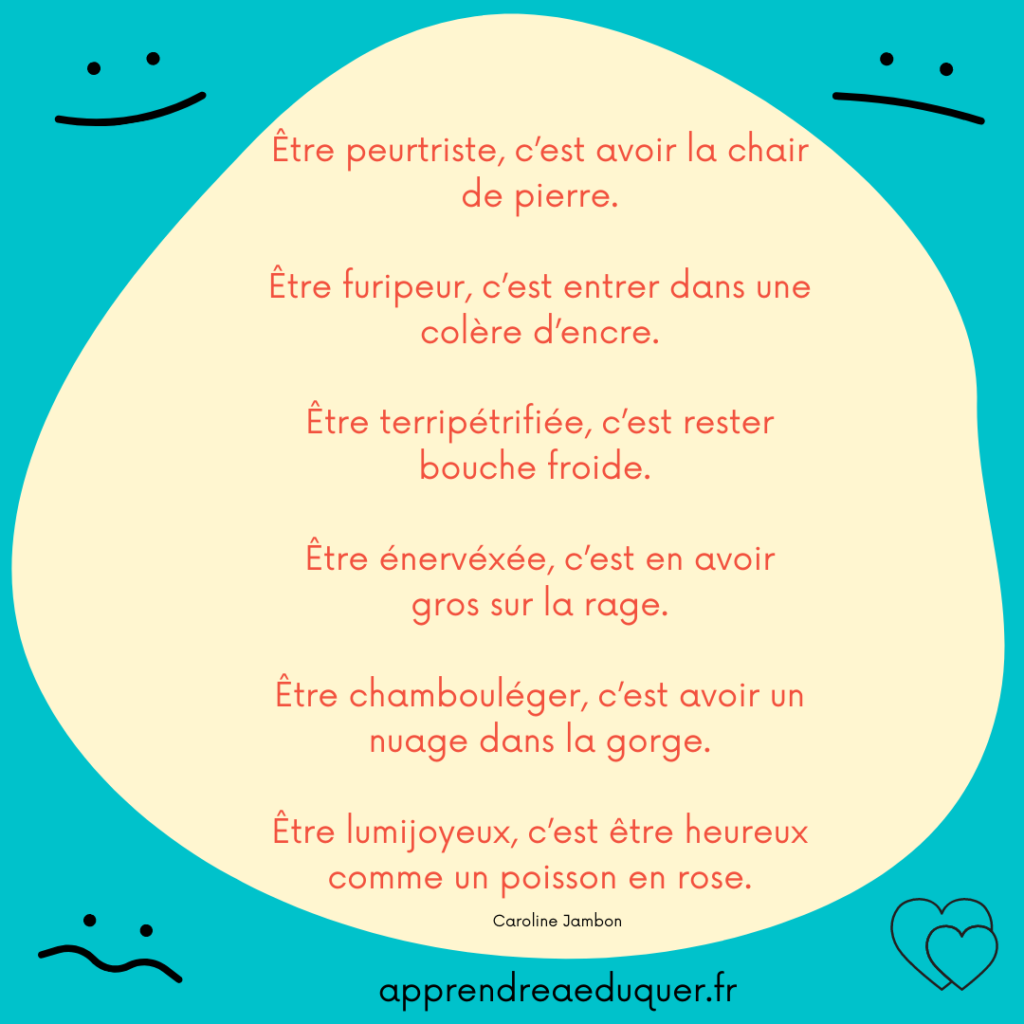
The idea comes from a poem that playfully swaps the objects of two phrases, turning a "watch in gold" into a "watch in mourning." In the same spirit, this text mixes two fixed expressions, one from each emotion, to describe what it feels like when both show up together.
Being "peurtriste" means being unhappy as a hen and having skin of stone. It is like when your friend stops talking to you: you are crushed at the thought of losing the friendship and frightened by loneliness.
Being "furipeur" means flying into an ink-black rage and making your blood run black. It is like when your parents are late picking you up: you are angry with them and afraid they forgot you.
More Blended Feelings
Being "terripetrified" means having cold sweats and staying frozen-mouthed, like meeting a dog in the street: surprised because you did not expect it, and scared it might bite. Being "chambouléger" is being on a little ball with a cloud in your throat, like coming home from vacation, sad it is over and happy it happened.
Talking About the Text Together
After reading, ask children what they find surprising or funny. Most will notice the invented words right away and enjoy spotting which two expressions were fused together. Let them guess before you explain.
This is also a natural moment to build emotional vocabulary. Name the primary emotions involved and ask whether they have ever felt two at once, like being excited and nervous before a school show. Pairing the poem with happy childhood conversations shows children that all feelings are welcome. These shared moments matter, because the time we spend together becomes their memory tomorrow.
For younger children, keep it physical: act out the situations and let them show the mixed feeling with their face and body. Sensory games work well here, and these sensory stimulation games can extend the theme through touch and movement. For a calmer follow-up, try some of the cheapest board games as a family.
| Emotion pair | Blended word | Example situation |
|---|---|---|
| Sadness and fear | peurtriste | A friend stops talking to you |
| Anger and fear | furipeur | Parents are late picking you up |
| Surprise and fear | terripetrified | Meeting an unfamiliar dog |
| Anger and sadness | énervéxée | Not managing to do what you want |
| Sadness and joy | chambouléger | Coming home from vacation |
The Creative Word Game Step by Step
First, invite each child to pick two emotions that often appear together. Second, ask them to invent one new word by blending the two emotion words, the way the poem does. Third, have them choose one fixed expression for each emotion, then swap the objects or adjectives between the two expressions.
Finally, ask them to describe a real situation where that mixture shows up. A child who cannot finish what they want might be "énervéxée": boiling with heart and heavy with rage, angry at themselves for failing and sad it is not going as hoped.
Writing is easier with support, and children still building literacy benefit from learning to write strategies like dictating to an adult first. Working in a group and reading the invented texts aloud adds a playful, performative layer that children love.
Vocabulary Lists to Spark Ideas
Give children word banks so they are not searching for language from scratch. Offer adjectives for joy, such as calm, confident, light, proud and radiant; for anger, such as annoyed, tense, furious and enraged; for fear, such as worried, panicked and terrified; and for sadness, such as hurt, discouraged, lonely and gloomy.
Add surprise words like stunned, puzzled and impressed, and disgust words like uncomfortable and repulsed. Then provide the matching expressions: "on cloud nine," "green with rage," "trembling with fear," "broken-hearted," "struck with amazement."
Children then experiment by swapping the endings between two expressions. Encourage silly combinations, because laughter lowers the pressure and keeps the focus on language rather than performance. Reading rich picture books, like these Benji Davies books, quietly feeds the same vocabulary bank. Just as preparing for the school route builds everyday confidence, a steady word bank builds emotional confidence.
Why Mixed Feelings Matter for Children
Children are often told to pick one emotion, yet real life rarely works that way. Naming a blend validates what they actually experience and reduces the sense that their feelings are wrong or contradictory.
This matters for emotional balance and for the confidence children carry into daily life. Simple rituals, such as a shared board game or a story at bedtime, create the safe space where these conversations happen naturally; these board games about equality are a good example of play that opens discussion. Everyday choices, from spring fashion picks to shared games, can also spark easy conversation.
The activity also builds empathy: once a child has invented a word for a mixed feeling, it is easier to imagine that someone else feels something similar. That is a small but real step toward understanding others.

My hands-on take
I have tried this with children who usually shrug at "how do you feel?" questions, and the invented words changed the tone completely. Once a child had a silly word to hold onto, the conversation stopped feeling like a test and started feeling like play.
The part that surprised me most was how quickly children connected their new words to real moments. One child proudly explained a mixed feeling about a swimming lesson, and the whole group nodded along. I keep the vocabulary lists handy now, because the writing flows far better when the words are already on the table.
Frequently asked questions
What age is this activity suitable for?
It works best with children who can read and write simple sentences, though younger ones can join by dictating their ideas to an adult. The reading itself can be shared with children as young as five or six.
Do I need to prepare the vocabulary lists?
Yes, having word banks ready makes a big difference. Children get stuck when they have to invent both the feeling and the language at once, so offering adjectives and expressions frees them to focus on the mixing.
What if a child cannot think of a situation?
Suggest everyday moments like a first day at school, a lost toy or a birthday ending. Once one example is offered, children usually generate several more on their own.
Can this be done with a group?
Absolutely. Writing together and reading the invented texts aloud turns it into a game, and hearing other children's combinations often sparks new ideas.
Product Reviews
 Best Toys for Dogs With High Prey Drive |
Best Outdoor Toys for 3-4 Year Olds |
Best Outdoor Toys for 6 Year Olds |
Best Harness for Poodle |
Best LEGO Sets for Adults |
Best Travel Toys for 4 Year Olds on Airplane |
Best Toy Stores in Washington DC |
Best Potty Training Toys |
Best Toys for Tripod Dogs |
Maillot equipe de france







