


Building self-esteem in children is one of the most useful things a parent can do, because a high and healthy sense of self-worth shapes how a child makes choices, copes with setbacks and stands up for what matters.
People with solid self-esteem believe they are capable and worthy. They tend to act in line with their emotions and values, recover from disappointment and keep going toward goals they have set for themselves. A child with healthy self-esteem can say a firm yes to their own limits and a firm no to what hurts their values.

Self-esteem is fed daily through small interactions: feeling loved, feeling useful and feeling competent. The ideas below show how ordinary moments can carry that message.
Quick takeaways
- Welcome feelings before correcting behaviour; it protects a child's inner compass.
- Help only when needed, and show rather than do it for them.
- Give trust first; control and trust cannot coexist.
- Allow small risks so children can build real competence.
- Praise honestly and name limits as well as strengths.
- Use play and daily tasks to feed feeling loved, useful and capable.
Welcome your child's emotions
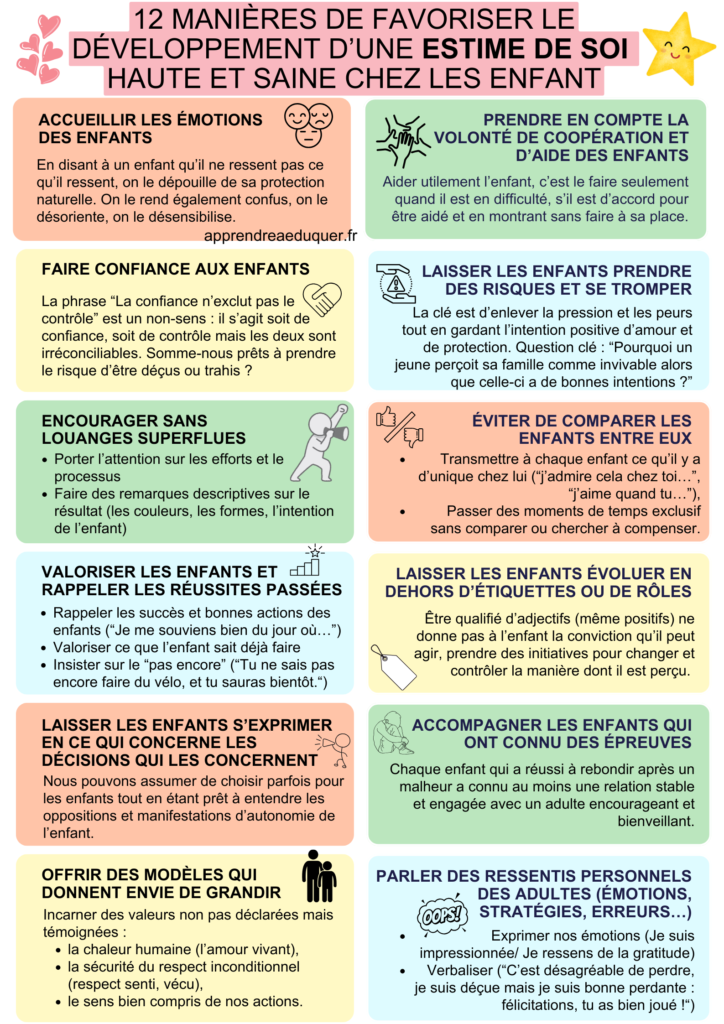
Teach a child to trust their own perceptions and to listen to their inner voice: "If I feel something, there may be something real in what I feel." When we tell a child they do not feel what they feel, we strip away their natural protection. We also confuse them, disorient them and desensitise them.
As Faber and Mazlish point out, denying a child's feelings forces them to build a false world of words and defence mechanisms far from their inner reality, separating them from who they are. Accepting emotions does not mean accepting every behaviour; it means acknowledging the feeling before setting limits on the action. Acknowledging feelings also makes room for honest conversations when something is troubling them, much like the careful listening needed in difficult family moments.
Name it, then guide it
Try reflecting back what you hear ("you seem really frustrated") before offering help or a rule. This small habit tells a child their inner world is real and worth paying attention to.
Notice their wish to cooperate and help
It is tempting to do things for children because it is faster: letting a child dress alone or tie their own laces takes more time. But helpful support is not the same as doing it for them. When we take over something a child can already do, or stop them from learning, we get in the way of their natural development.
Useful help means stepping in only when the child is struggling, when they agree to be helped, and by showing rather than doing it in their place. Give responsibilities and signs of trust: "I'm putting you in charge of…", "I trust you to…". Invite their help instead of brushing it aside to avoid mess: "Would you like to help me by doing…?", "How could we do this? Any ideas?" This cooperative approach also shapes how you handle dog training alongside children.
Even small daily tasks, like choosing a toy to tidy away or picking a first birthday toy for a younger sibling, build the feeling of being useful. Fine motor tasks like these are a great place to start, and the best fine motor toys can make them even more engaging.

| Situation | Less helpful response | More helpful response |
|---|---|---|
| Child is upset | "You're fine, stop crying" | "You seem really upset; tell me more" |
| Child dresses slowly | Adult dresses the child | Allow extra time, help only if asked |
| Child makes a mistake | "You always get it wrong" | "That was hard; what would you try next?" |
| Child offers to help | "Not now, you'll make a mess" | "Yes, you can hand me the plates" |
| Child wants independence | Constant checking and controlling | Agree on a clear limit, then step back |
Trust them before they prove themselves
Trust does not have to be the result of reliable behaviour; the reverse is often true. Giving trust without conditions or expectations can change the dynamic of a relationship, because trusting someone before they prove themselves can encourage trustworthy behaviour, a kind of self-fulfilling prophecy.
If we need to control in order to trust, that is not trust. "Trust but verify" is a contradiction: it is either trust or control, and the two cannot be reconciled. Leaning toward control often comes from fear of being disappointed or betrayed, from worry about what others think, or from a sense of parental responsibility.
The problem is that instead of openly sharing our emotions, fears and values in our own words, we slide into controlling the child through punishment, rewards or bargaining. Naming our real concern ("I worry when you are late") keeps the relationship honest and leaves room for trust to grow.
Let them take risks and get it wrong
Overparenting is the tendency to do too much and want everything done perfectly, sometimes doing things in the child's place or without asking their opinion. It is a feature of modern societies in several ways: births are almost all desired and more or less planned, and there is particular pressure around children's achievement and safety.
Protecting a child from every bump removes the very experiences that teach competence. A child who is allowed to try, fail and try again learns that a poor result is disappointing but does not reduce their worth as a person deserving of love. That distinction matters: with low self-esteem, a bad performance damages the child's self-image; with healthy self-esteem, it is simply information.
Letting children test small freedoms, whether a short walk, a new game or a challenging foam block toy build, shows them you believe they can manage.

Separate performance from worth
People with good self-esteem recognise their qualities without false modesty or inflated ego, and they are equally aware of their limits. Help your child name both: what they did well and what they found hard. This keeps praise honest and keeps failure in perspective.
When a child is upset about a result, acknowledge the disappointment first, then gently remind them that the result describes a task, not a person. Avoid comparisons with siblings or classmates, which turn achievement into a competition for love.
Children also need calm, predictable routines to feel secure, and everyday care tasks, from potty training toys to bedtime rituals, are chances to show confidence in their growing independence.
Build confidence through play and daily life
Play is where children rehearse competence: choosing, building, negotiating and starting again when something collapses. Offer materials and time rather than instructions, and let your child lead the game. A few open-ended items, such as a travel toy kept for journeys or a simple construction set at home, give plenty of room for that kind of self-directed play.
Outings work the same way. Letting a child help plan a family walk, carry a small bag or choose the route builds the sense of being capable and trusted. Even a simple afternoon together, like the kind of family outing that has no fixed agenda, teaches children that their company and ideas matter.
And when a child is struggling with something that looks easy to us, remember that difficulty is real for them; patience now protects their willingness to keep trying later, an idea explored in why easy things can feel so hard. Sometimes that struggle is really a wish to be small again, and meeting it gently helps.

My hands-on take
In my own home, the hardest habit to change was speed. Letting my child put on shoes alone meant leaving ten minutes earlier, and for a while I simply did it for them. When I started building in that extra time, the arguments about getting ready mostly faded, because the task had become theirs rather than mine.
The second change was listening before fixing. I now try to say "that sounds frustrating" before offering a solution, and I have noticed my child explaining more and shutting down less. I still get it wrong, especially when I am tired, but the direction feels right: fewer corrections, more trust, and small daily moments where a child can feel useful and capable.
Frequently asked questions
Is high self-esteem the same as being confident?
Not quite. Confidence is about believing you can do a task; self-esteem is about believing you are worthy and capable as a person. A child can be confident at football and still struggle to feel valued.
Does praising children build self-esteem?
Praise helps when it is specific and honest, but constant or inflated praise can make children depend on approval. Naming effort, qualities and limits together keeps the message grounded.
What if my child fails at something important?
Acknowledge the disappointment first, then separate the result from the child's worth. Remind them that a poor outcome is information about a task, not a verdict on who they are.
Can I rebuild self-esteem later?
Yes. Self-esteem is fed daily through interactions, so small changes in how you listen, trust and share responsibility can shift the pattern over time.
Product Reviews
 Best Toys for Dogs With High Prey Drive |
Best Outdoor Toys for 3-4 Year Olds |
Best Outdoor Toys for 6 Year Olds |
Best Harness for Poodle |
Best LEGO Sets for Adults |
Best Travel Toys for 4 Year Olds on Airplane |
Best Toy Stores in Washington DC |
Best Potty Training Toys |
Best Toys for Tripod Dogs |
Maillot equipe de france







