


Spotting a manipulative parent starts with understanding that manipulation is not a single harsh word or one bad day. Behavioral therapist Isabelle Nazare-Aga, who specializes in supporting victims of psychological violence, reminds us that guilt-tripping, lying, bad faith, or belittling do not automatically make someone manipulative. What matters is frequency, intensity, and the consequences on the people involved.
Not everyone is manipulative in the sense of a personality disorder, and not every parent is a monster. Nazare-Aga describes manipulative parents as having "the art of destroying what makes you happy." The real difference lies in how often and how diversely a parent uses the child while subtly devaluing them.

Quick takeaways
- Manipulation is defined by frequency, intensity, and impact, not one harsh moment.
- Meeting at least fourteen of thirty listed traits suggests a manipulative pattern.
- Constant vigilance and stress in the child matter more than any single behavior.
- Tactics include guilt, vague answers, denial, triangulation, and disguised threats.
- Naming the pattern helps you interrupt the cycle in your own parenting.
- Respectful kind treatment grows from clear requests, repair, and predictable routines.
When Does Behavior Become Manipulation?
A parent can sometimes belittle a child and then apologize once the child explains how it felt, or after realizing the mistake. That is ordinary human imperfection, not manipulation. The distinction rests on repetition and variety: the same undermining tactics returning again and again, through many different means.
Nazare-Aga estimates that manipulative parents have "the art of destroying what makes you happy." They may weaken a child's self-esteem at one moment and demand overly early autonomy at the next. In every case, the child suffers from emotional deprivation. The parent's moods set the atmosphere of the whole household, and even when the parent is intrusive, the resulting insecurity can go unnoticed.
This dynamic is built over the entire shared life of childhood and adolescence, and it eventually becomes part of the victim's identity. Recognizing it is the first step toward healing your own story and moving toward kinder, more respectful parenting.

The Thirty Traits and the Threshold
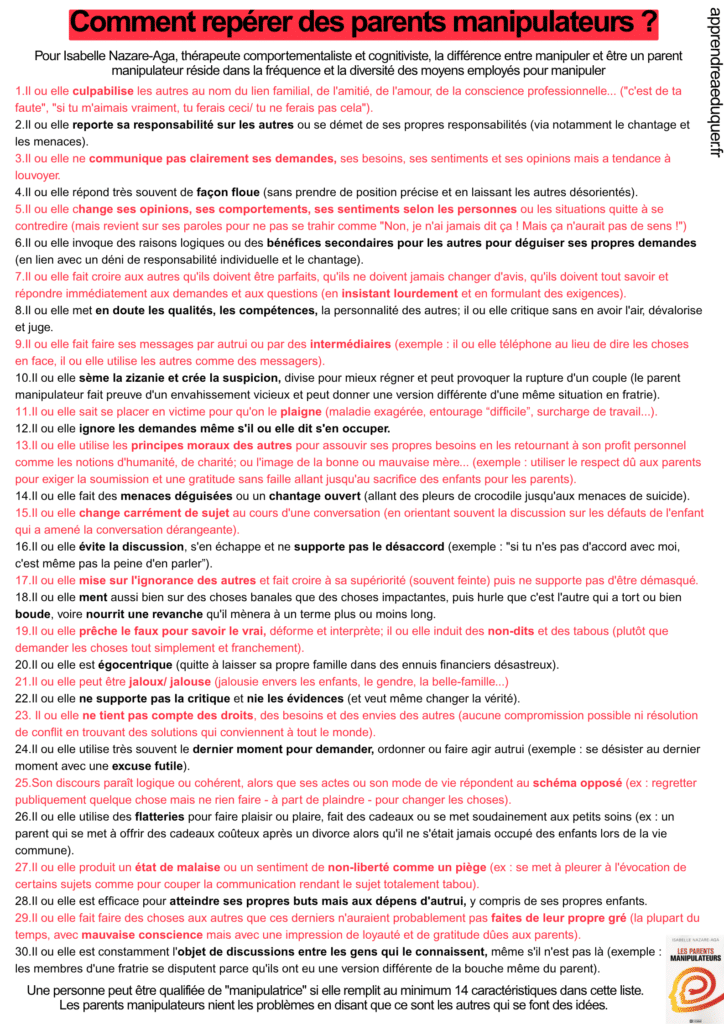
To help people spot a manipulative parent, Nazare-Aga offers a list of thirty characteristics. A person can be described as manipulative if they meet at least fourteen of them. Many people show one trait or another now and then, so the count alone is not the whole picture.
What truly signals a personality-level pattern is repetition combined with near-continuous stress in the victim. Think of a child who is always on guard, afraid of parental reactions even during calm periods. That constant vigilance, rather than a single incident, is what matters.
Guilt, Blame, and Unclear Requests
The list includes guilt-tripping in the name of family love ("if you really loved me, you would do this"), shifting responsibility onto others, and using blackmail or threats. It also covers vague communication: unclear requests, fuzzy answers that leave others disoriented, and opinions that shift depending on the audience, followed by denial ("I never said that"). Some parents disguise their own demands as logical reasons or benefits for the child.
Others convince children they must be perfect, never change their minds, and answer immediately. They question the child's qualities and criticize without appearing to, devaluing and judging. Some send messages through intermediaries instead of speaking face to face, or sow discord and suspicion to divide and rule, even giving different versions of the same situation to different siblings. Playing the victim, ignoring requests while claiming to handle them, and using moral principles to demand submission all belong to the pattern too.
| Behavior | Occasional slip | Manipulative pattern |
|---|---|---|
| Guilt-tripping | Happens once, followed by apology | Repeated to control choices |
| Communication | Occasionally unclear | Habitually vague and shifting |
| Responsibility | Owns mistakes | Blames others, denies words |
| Child's state | Brief upset, then calm | Constant vigilance and stress |
| Repair | Genuine, specific apology | Rare or turned into blame |
Subtle Tactics That Wear a Child Down
Manipulative parents also use disguised threats or open blackmail, from crocodile tears to threats of a suicide attempt. They change the subject mid-conversation, often steering it toward the child's flaws when a topic becomes uncomfortable. They avoid real discussion and cannot tolerate disagreement ("if you don't agree with me, there's no point talking").
Some lean on others' ignorance and project a superiority that is often feigned, then cannot stand being exposed. Lying is another tool, as is making others believe they owe endless gratitude. These behaviors erode trust quietly, which is why they are so hard to name from inside the family.
If you are rebuilding a calmer daily life with children, small shared rituals help restore a sense of safety, much like the simple family yoga sessions that give everyone a predictable, gentle moment together. Reading about how trust develops, for instance in early speech milestones, can also remind you that connection grows through patient, responsive attention rather than control.
Why Recognition Matters for Your Own Parenting
Naming these patterns is not about condemning a parent forever. It is about understanding what shaped you, so you can interrupt the cycle. Many adults who grew up with a manipulative parent notice they either replicate control or swing to the opposite extreme, avoiding all boundaries.
Healing means learning to communicate clearly, to own your requests, and to tolerate your child's disagreement without seeing it as betrayal. It also means repairing after mistakes out loud, which teaches children that relationships can recover. Practical parenting resources, such as holiday homework tips, show how structure and warmth can coexist.
Building a kinder environment often starts with everyday choices. Choosing open-ended play, like the educational toys, supports a child's autonomy without pressure. Even preparing food together, following pumpkin crepe recipes, becomes a moment of cooperation rather than command.

Small Steps Toward Bientraitance
Bientraitance, or respectful kind treatment, is built on consistency. Say what you mean, mean what you say, and apologize when you slip. Notice when you are tempted to guilt-trip, and replace it with a direct request. These small shifts protect a child's self-esteem far more than grand declarations.
Create predictable routines that reduce the insecurity a manipulative atmosphere breeds. A calm bedtime transition, for example, follows the same logic as the guidance in crib to bed. Shared family moments, like homemade Christmas sweets, give children steady, positive memories to hold onto.
Finally, give yourself permission to seek support. Understanding your history is not disloyalty; it is the foundation for parenting differently. As children grow, the questions shift, and reading about stages such as one year milestones helps you respond to their needs rather than to old fears.

My hands-on take
When I first read about these traits, I felt uncomfortable recognizing a few of them in myself on hard days. That discomfort turned out to be useful. I started paying attention to how often I asked my child to answer immediately, or how quickly I reached for "after everything I do for you" when I was tired. Naming those habits did not make me a bad parent; it gave me something concrete to change.
What helped most was slowing down and making requests direct. Instead of hinting, I say what I need. When I slip and guilt-trip, I go back and apologize specifically, not vaguely. I also built small routines we can count on, because predictability seems to lower everyone's guard. None of this is dramatic, but over months it changed the mood at home, and my child stopped bracing for my reactions.
Frequently asked questions
Does one guilt-trip make a parent manipulative?
No. A single harsh comment followed by a genuine apology is ordinary imperfection. The pattern matters when the behavior repeats, uses many tactics, and leaves the child constantly on guard.
How many traits indicate a manipulative parent?
Nazare-Aga's list contains thirty characteristics, and meeting at least fourteen suggests a manipulative pattern. The count should be read alongside the child's ongoing stress and the repetition of behaviors.
Can someone raised this way parent differently?
Yes. Recognizing the pattern is the first step. Clear communication, tolerating disagreement, and repairing mistakes out loud help break the cycle and build respectful kind treatment.
Why is the insecurity so hard to notice?
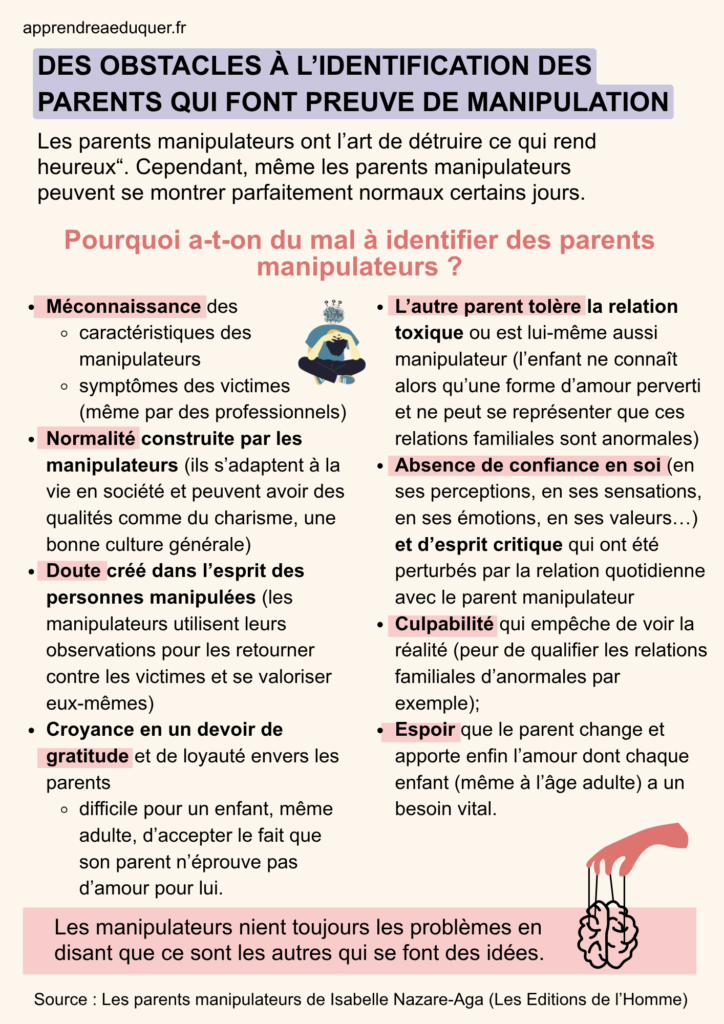
The parent's moods set the household atmosphere gradually, so the resulting insecurity feels normal. Because it develops over childhood and adolescence, it becomes part of the person's identity.
Product Reviews
 Best Toys for Dogs With High Prey Drive |
Best Outdoor Toys for 3-4 Year Olds |
Best Outdoor Toys for 6 Year Olds |
Best Harness for Poodle |
Best LEGO Sets for Adults |
Best Travel Toys for 4 Year Olds on Airplane |
Best Toy Stores in Washington DC |
Best Potty Training Toys |
Best Toys for Tripod Dogs |
Maillot equipe de france







