


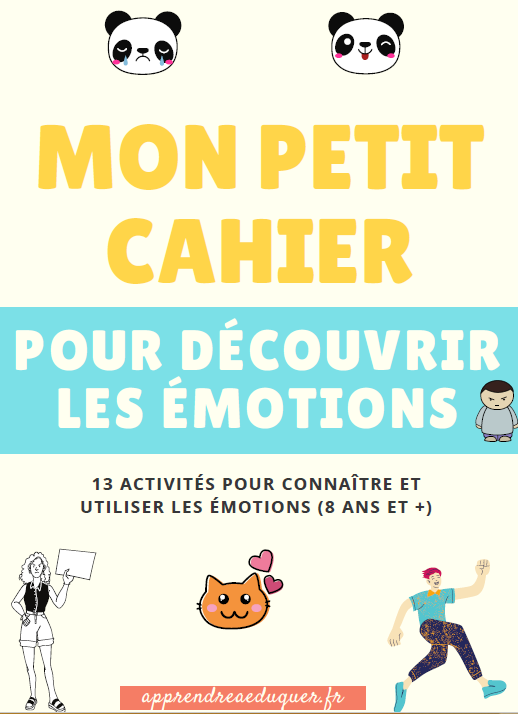
Emotions for kids are often treated as something to manage rather than something to understand, and that is exactly where a simple workbook can help. This printable set of 13 activities invites children to fill the pages with their own ideas and everyday experiences, building a personal toolbox for understanding feelings.
The aim is to explore every dimension of emotion, both their own and other people's. Children reflect on what feelings evoke for them and become more familiar with what they actually sense in the moment.

When emotions are tamed the way you tame an animal, they can become friends and allies: a way to understand yourself, understand others and make better choices. The workbook also creates an easy opportunity for shared parent-child time.
Quick takeaways
- The workbook contains 13 activities for children aged 8 and up who read confidently.
- Younger children can complete it in a pair with an adult.
- Activities use drawing, writing, imagination, reflection and family time.
- The sequence moves from body awareness to naming, needs, calming, conflict and empathy.
- It can be downloaded free, printed, then stapled or bound.
- Keep completed pages: they become a personal reference for real situations.
Starting With the Body: Activities 1 and 2
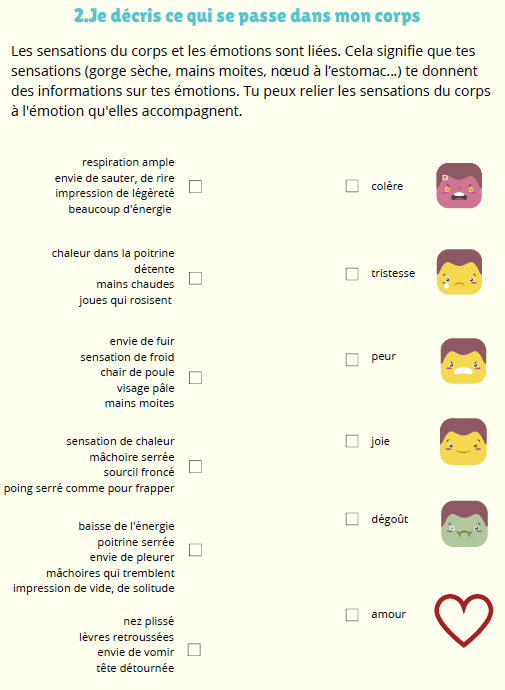
The first two activities stay close to physical sensation. Children begin by getting to know their body, then describe what happens inside it when a feeling arrives: a tight throat, a hot face, restless legs. Naming these signals early makes feelings far less abstract.
This body-first approach pairs well with everyday care routines, since a child who notices tension also notices tiredness and discomfort. Parents who are already attentive to small physical details, such as healthy hair growth or everyday hygiene habits, will recognise how much children pick up from their own bodies when given the chance.
Keep the tone curious rather than corrective. The point is not to identify a "right" sensation but to let your child describe what they notice in their own words, even if that description changes from one day to the next.
Playing and Drawing With Emotions: Activities 3 and 4
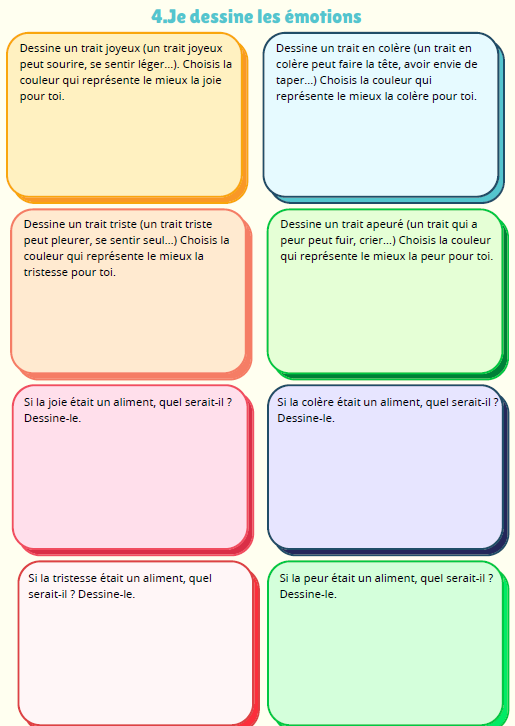
Activities three and four move from words to play and drawing. Children play with emotions, then draw them, giving shape and colour to something that is otherwise invisible. Drawing is often easier than talking for a child who cannot yet explain what is going on.
These creative pages work best without a model to copy. Ask questions instead of giving examples: what colour is this feeling, how big is it, does it have a shape? Some children will fill the page, others will draw a single dot, and both are valid answers.
If your child enjoys structured creative time, the same principle applies to other quiet activities that reward patience and attention, much like the focus required by LEGO set collecting or any hobby built up slowly over months. The workbook simply borrows that concentration and turns it inward, much like the patience explored in these fertility facts and the steady attention behind scholarship application questions.
| Activities | Main focus | Good moment to use it |
|---|---|---|
| 1-2 | Body awareness and physical signals | Calm moments, after school |
| 3-4 | Play and drawing | Rainy afternoons, creative time |
| 5-8 | Naming feelings and linking to needs | Over several short sittings |
| 9-10 | Riding the wave, calming down | After a difficult episode |
| 11-13 | Expression, conflict, empathy | Before or after a disagreement |
Precision and Needs: Activities 5 to 8
The middle section goes deeper. Children explore all the dimensions of an emotion, then learn to name feelings precisely instead of settling for "fine" or "bad". A precise word, such as disappointed rather than sad, already gives a child more room to act.
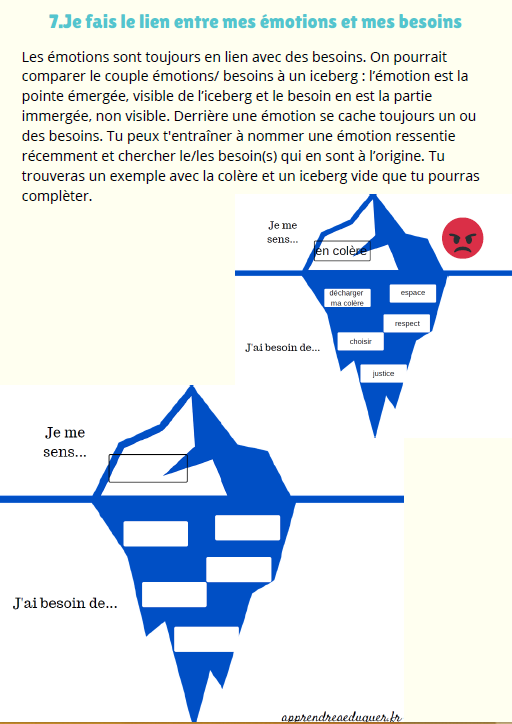
Activities seven and eight connect emotions to needs: what was missing, what was too much, what would help. Children then imagine their emotions and needs, which turns a vague mood into something they can reason about. This is the heart of the workbook and the part worth revisiting over several sittings.
Language matters here, and so does the vocabulary children hear around them. Families who read together, whether a story about a child's illness or a simple picture book, give children more words for complicated feelings. Words are the tool; the workbook is where they get practised.
Riding the Wave and Staying Calm: Activities 9 and 10
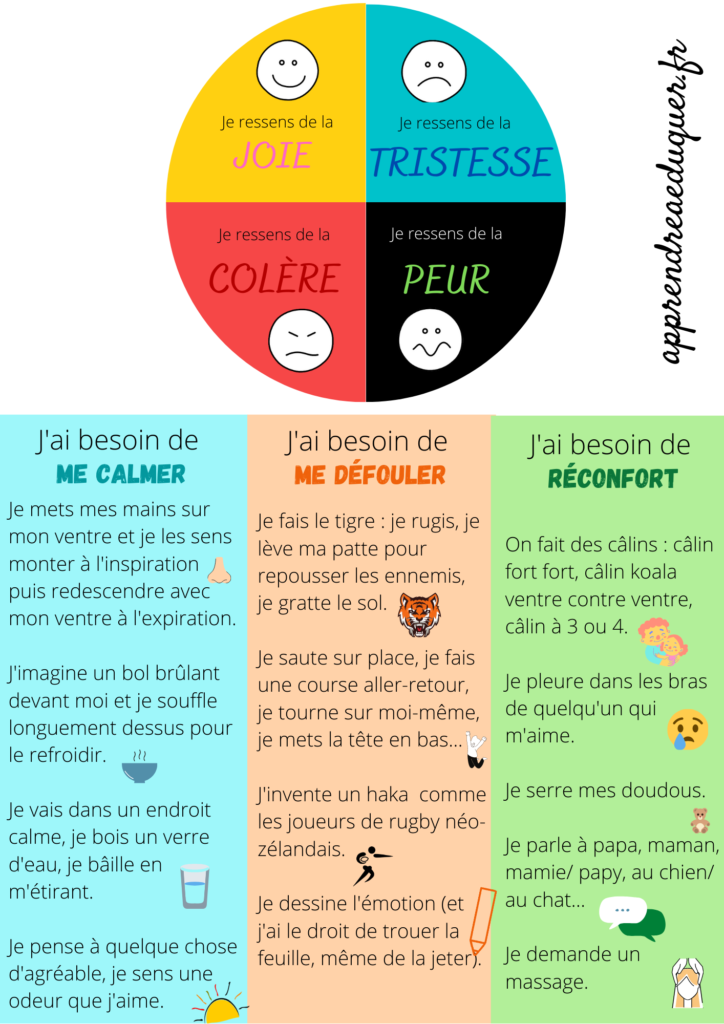
Activity nine introduces the wave of emotions: feelings rise, peak and pass. Children learn to welcome an emotion rather than fight it, noticing that it does not last forever. This single idea often changes how a child reacts to frustration.
Activity ten focuses on calming down before exploding. The workbook invites children to identify what helps them settle, whether that is breathing, movement, a quiet corner or a glass of water. The list belongs to the child, not to the adult.
Calm is also a household habit. A predictable rhythm at home, including relaxed moments such as screen time limits or a shared evening routine, gives children fewer reasons to boil over and more chances to practise what they wrote down. Simple household chores can build that same steady rhythm.
Why the wave image works
It gives children a picture they can recall in the middle of a difficult moment, when explanations are useless and a simple image still lands.
Expression, Conflict and Empathy: Activities 11 to 13
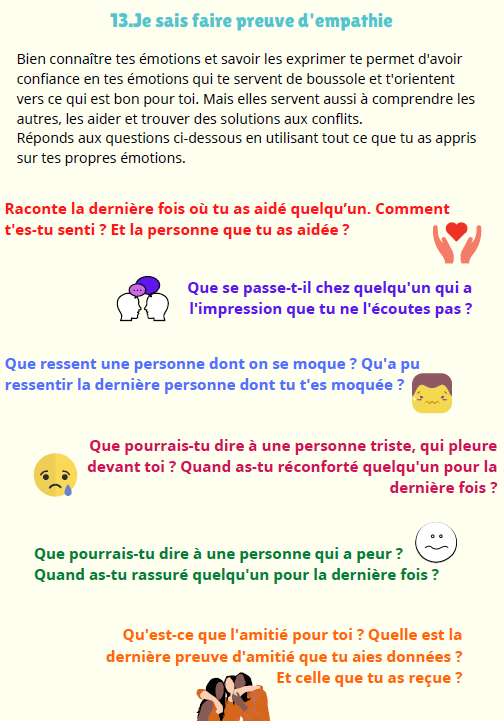
The final activities turn insight into action. Children look for ways to express emotion, learn to say what they feel during a conflict, and practise empathy by imagining another person's point of view. These are social skills as much as emotional ones.
Empathy grows through contact with people outside the family circle, including teachers, carers and neighbours. Everyday respect for the caregiver relationship or a grandparent gives children a real model to imitate, far more powerful than a worksheet alone. Role-play games like which Friends character can also help children explore feelings from another point of view.
Conflict pages are worth keeping. When a real argument happens, you can return to the page together and use the child's own words, which feels very different from an adult's lecture. Over time, this becomes a shared language for repairing things after a difficult moment, much like the gentle everyday care described in a good children's comb.

My hands-on take
I printed this kind of workbook on a quiet Sunday and left it on the kitchen table without saying much. My child ignored it for two days, then filled three pages in one go, mostly with drawings of a red blob and a grey one. The most useful part came later, when a small argument started and I asked which colour was showing up. It did not fix everything, but it slowed the moment down enough to talk.
My advice is to resist correcting the pages. Let the spelling be wrong, let the drawings be strange, and do not turn it into homework. Keep the finished booklet somewhere visible, because children return to their own words far more readily than to ours.
Frequently asked questions
What age is this emotions workbook for?
It is designed for children aged 8 and up who read well enough to work through the pages alone. Younger children can do it in a pair with an adult reading the instructions aloud.
Do we need to print it?
Printing is the simplest option, since the activities involve drawing and writing directly on the pages. You can then staple or bind the sheets into a small notebook your child keeps.
Should we do all 13 activities at once?
No. Spreading them over several weeks gives children time to absorb each idea, and the later activities on calming and conflict work better once the earlier pages are familiar.
Is it only for children?
The workbook includes activities meant to be done as a family, and the shared pages often open conversations that are harder to start without a prompt.
Product Reviews
 Best Toys for Dogs With High Prey Drive |
Best Outdoor Toys for 3-4 Year Olds |
Best Outdoor Toys for 6 Year Olds |
Best Harness for Poodle |
Best LEGO Sets for Adults |
Best Travel Toys for 4 Year Olds on Airplane |
Best Toy Stores in Washington DC |
Best Potty Training Toys |
Best Toys for Tripod Dogs |
Maillot equipe de france







