


Emotional censorship of children happens in small, everyday phrases: "Stop crying," "You're not pretty when you're angry," "It's not scary," "You're being a baby." Each one seems harmless in the moment, yet together they teach a child that some feelings are not welcome.
This article looks at what emotional censorship really is, why it counts as a form of violence, and how it shapes the way children see themselves and their own inner life. It also offers practical alternatives for parents who want to do things differently.

Quick takeaways
- Emotional censorship means minimizing, denying or punishing a child's feelings.
- Phrases like "stop crying" or "it's not scary" teach children that some emotions are unwelcome.
- Sending a child away when emotional signals that their feelings are not accepted at home.
- Some children cope by going quiet, hiding their true self to avoid rejection.
- Acknowledging the feeling first, then setting the limit, is a workable alternative.
- Repair after a difficult moment matters more than getting it right every time.
What emotional censorship actually looks like
Emotional censorship means minimizing a child's feelings, telling them not to feel what they feel, or denying their experience outright. The classic example is the reassuring phrase "But no, it's not scary!" — well-intentioned, yet it tells the child their fear is wrong. Other forms include "Stop crying," "You're mean," "You're stubborn," "Calm down or I'll punish you," or the dismissive "It's no big deal."
In these moments, a child's requests and reactions get treated as aggression or as signs of weakness rather than as communication. The child learns quickly which emotions are allowed and which must be hidden. Parents who want to support healthy development may find it helpful to think about baby care guide basics, since emotional needs start in the very first months.
Why the words matter
None of these phrases is cruel on its own. The problem is the pattern: repeated often enough, they teach a child that their inner world is a problem to be managed, not a signal to be understood.
Why it counts as a form of violence
Emotional censorship is a form of violence because it cuts the child off from their inner strength. When a child is sad or angry and is sent to their room, the message they receive is that their emotions are not welcome in the family. They are allowed to show only what is expected or tolerated: calm and obedience.
Sometimes the response goes further and includes hitting — spankings, slaps, an ear pinch, hair pulling. The child is then led to believe it was their own fault, told repeatedly that they are stubborn, that they exaggerate, that they deserved it, that they are being difficult and that if they push the limits they will find them. This confusion between punishment and personal fault is deeply unfair to a child who is simply expressing a need.
Parents working on their own reactions often benefit from support, much as they would consult guidance on managing fever calmly rather than reacting in panic. The principle is the same: respond to the signal, do not suppress it.
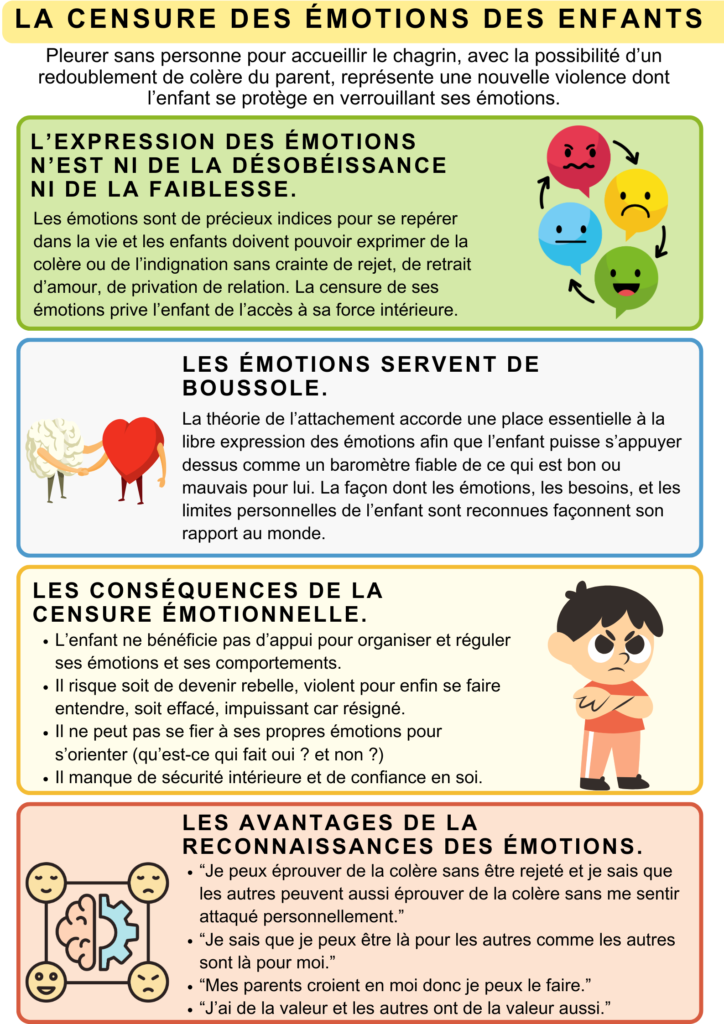
| Censoring phrase | What the child hears | Alternative to try |
|---|---|---|
| Stop crying | Your sadness is a problem | I'm here with you |
| It's not scary | Your fear is wrong | That felt scary to you |
| You're mean | You are bad, not your behavior | You're angry; let's talk about it |
| Calm down or I'll punish you | Emotions bring punishment | Let's take a calm moment together |
| It's no big deal | Your feelings don't matter | That mattered to you |
| You're too sensitive | Your perception is faulty | You noticed something big |
What children do to protect themselves
To protect themselves from the pain of being rejected when they express anger, disagreement or desire, some children go quiet. They put their emotions and their true self into hiding and express only what their parents authorize. On the outside they look easy, cooperative and well-behaved; on the inside they are learning to disappear.
This adaptation can look like progress to an exhausted adult, which is exactly why it goes unnoticed. A child who never protests is not necessarily a child at peace. They may simply have concluded that honesty is too costly.
The cost of going quiet
Children who hide their feelings lose practice in naming them, asking for help and setting boundaries. Those skills matter far beyond childhood, from friendships to school to the small daily negotiations of family life, such as co sleeping arrangements or bedtime routines where a child needs to say what they feel.
What children need instead of censorship
Children need their emotions acknowledged before anything else. That does not mean agreeing with everything or abandoning limits. It means naming what you see: "You're really disappointed that we're leaving the park." Once the feeling is recognized, the child can often calm down enough to hear the limit that follows.
Practical alternatives are simple but not always easy. Replace "stop crying" with "I'm here." Replace "it's not scary" with "that felt scary to you." Replace "calm down or else" with "let's take a moment together." These phrases do not spoil a child; they teach emotional vocabulary, which is the foundation of self-regulation.
Play supports this work too. Open-ended toys and shared games give children a safe outlet for big feelings, and even choosing budget toys thoughtfully can help build a play space where expression is welcome. A calm, predictable environment — the kind described in guides on outdoor toddler toys or indoor play — makes those moments easier for everyone.
Building a family culture where feelings are allowed
No parent gets this right every time. The goal is not perfection but a repair-friendly atmosphere: when you snap, come back and name it. "I shouted earlier. You were sad and I didn't listen. Let's try again." Repair teaches children that relationships survive conflict, which is one of the most protective lessons a child can learn.
It also helps to look at your own history. Many adults were themselves censored as children, so certain cries or protests trigger an automatic reaction. Noticing that pattern is the first step to responding rather than reacting. Reading about how children develop, whether through inherited intelligence debates or screen time effects, can put everyday emotional moments into perspective.
Finally, protect the basics: sleep, food, movement and time outdoors. A tired or hungry child has less capacity to regulate, and so does a tired parent. Small practical habits, from back care tips for little ones to a predictable evening routine, quietly support emotional balance for the whole family.

My hands-on take
I remember catching myself mid-sentence one evening: "Stop crying, it's nothing." My child had dropped a drawing and was sobbing, and my first instinct was to make the noise stop. I paused, sat down next to them and said instead, "You worked hard on that." The crying continued for a moment, then softened. Nothing dramatic happened — no expert technique, no perfect script.
What changed over time was my own tolerance for big feelings. I started narrating what I saw rather than judging it, and I began apologizing when I got it wrong. Those small repairs did more for our household than any rule. If you are trying this, expect to slip often. The point is not to silence the storm but to stay in the room while it passes.
Frequently asked questions
Is emotional censorship the same as setting limits?
No. Limits are about behavior, while censorship is about feelings. You can say "no hitting" while still accepting that your child is furious. The feeling is allowed; the action still has a boundary.
Does acknowledging feelings spoil a child?
Naming a feeling does not mean giving in to every demand. Children who feel understood are usually calmer and more able to accept limits, because they are not fighting on two fronts at once.
What if I was raised this way myself?
It is very common, and it does not make you a bad parent. The important step is noticing the automatic reaction and practicing repair afterward. Change comes from repetition, not from never slipping.
Can a child who never complains still be struggling?
Yes. Quiet compliance can be a protective strategy rather than genuine calm. Watch for a child who never protests or asks for help, and create small openings for them to express preferences.
Product Reviews
 Best Toys for Dogs With High Prey Drive |
Best Outdoor Toys for 3-4 Year Olds |
Best Outdoor Toys for 6 Year Olds |
Best Harness for Poodle |
Best LEGO Sets for Adults |
Best Travel Toys for 4 Year Olds on Airplane |
Best Toy Stores in Washington DC |
Best Potty Training Toys |
Best Toys for Tripod Dogs |
Maillot equipe de france







