


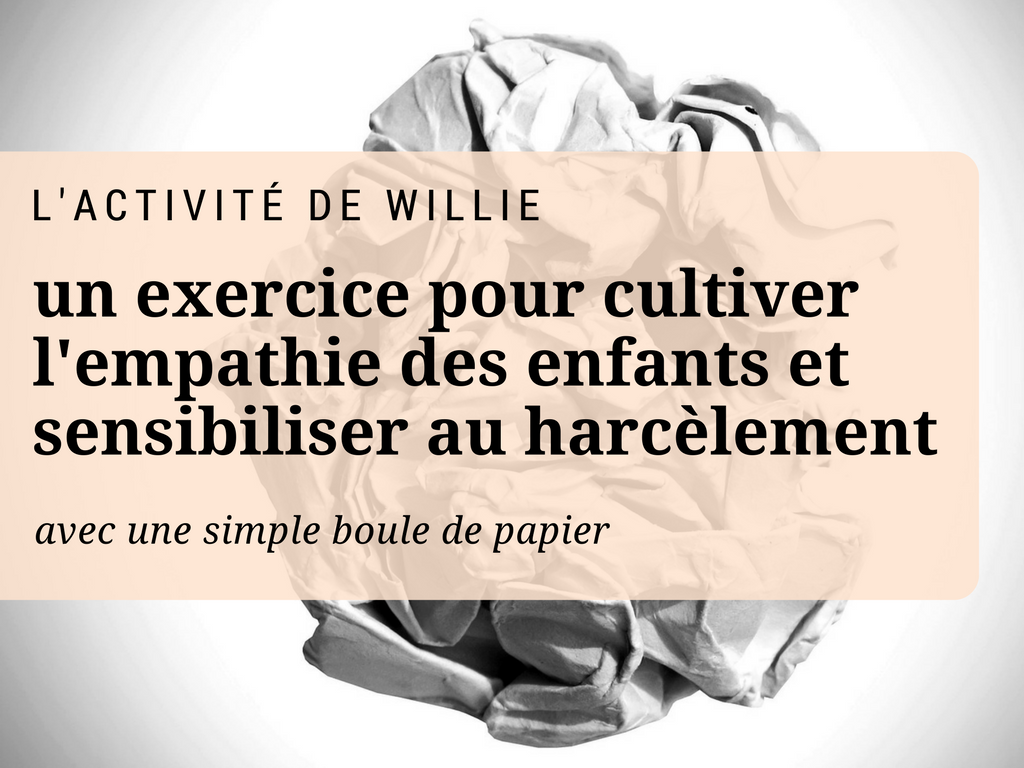
Willie's activity is a simple exercise that uses nothing more than a sheet of paper to cultivate empathy in children and raise awareness about bullying. It invites kids to reflect on the impact of harsh words and on the actions they can take when hurtful things happen, whether to themselves or to others.
Children often come to see hurtful comments, criticism, judgment and rejection as "normal" parts of daily life. This activity gives them a concrete way to feel what those words do to a person, and to discover that kindness can smooth things over but never fully erases the creases.

Quick takeaways
- Willie's activity uses one sheet of paper to make the impact of hurtful words visible.
- Children share real examples of hurtful comments while the paper is crumpled.
- Encouraging suggestions smooth the paper out, but the creases never disappear.
- The finished Willie poster becomes a classroom reminder about respect.
- The same exercise adapts easily to home use with siblings.
- The message: harm can be repaired, but the mark can remain.
Why Talk About Hurtful Words With Children?
Words can be violent, and they can hurt even when no one raises a hand. Left unexamined, children may accept teasing and put-downs as just part of recess. Willie's activity gives them a shared language for something that is otherwise invisible.
The exercise asks children to think about non-violent ways of interacting with others, and to realize that damage can be repaired while the injury still lingers. That dual lesson, repair is possible but the mark remains, is what makes the paper metaphor stick. It pairs naturally with conversations about holding crying children and about how we respond when someone is upset.
What the Activity Aims to Achieve
By the end, children should understand the consequences of certain behaviors and comments, have reflected on kinder alternatives, and grasp that a crumpled sheet never becomes perfectly flat again.
How to Set Up Willie's Activity Step by Step
Draw the outline or the face of a person on a large sheet of paper. Tell the children that this character is called Willie. Then ask the group to share examples of comments or behaviors that have hurt them in the past, things heard in the schoolyard for instance.
For every example given, crumple a part of the large sheet until it becomes a paper ball. Go slowly and let each contribution land; the growing ball is the point. If you want to extend the reflection afterward, movies about values can keep the conversation going at home, and these parenting TED Talks offer further guidance.
Guiding the Discussion
Ask the children what Willie feels: which emotions run through him, what he wants to do or say, what he thinks. What does he feel toward the people who treated him badly, and what would he like to do to them? Does he even want to come back to class? Parents planning another child can also redesign their budget to make room for these conversations.
| Phase | What the adult does | What children learn |
|---|---|---|
| Set up | Draw Willie on a large sheet | A character represents a real person |
| Crumple | Crumple paper for each hurtful example | Words leave marks |
| Discuss | Ask what Willie feels and wants | Empathy for the target |
| Repair | Smooth paper for each kind suggestion | Kindness helps but creases stay |
| Display | Hang Willie in the classroom | Respect is an ongoing habit |
Helping Willie Feel Better: The Repair Phase
Open the exchange: has anyone in the class ever felt the way Willie feels right now? Then ask what the group could do or say to help Willie feel better. As soon as a child offers an encouraging suggestion, an apology, support, a gesture of friendship, or the idea of turning to an adult, smooth out a piece of the silhouette.
Keep going until the sheet looks flat again. Then have the children observe that despite all the encouragement and comfort, the creases remain. This is the moment to underline the importance of kind behavior and empathy, remembering that words can be very hard to take back and that the "creases" can stay printed on people for a long time. For children who struggle with impulse control, controlling aggression offers complementary strategies.
Using Willie as a Classroom Reminder
Hang Willie in the classroom as a visual reminder, and mention his crumpled body when children forget to treat each other with respect. If a student behaves inappropriately, remind them how their behavior affects classmates and ask what they would need to do better.
If a student seems to be having a hard time, ask whether they are living a "Willie day" and what might help them feel better. The poster becomes a quiet, non-shaming reference point the whole group shares. Teachers who want to build a calmer classroom culture often pair this with books about routines and with clear, consistent expectations. Discussing controversial parenting issues can also help teachers align their approach.
Keeping the Message Alive
Revisit Willie regularly rather than only after an incident. A short check-in during circle time keeps empathy part of the weekly rhythm, much like learning to dance builds social awareness through practice.
Adapting the Exercise for Home and Other Ages
Parents can run the same activity at the kitchen table with a single sheet of paper and a marker. It works with siblings after a fight, or as a calm-down ritual when harsh words have been exchanged. The creases give children something to look at instead of something to argue about.
With younger children, keep the language simple and focus on feelings; with older ones, extend the reflection to group dynamics and online comments. The core message stays the same at every age. Families navigating big emotions may also find support in parenting from love and in friendship and family conversations about how we treat the people closest to us.

My hands-on take
I have run a version of this with my own children after a rough afternoon, and the paper did more talking than I did. My youngest kept smoothing the sheet with her palm, certain she could flatten it completely, and when she finally saw the creases she went quiet. That silence was worth more than any lecture I could have given.
What I appreciate most is that it gives everyone something to look at instead of someone to blame. We now keep our crumpled Willie on the fridge, and when voices rise, one of us points at it. It is not a cure for sibling fights, but it has made repair feel like something we do together rather than a punishment.
Frequently asked questions
What age is Willie's activity suitable for?
It works best with children old enough to name emotions and share examples, typically early elementary and up. With younger children, simplify the language and focus on feelings rather than consequences.
How long does the activity take?
A single session can run in a short block, with the crumpling and discussion taking most of the time. The repair phase and reflection can be revisited on another day.
Can parents do this at home?
Yes. One sheet of paper and a marker are enough. It works well after a conflict between siblings or as a calm-down ritual.
Does smoothing the paper really teach anything?
The visible creases are the lesson. Children see that apologies and kindness matter, yet the memory of hurtful words can stay.
Product Reviews
 Best Toys for Dogs With High Prey Drive |
Best Outdoor Toys for 3-4 Year Olds |
Best Outdoor Toys for 6 Year Olds |
Best Harness for Poodle |
Best LEGO Sets for Adults |
Best Travel Toys for 4 Year Olds on Airplane |
Best Toy Stores in Washington DC |
Best Potty Training Toys |
Best Toys for Tripod Dogs |
Maillot equipe de france







