


Solution-focused positive thinking for kids is not about pretending that difficulties do not exist. It is a way of steering a child's attention towards what can be done, rather than what cannot. The approach described in Michel Claeys-Bouuaert's practical guide to emotional education invites adults to help children notice how they think and to turn a negative observation into a learning opportunity.
This does not mean ignoring emotions, pain or frustration. It means acknowledging them fully, then gently exploring possibilities. The contrast is simple: stating a difficulty is not the same as stating a possibility, and being locked into "I can't" is not the same as exploring what is feasible.

Quick takeaways
- Positive thinking acknowledges difficult feelings rather than denying them
- Reframe fixed statements by adding "yet" and asking solution-focused questions
- Model optimistic thinking aloud, including how you handle your own mistakes
- Ask children what they could do to improve a situation before offering answers
- Use short, positive "I" affirmations chosen by the child and repeated regularly
- Build one habit at a time and expect occasional setbacks
Positive thinking versus positive denial
Before using any technique, it helps to be clear about what positive thinking is not. It is not the denial, minimisation or ignoring of hardship. A child who is sad, angry or discouraged needs that feeling recognised first. Only then can the focus shift towards solutions.
The guide sets out a series of useful contrasts. Affirming difficulties is not the same as affirming possibilities; being shut inside an incapacity is not the same as exploring what is doable. Expressing fear is not expressing confidence, a limit is not a permission, and helplessness is not power. Low energy and gloom sit at the opposite end from joy and creativity.
Keeping these pairs in mind gives parents a mental checklist. When you hear your child speak, ask yourself which side of the contrast the sentence sits on, and whether a small shift is possible without dismissing the emotion behind it.
Reframing your child's negative wording
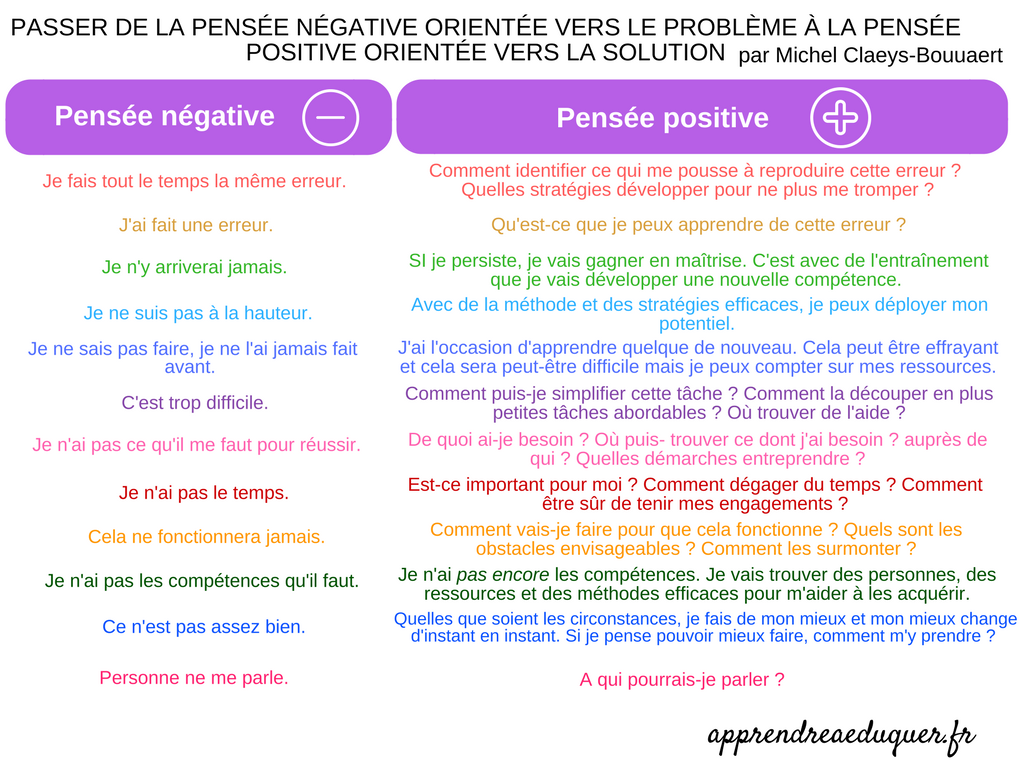
The first practical lever is language. When a child expresses a fixed, closed thought that reflects helplessness, you can reformulate it to emphasise exploration. "I'll never manage" becomes "You haven't managed yet; with practice you'll get there soon." The word "yet" does a lot of quiet work here.
"I'm useless" is best met with questions rather than reassurance alone: which skill would you like to develop? What could you start with? How will you go about it? What is the first small step? How will you know you are progressing? These questions hand the thinking back to the child, which is where the real learning happens.
This questioning style also works well in groups. Teachers and parents can ask a whole class what they think could improve a situation that is causing trouble, an approach that pairs naturally with cooperative games and other shared activities where children negotiate and solve problems together. It also helps to reframe school attitudes the same way.
| Fixed statement | Reframed response | Follow-up question |
|---|---|---|
| I'll never manage | You haven't managed yet | What would help you practise? |
| I'm useless | Which skill do you want to build? | What is your first small step? |
| I can't do it | What part can you do? | How will you know you're progressing? |
| It's too hard | It's hard right now | What would make it easier? |
| Nobody likes me | That felt hurtful today | What could you try tomorrow? |
Being a model of optimistic thinking
Children learn far more from what adults do than from what adults say. If you want to teach optimistic thinking, practise it out loud. Narrate difficulties and the search for solutions as they happen, so your child hears the process rather than only the result.
Demonstrate a positive relationship with mistakes: "I got that wrong, what can I learn from it?" Show confidence in yourself, generate creative ideas aloud, and look for third routes when a situation seems binary. Positive thinking also means letting go of the fear of failure and learning to listen to the messages emotions carry.
Everyday moments are ideal for this. A tricky DIY project, a long car journey or a game that goes badly all offer rehearsal space, much like the travel games that turn a tedious drive into a lesson in patience and improvisation.
Involving children in finding their own solutions
Whenever a difficulty arises, try asking the child what they think they could do to improve the situation. Do this consistently, individually and in groups. The aim is autonomy: the child gradually learns that problems are things to be worked on rather than things that happen to them.
Resist the urge to supply the answer immediately. Let silence sit for a moment, accept imperfect ideas, and ask what might happen next if that idea were tried. You can also invite children to notice progress, which builds the habit of self-reflection over time.
This habit of independent problem-solving supports many other areas of growing up, from managing a child's posture during homework to handling the small social bumps of school life with a little more confidence. It also helps when they are ready at 12 for bigger transitions, and when parents face moments like the Kristeller maneuver and need to stay calm.
Using positive affirmations with children
Affirmations are simple, strong words carrying a clear and conscious intention. They are phrased positively, because saying what you do not want does not clarify what you do want. Useful openings include "I can", "I want", "I choose to", "I am", "I have the right to", "I decide to" and "my goal is".
Good affirmations are "I" messages expressing wants, values, emotions, needs and intentions. They are set in a short timeframe with a deadline, they affirm being rather than hoping, and they carry personal goals born of intrinsic motivation. Regular repetition matters more than perfect wording.
Keep them short enough for a child to remember and say naturally. A phrase pinned above a desk or repeated at bedtime works better than a long script, and the child should always be the one choosing the words.
Turning theory into daily family practice
None of this requires a special session or a workbook. It happens in the small exchanges of an ordinary day: the reframed sentence, the question instead of the answer, the adult who says out loud how they will tackle a problem. Consistency matters more than intensity, much like the steady routine of introducing porridge.
Start with one habit, such as catching "never" and "can't" and adding "yet". Once that feels natural, add the solution-seeking question. Later, introduce a short affirmation the child has chosen. Building slowly keeps the approach warm rather than preachy.
Expect setbacks. Children will still say "I'm useless" on hard days, and that is fine. The goal is not a permanently cheerful child but one who gradually acquires a wider repertoire of ways to respond when things go wrong. Just as you would check for color blindness with patience, meet these moments calmly.

My hands-on take
I started with the "yet" trick almost by accident. My youngest kept announcing that he couldn't tie his laces, and instead of jumping in to fix it, I found myself saying "you can't do it yet". He looked at me suspiciously the first few times, but the word stuck, and so did the persistence.
The harder part was modelling. I noticed how often I muttered "I'm hopeless at this" while wrestling with flat-pack furniture or a recipe gone wrong. Saying out loud what I was going to try next felt awkward at first, almost theatrical, but the children picked it up far faster than any instruction I could have given them. The affirmations came last, and only one survived: a short line my daughter chose herself and still repeats before school.
Frequently asked questions
Isn't positive thinking just telling children to cheer up?
No. The approach explicitly rejects denying or minimising difficulties and emotions. Feelings are acknowledged first; only then does the focus move towards what can be done about the situation.
What if my child refuses to reframe their words?
That is normal, especially on difficult days. Offer the reframe lightly and move on, and let your own out-loud thinking do the teaching over time rather than insisting on a response.
How long should an affirmation be?
Short enough for a child to remember and repeat naturally. A brief "I" message with a clear intention, chosen by the child and repeated regularly, works better than a long sentence.
Does this work in classrooms too?
Yes. Asking a group what they think could improve a problem situation is a recognised way to build autonomy, and it fits naturally into shared games and collaborative activities.
Product Reviews
 Best Toys for Dogs With High Prey Drive |
Best Outdoor Toys for 3-4 Year Olds |
Best Outdoor Toys for 6 Year Olds |
Best Harness for Poodle |
Best LEGO Sets for Adults |
Best Travel Toys for 4 Year Olds on Airplane |
Best Toy Stores in Washington DC |
Best Potty Training Toys |
Best Toys for Tripod Dogs |
Maillot equipe de france







