


A puzzle game for family gratitude and positive emotions turns an ordinary evening into a gentle ritual of connection. It borrows simple ideas from positive psychology: noticing good things, saying thank you, doing small acts of kindness and creating real contact through words and touch.
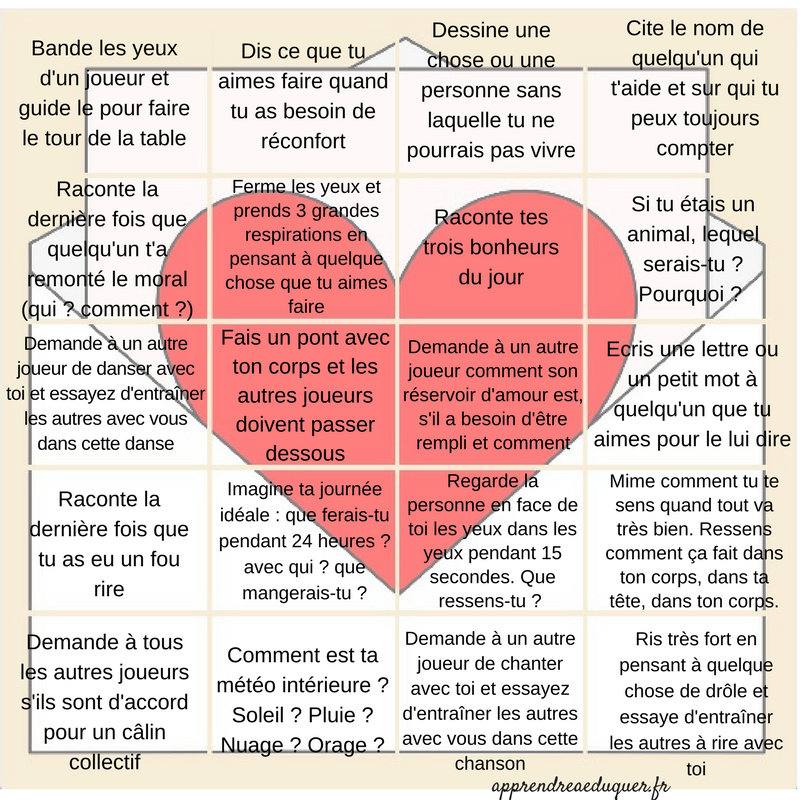
The rules are easy enough for children to follow. You print a board, cut it along the lines so each square becomes a puzzle piece, and place the pieces face down. Players take turns drawing a piece, reading the challenge or question aloud, and completing it before laying the piece face up on the table.

Piece by piece, the picture rebuilds itself — and so does the mood in the room.
Quick takeaways
- Print the board, cut along the lines, and play with pieces face down.
- Players take turns reading a prompt and completing it before placing the piece.
- Nobody is forced to answer or act; a refusal is always acceptable.
- Challenges involving others require their consent, including hugs and blindfolds.
- Close with a gratitude circle where each person thanks another.
- Use single cards on ordinary evenings for quick reconnection.
How the gratitude puzzle game works
Set-up takes only a few minutes. Print the board, cut along the marked lines, and shuffle the pieces face down in the middle of the table. Each player in turn picks one, turns it over, reads what is written and does the small challenge or answers the question. The piece then stays face up on the table.
The aim is collective rather than competitive: every piece returned brings the puzzle closer to being complete. Nobody wins and nobody loses, which keeps the atmosphere relaxed and makes it a good fit for mixed ages. If you want a calmer wind-down activity afterwards, a Benji Davies books session pairs nicely with the same quiet mood.
A game that fits any evening
Because there is no score and no timer, you can stop whenever attention fades and pick it up again another day. That flexibility matters with young children, whose patience rarely matches a full board.
The ground rules: kindness and a safe frame
One rule matters more than all the others: nobody is ever obliged to answer a question or perform an action. If a player does not feel comfortable, that is completely fine, and the game simply moves on to the next person.
Some challenges also involve other players, so consent is needed from everyone concerned. A player asked to be blindfolded, hugged or danced with has the right to say no, and that no is respected without comment. Reminding the group of this before you start prevents most awkward moments.
This same respectful framing is useful well beyond the game table — the kind of everyday parenting thinking you find in pieces on baby care myths or on housewife prejudice, where assumptions are gently questioned rather than imposed. It also echoes the spirit of the time we spend together, and the simple toys that make it easier, like the best toys under $50.
| Type of prompt | Example | How to handle it |
|---|---|---|
| Movement | Dance, sing, body bridge | Offer it, never insist |
| Memory | Three good things of the day | Let players pass freely |
| Emotion | Inner weather, love tank | Listen without correcting |
| Contact | Eye contact, group hug | Ask everyone first |
| Creative | Draw or write a note | No need to share it |
Closing with a gratitude circle
Once the puzzle is complete, close the session with a short gratitude circle. Each member is invited, in turn, to thank one or several others for something that person shared, said or did during the game.
It can be a single sentence — “thank you for making me laugh” — and it does not need to be elaborate. The point is to name aloud what someone brought to the moment, which children often notice but rarely voice. Hearing themselves thanked for a specific gesture is far more meaningful than generic praise.
Keep it short and optional
If someone prefers to pass, let them. A brief circle that ends on a warm note works better than a long one that turns into a performance, and it leaves everyone with something to carry into the next day.
Using the cards informally day to day
The game does not have to stay a game. A different family member can draw one card each evening and carry out the action written on it as a short moment of reconnection. The cards then become daily supports for activities that feed the bond and fill everyone's emotional tank.
This informal version suits busy weeks when a full board feels like too much. One card, one small gesture, and the day ends on a warmer note. It also travels well: a few pieces in a bag can turn a wait at the doctor's into a shared moment, much like a small one year old toy keeps a toddler occupied without fuss.
Over time, the same simple prompts — a compliment, a memory, a question about feelings — become part of family vocabulary.

The challenges on the board
The pieces mix movement, imagination, memory and emotional expression, so no two turns feel the same. Some ask a player to be blindfolded and guided around the table, to dance or sing and draw others in, or to make a bridge with their body for everyone to pass under.
Others are quieter: describe what you like to do when you need comfort, name someone you can always count on, tell your three good things of the day, or say what your inner weather is like — sun, rain, cloud or storm. There are drawing and writing prompts too, such as a letter to someone you love.
Several cards invite reflection on the body and on connection: fifteen seconds of eye contact, miming how you feel when everything is going well, three deep breaths while thinking of something you enjoy, or asking another player how full their love tank is. A group hug is proposed only with everyone's agreement. For families who enjoy building together afterwards, a LEGO Ideas project or a toys for 3 year olds set can extend the shared focus. Active families might also enjoy outdoor toys, while curious kids can explore science toys.
Getting the most out of family game time
Choose a moment when nobody is hungry or rushed, and keep the first session short. Model the tone yourself by answering openly and accepting refusals cheerfully, because children copy what they see far more than what they are told.
Older children can read the pieces for younger ones, which adds a caretaking role to the game. If a prompt falls flat, skip it without discussion and move on — the goal is connection, not completion. Families who like routine often find that a fixed slot, such as after dinner on a Sunday, makes the ritual stick more easily than an improvised one.
Finally, store the cut pieces in a small envelope or box so the game survives the week. A labelled container avoids the familiar fate of scattered cards, and it means the next session can start in seconds rather than in a search.

My hands-on take
I have played this with my own family on quiet Sunday evenings, and the lesson I keep relearning is that the simplest cards land hardest. The eye-contact one, which I expected to be awkward, produced the most talking afterwards. The dancing one produced the most laughter, and the least dignity.
My practical advice is to cut the pieces a little larger than you think you need and to keep them in a labelled envelope, because loose squares vanish fast. I also stopped announcing the game in advance — a short “one card each before bed?” gets far less resistance than an advertised family activity. And when someone says no, I now say “of course” and move on quickly, because the whole point is that the safe frame is real.
Frequently asked questions
What age is this game suitable for?
It works best with children old enough to read or to be read to, roughly school age and up. Younger children can join with an adult reading the pieces aloud and simplifying the prompts.
Do we need to finish the whole puzzle in one sitting?
No. You can stop at any point and continue later, since the pieces stay face up on the table. Short sessions often work better than long ones, especially with young children.
What if a child refuses a challenge?
That is part of the game. Refusing is explicitly allowed, and the group simply moves to the next player without pressure or commentary.
Can we use it with just two people?
Yes. Some prompts involve several players, so simply skip those or adapt them for two. The gratitude circle works perfectly well with a pair.
Product Reviews
 Best Toys for Dogs With High Prey Drive |
Best Outdoor Toys for 3-4 Year Olds |
Best Outdoor Toys for 6 Year Olds |
Best Harness for Poodle |
Best LEGO Sets for Adults |
Best Travel Toys for 4 Year Olds on Airplane |
Best Toy Stores in Washington DC |
Best Potty Training Toys |
Best Toys for Tripod Dogs |
Maillot equipe de france







