


Postpartum depression signs can be easy to miss, even by the people closest to a new mother. The arrival of a baby is a life event with a high potential for depression, because the postpartum period is a time of fragility, reorganization and physical change.
Emotional upheaval linked to motherhood is not abnormal: it concerns a significant share of mothers, and it is insidious enough that many women struggle to put words on their deep malaise. Early signs are not always noticed by partners, relatives or professionals, and when they go unseen they can worsen over time.

This guide walks through the warning signs, the shame that keeps mothers silent, and the concrete ways to get help.
Quick takeaways
- Postpartum depression is insidious and often hard for mothers to describe.
- Early signs are not always noticed by partners, relatives or professionals.
- Guilt and shame push many mothers into silence and isolation.
- Violent or suicidal thoughts are serious warning signs, not proof of bad mothering.
- Mother-baby units and trained professionals can welcome a mother's words.
- Talking to a specialized professional is urgent and is not a failure.
Why the postpartum period is a time of fragility
Becoming a mother is a life event with a strong potential for depression. The postpartum period requires a woman to integrate the birth into every dimension of her life and to reclaim a body that has changed. This is a moment of reorganization, not a simple return to normal.
Signs can appear just after the birth, but they are not always perceived by the partner, relatives or professionals. If these early warnings are not spotted, they can get worse with time. When the partner returns to work and the young mother faces the aftermath of birth in solitude, postpartum depression can settle in for the long term.
Many mothers assume they are the only ones suffering this much. That isolation makes it harder to reach out, and it is why clear information matters so much, much like the practical guidance in new mother's cabinet or the everyday tips in working from home.
Signs that can alert you to postpartum depression
The depression is insidious, and mothers who suffer from it may have great difficulty describing their deep malaise. A mother may feel incapable of caring for her baby properly, or believe that if she disappeared the child would be raised by people more competent than her.
When thoughts turn frightening
Some mothers think or say horrible things about their child or about themselves. Others experience violent thoughts toward the baby, such as throwing the baby out of a window or into a bin. These thoughts are a serious warning sign, not a proof that the mother is a bad person.
Women facing maternal depression see themselves as “monster mothers” and live in perpetual suffering and shame. Guilt and the feeling of being in an “abnormal” state create a vicious circle. Everything becomes dark, with no hope of getting out; thoughts are no longer productive, and a veil falls over days that follow one another without interest.
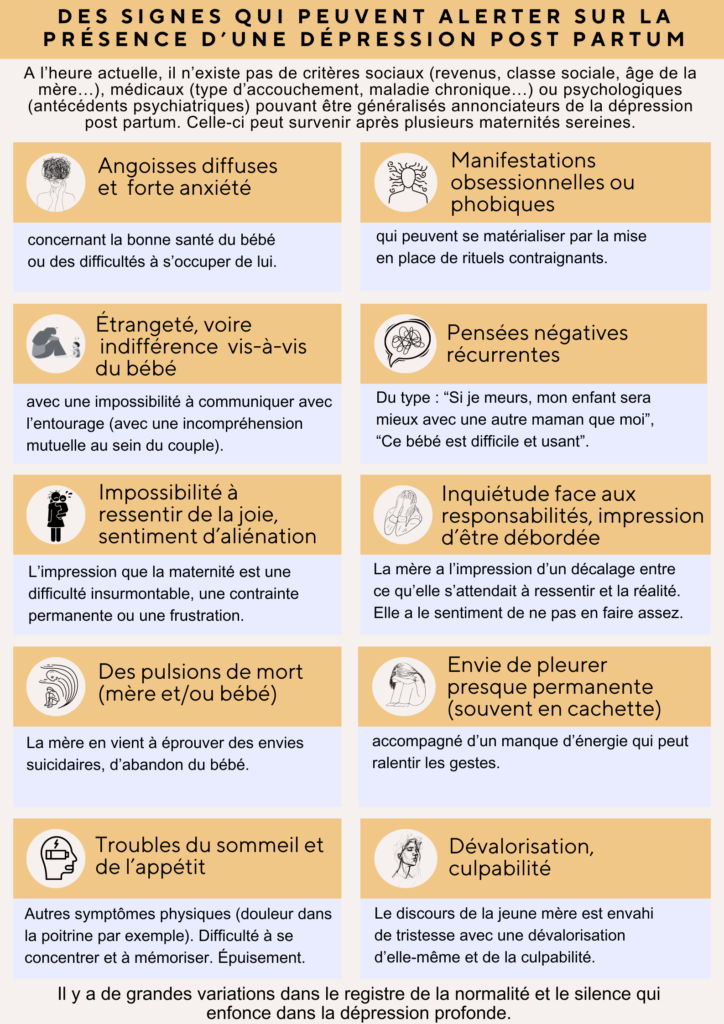
| Sign | What it may indicate | Suggested response |
|---|---|---|
| Feeling unable to care for the baby | Loss of confidence, depression | Talk to a professional |
| Believing the baby would be better off without her | Suicidal thoughts | Seek help immediately |
| Violent thoughts toward the baby | Severe distress | Contact a specialized unit |
| Persistent shame and guilt | Vicious circle of isolation | Speak to a trusted person |
| Malaise worsening after partner returns to work | Depression settling long term | Ask for early support |
The shame that keeps mothers silent
Many mothers believe they are alone in suffering to this point. They compare themselves to the idyllic vision of motherhood promoted by society and conclude that something is deeply wrong with them. That comparison feeds the shame and pushes them further into silence.
Parenting magazines publish articles on the “baby blues” but very rarely on maternal depression, which leaves a gap in public information. Yet such words challenge the idealized picture of motherhood that is so valued socially. Naming what is happening is the first step out of the vicious circle.
Support does not have to wait for a crisis. Even small routines, like the ones in teach your child or the calming activities in open ended toys, can help a mother rebuild a sense of normalcy while she seeks proper care.
How professionals and specialized units can help
Hospital staff and private practitioners are increasingly well trained to spot symptoms and to welcome a mother's words, even when those words challenge the idealized vision of motherhood. Mother-baby units (maternology units) are dedicated places for the care of certain mothers facing postpartum depression.
Getting help early matters because the illness tends to worsen when it stays hidden. A partner returning to work, a move, or a lack of sleep can all tip a fragile balance. Talking to a specialized professional is urgent, and it is not a sign of failure.
Families can also lean on simple, structured resources, from the practical ideas in TED Talks parenting to the reassuring routines in lactose free ice creams, to keep daily life manageable while treatment begins.
Everyday support for a mother who is struggling
Practical help often speaks louder than advice. Taking over a feed, a bath or a school run gives a mother space to rest and to attend appointments. Small, concrete offers are easier to accept than a vague “let me know if you need anything.”
Partners and relatives can also watch for the signs described above and gently name what they notice, without judgment. Listening without minimizing is a skill, and it can be learned, much like the patience described in child is shy or the encouragement found in martial arts.
Keeping some lightness in the home helps too. A few shared activities, from outdoor toys kids to a simple family outing, can restore a sense of connection without pressure.
When to seek help without waiting
If a mother recognizes herself in these signs, or if a loved one does, the priority is to talk about it with a specialized professional. Suicidal thoughts or violent thoughts toward the baby are reasons to seek help immediately, not to wait and see.
It is also worth remembering that postpartum depression affects fathers too, and that information should reach both parents. Understanding the phenomenon makes it easier to recognize it and to face it together.
Recovery is possible with the right support, and the earlier the conversation starts, the better the chances of breaking the vicious circle of guilt and shame.

My hands-on take
I remember visiting a friend a few weeks after her second baby was born. She smiled through the whole afternoon, made tea, apologized for the mess, and said she was fine. It was only months later that she told me how dark those weeks had been, and how convinced she was that saying it out loud would make her a bad mother.
What helped her most was not advice. It was someone taking the baby for an hour so she could sleep, and a friend who asked a direct question instead of a polite one. Since then, I try to offer something concrete rather than a vague “let me know,” and I try to listen without rushing to reassure. If a mother tells you she is struggling, believe her the first time.
Frequently asked questions
Is postpartum depression the same as baby blues?
No. Baby blues is widely covered, while maternal depression is rarely discussed in parenting media. Postpartum depression is more insidious and can settle in for the long term if the early signs are missed.
Can a mother with violent thoughts toward her baby still be a good mother?
These thoughts are a warning sign of severe distress, not proof of bad mothering. Mothers who experience them often see themselves as “monster mothers,” which is precisely why they need professional support rather than judgment.
Who can spot the early signs?
Partners, relatives and professionals can all notice them, but they are not always perceived. Hospital staff and private practitioners are increasingly trained to spot symptoms and welcome a mother's words.
Where can a mother find dedicated care?
Mother-baby units, also called maternology units, are dedicated places for the care of certain mothers facing postpartum depression. Talking to a specialized professional is the recommended first step.
Product Reviews
 Best Toys for Dogs With High Prey Drive |
Best Outdoor Toys for 3-4 Year Olds |
Best Outdoor Toys for 6 Year Olds |
Best Harness for Poodle |
Best LEGO Sets for Adults |
Best Travel Toys for 4 Year Olds on Airplane |
Best Toy Stores in Washington DC |
Best Potty Training Toys |
Best Toys for Tripod Dogs |
Maillot equipe de france







