


Parental guilt shows up for almost every caregiver, especially the moment you start learning about gentle parenting and the harmful effects of ordinary educational violence such as spanking, punishments, rewards, time-out and blackmail. Reading about these things is not the same as being made to feel guilty. Information simply shines a light on a gap.
That gap is where guilt lives: between the parent you want to be and the parent you were at seven in the morning. Feeling it does not mean you are failing. It means something in you cares deeply and is asking for a change.

Quick takeaways
- Guilt is an alarm bell pointing to a gap between your values and your actions.
- Being informed about harmful practices is not the same as being blamed.
- Name the emotion and the need underneath it; relief follows.
- Unprocessed guilt can lead to rigidity, control, depression or burnout.
- Guilt becomes fertile ground when it guides you toward new choices.
- Grieve perfection: it is what makes sustainable kindness possible.
Guilt is a signal, not a sentence
Many parents commit to gentle parenting without feeling guilty at all, even if the feeling surfaces now and then when patience runs out or kindness slips. They choose this path because it feels right and adjusted, knowing it is long, full of obstacles, and heavy work, because there is so much to unlearn and relearn.
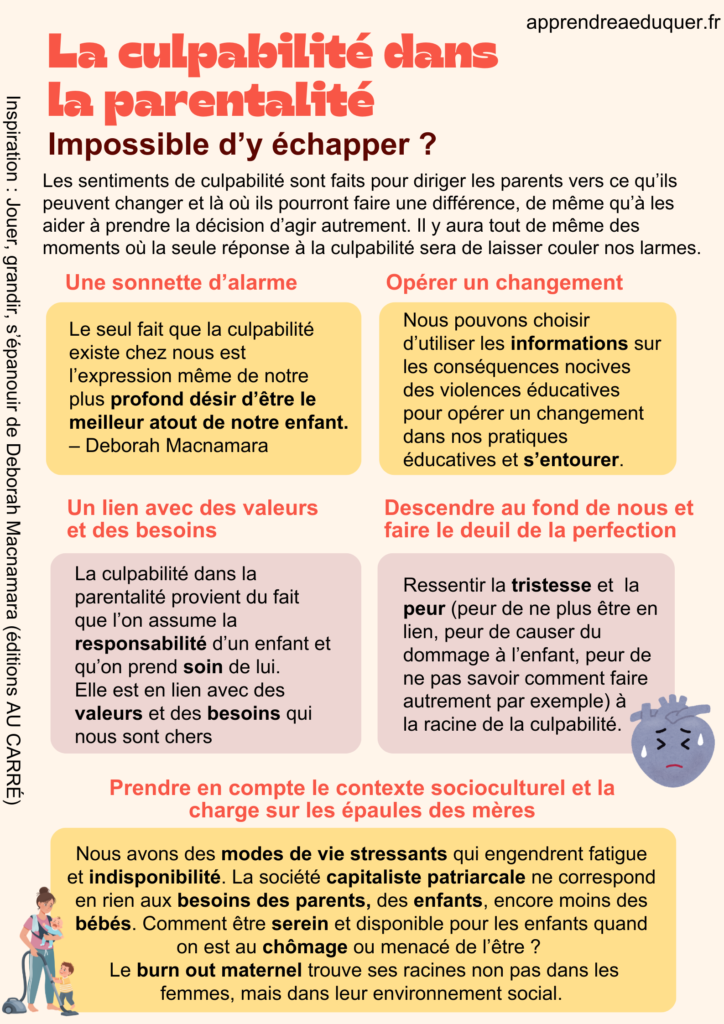
Parental guilt works best as an alarm bell. It draws attention to a change to make, and once values and actions line up again, it has no more use and fades. You can choose to use what you know about the harm of ordinary educational violence, and the discomfort it creates, to shift your practices.
Help is easier to find than ever
Books, support groups, training and blogs now offer practical tools and resources to make that shift possible. As the psychologist Deborah Macnamara puts it, the very existence of guilt in us expresses our deepest wish to be our child's best asset. If bedtime is your daily flashpoint, these baby sleep methods can lower the pressure on everyone.
Why guilt appears when you care for a child
Guilt takes responsibility for a child and the care that comes with it, then surprises you when something falls short of your expectations, for example shouting after promising yourself you would not. It has something to do with perfection and with the difficulty of welcoming what moves inside you.
Learning to recognise your emotions with vulnerability, in connection with deep human needs, takes time, but naming them brings real relief. You may feel guilty after yelling, or on understanding that a practice you use, such as forced isolation, is in fact harmful to a child's mental health. It can help to read about curious scientific facts on the parent-child bond.
That guilt probably connects to values and needs you hold dear: recognition, competence as a parent, a sense of your own worth. Feeling the sadness and perhaps the fear underneath, fear of losing connection, of causing harm, of not knowing how to do otherwise, lets you learn from your actions and grow. Small daily rituals help here, and even something as simple as a letter to children can repair a difficult moment. If your child asks for long healthy hair, caring for it together can become one of those rituals.
| What you notice | Possible need underneath | A gentle next step |
|---|---|---|
| You shouted again | Competence, connection | Repair with a short, calm conversation |
| You feel rigid about rules | Security, recognition | Pick one rule to soften this week |
| You compare yourself to others | Sense of your own worth | Limit social media for a few days |
| You feel exhausted and hopeless | Rest, support | Ask for practical help from a trusted adult |
| You want radical change | Meaning, alignment | Discuss one small step with your partner |
When guilt turns into over-functioning
If you refuse this work of going down to the bottom of yourself, guilt can push you into over-functioning: becoming rigid, intolerant and intransigent with yourself, or overly preoccupied with controlling your child. Pushed to its extreme, it can also lead to depression or parental burnout.
Handled differently, guilt becomes fertile ground. It helps you know the values that matter to you and turns you toward other choices. Those choices can be small, made step by step, or radical: a family moving to the countryside to escape city stress, a parent stopping work for more family time in quantity and quality, children being home-educated.
Watch for the pressure cooker
Whatever the size of the change, it needs room to breathe. A household running on too many screens and too little rest struggles to stay kind, and knowing screen effects on attention can be the nudge that reshapes an evening routine.
Relief and anger can live side by side
For many parents, reading about gentle parenting brings both relief and real anger. Relief, because it is normal for children to have meltdowns, and even more normal in societies where little is done to ease attachment and respect children's fundamental needs.
Anger, because it is hard to accept how far the organisation of work and school has encroached on the quality of our lives and our family relationships. Of course it is difficult to parent kindly when you must hurry children every morning to drop them at school or nursery on time, or when your own traumatic memory lights up at every tantrum.
Yet difficult does not mean impossible. We manage not to hit our boss or our neighbour when they upset us, and our children deserve that same self-mastery. Guilt can be a door to push open, provided you welcome it with all the vulnerability it requires. The father's presence matters here too, and the father's early role is worth protecting. Every child is different, as stories like that of Chachat remind us, and small daily choices, from choosing children's sunglasses to how we respond to a tantrum, all shape the calm we are trying to build.
Letting go of perfection frees you
Guilt can become unbearable when you consider your imperfections and your incompetence. You free yourself from it when you accept grieving perfection and the ideal child you imagined, and when you stop expecting yourself to meet every need at every moment.
That grief is not resignation. It is what makes room for realistic, sustainable kindness, the kind that survives a bad night. Practical support helps: shared nights, simpler meals, and a clear plan such as the science of baby naps so that rest stops being a battle.
Build your own support network
No one shifts their parenting alone. Look for a group, a trusted professional or a friend who understands the journey, and keep tools within reach for the hard days, whether that means non-toxic teething toys for a fussy baby or a calm routine for a difficult evening. Progress is measured in months, not mornings.

My hands-on take
I remember the first time I read about the effects of ordinary educational violence. I felt a hot wave of shame, then a defensive voice in my head telling me I was being judged. It took me a while to notice that the shame was not coming from the page. It was coming from the gap between what I believed and what I actually did at the end of a long day.
What helped was making the gap small enough to close. I stopped promising myself I would never shout and started promising myself I would repair afterwards. I wrote down three values I wanted our home to feel like, then looked at one ordinary routine that worked against them. Changing that one routine did more for my guilt than any amount of reading.
Frequently asked questions
Does learning about gentle parenting mean I am being blamed?
No. Information describes what harms children; it does not judge you. Feeling uneasy simply shows that the topic touches values you already hold.
Is guilt always a bad sign?
Not necessarily. It often signals a gap between your values and your actions, and once you adjust something, it usually fades.
What happens if I ignore guilt for too long?
It can push you toward over-functioning, rigidity or excessive control, and at its extreme toward depression or parental burnout.
Can guilt really lead to something positive?
Yes. It can help you identify what matters to you and turn you toward new choices, small or radical, that fit your family better.
Product Reviews
 Best Toys for Dogs With High Prey Drive |
Best Outdoor Toys for 3-4 Year Olds |
Best Outdoor Toys for 6 Year Olds |
Best Harness for Poodle |
Best LEGO Sets for Adults |
Best Travel Toys for 4 Year Olds on Airplane |
Best Toy Stores in Washington DC |
Best Potty Training Toys |
Best Toys for Tripod Dogs |
Maillot equipe de france







