


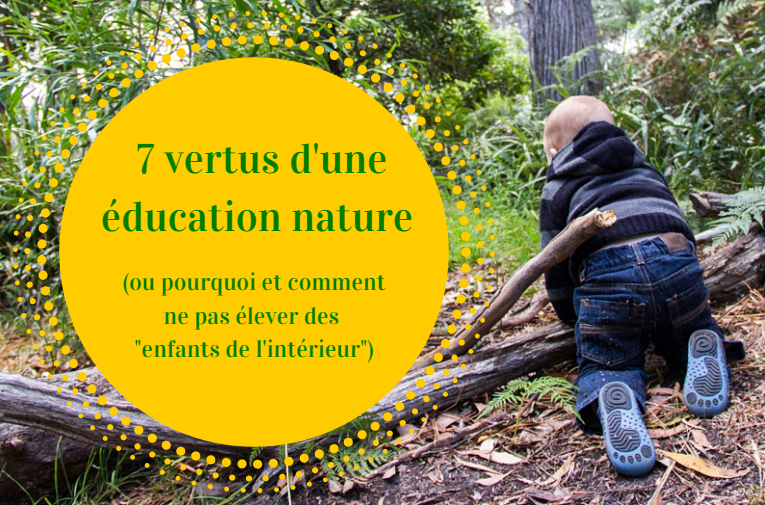
A nature education is not a nostalgic fantasy: it is a deliberate choice to let children grow up in contact with the living world rather than between four walls. Many children today have become "indoor children", moving from school to car to house to screen without ever really touching the ground outside.
Several forces explain this shift: more families living in cities, neighbourhoods with little green space for free play, media that feed fear and doubt, a growing obsession with safety, the erosion of free time in favour of structured activities, more sedentary habits and the constant pull of screens.

The consequences are real: more health problems, a weaker ecological awareness and a growing intolerance of childhood itself — its noise, mess, dirt and movement. Yet free play outdoors builds skills that last a lifetime, and it benefits adults as much as children.
Quick takeaways
- Nature education counters the "indoor child" pattern of school, car, house and screen.
- Free outdoor play builds self-esteem and self-confidence through real, self-solved challenges.
- Uneven ground and open-ended materials develop both gross and fine motor skills.
- Imagination, empathy and ecological awareness grow from direct contact with living things.
- Physical feedback outdoors teaches patience, perseverance and measured risk-taking.
- Regular time in green spaces supports mood and reduces stress for children and adults.
Self-esteem and self-confidence
Self-esteem comes from the value we give ourselves, and it grows through affection, presence and respect. Self-confidence is about ability: being capable of doing a task, reaching a goal, feeling that your inner resources will carry you through a difficult moment. By letting a child explore and play freely, by showing trust and giving responsibility, we nurture both.
Climbing a tree, jumping from a height, catching a stubborn insect or getting over an obstacle are all challenges. Each one asks the child to solve a problem alone, find a personal solution, try again after several failures and refine their strategy. That quiet repetition is where real confidence is built.
Letting children take measured risks
Allowing a child to test their limits does not mean abandoning supervision. It means staying close, resisting the urge to intervene at every wobble, and letting them discover what their body can do.
Motor development and fine motor skills
Running, jumping, climbing, crossing uneven ground and getting over obstacles all support gross motor development: agility, balance, spatial awareness, judging danger, reacting to the unexpected and taking measured risks. Handling, building, cutting, pulling, catching, picking and creating develop the fine motor skills of the hand.
Free play in nature is also a simple way to prevent troubles linked to a sedentary lifestyle and to stay physically fit. If you are looking for outdoor toys that support this kind of movement, choose open-ended equipment that invites climbing, balancing and building rather than passive entertainment. Safety awareness matters too, as shown by the tragic case of a boy and a balloon.
Children who move outdoors every day build stamina without noticing it, because the effort is wrapped in play.
| Aspect | Indoor childhood | Nature education |
|---|---|---|
| Daily movement | Mostly seated, screen-based | Running, climbing, balancing |
| Problem-solving | Adult provides the answer | Child tries, fails, adjusts |
| Materials | Finished toys and screens | Sticks, stones, leaves, water |
| Risk | Avoided or controlled | Measured and supervised |
| Environment | Abstract, distant | Known, observed, protected |
| Adult role | Organiser and supervisor | Trusting companion |
Creativity and imagination
Free play lets children invent their own scenarios, run their own experiments, repurpose objects and materials without fear of adult judgement, and start activities on their own. A stick becomes a sword, a wand or a fishing rod; a pile of leaves becomes a shop or a nest.
The ability to transform what already exists, and the resourcefulness that comes with it, are precious tools for an entire life. Screens tend to hand children a finished world, while nature hands them raw material. A children's art approach works the same way: give the materials and step back.
Boredom outdoors rarely lasts, because the environment itself keeps offering new possibilities.
Self-awareness, awareness of others and empathy
Playing freely in nature means living interconnection: reconnecting body and mind, connecting yourself with your surroundings, and seeing how the elements of that environment connect with each other. Children cooperate to face a challenge and become aware of chain reactions — a dam built downstream changes what happens upstream.
This sense of belonging to a wider world is also what makes a family outing meaningful. Even simple plans, like the family plans you can organise in spring, become lessons in attention when children are allowed to explore rather than simply follow. The same attentive curiosity shows up in how children learn about bilirubin and newborns or choose the best toys.
Empathy grows from there: noticing a fragile insect, a nest, a young plant, teaches care in a concrete way.

Respect for the environment, lived from the inside
Connecting with nature through play helps build human beings who respect their environment. Observing the beauty and wonders of nature, learning to know and understand it, becomes naturally incompatible with irresponsible consumption or with using chemicals that destroy the environment.
This is why a respect for the environment that is lived rather than lectured tends to stick. A child who has watched a pond for a whole afternoon does not need a sermon about water. If you want to extend that curiosity, art books and nature stories can help children put words to what they have observed.
The same logic applies to the wider world: children who know a place tend to protect it.
Responsibility, patience and perseverance
In free play, children quickly understand that they must pay attention to their movements, their inner resources and their reading of the situation: a step too short and it is a fall into the river, a bad estimate of a surface and it is a slip on a wet stone, a branch too fragile and it is one less support for the climb.
That immediate, physical feedback teaches patience and perseverance better than most instructions. It also builds the habit of checking before acting, which carries over into daily life.
Simple routines reinforce it: a family outing prepared together, with a small bag and a plan, gives children a role and a sense of responsibility. The same principle applies to back to school reward toys, which can encourage children to keep trying.

Less stress and fewer behavioural troubles
Studies have shown that playing outside and being exposed to green spaces would improve school results. Contact with nature would also regulate the mood of children and adults alike. Regular time outside lets a child grow in close relation with themselves — through a sharpened awareness of their body — and with what surrounds them: other people and nature.
This makes them conscious of their actions and their responsibilities. If you are unsure how to start, snow games in winter or a simple daily walk in any season are enough to begin; the point is regularity, not performance.
Many parents notice calmer evenings after an afternoon outdoors, and calmer evenings make calmer mornings.
My hands-on take
In my own home, the hardest part was not convincing my children to go outside — it was convincing myself to let them. I had developed the habit of commenting on every climb and warning about every stone. What changed things was stepping back and staying quiet, sitting on a bench while they figured out a slope on their own.
The first few afternoons were slow. Then something shifted: they started inventing games with what they found, arguing less, and coming back calmer than after an hour of structured activity. I also learned to keep a spare set of clothes by the door, because dirt is part of the deal. Nature education, in my experience, is less about teaching children something than about unlearning our own reflex to intervene.
Frequently asked questions
At what age can nature education start?
It can start very early, with short periods outside and close supervision. The goal is regular contact rather than long expeditions, and the adult's role is to stay nearby while letting the child explore.
Is outdoor free play dangerous?
It involves measured risk, not neglect. Staying close, checking the terrain and letting children test their limits gradually gives them the experience they need to judge danger themselves.
What if we live in a city with little green space?
A park, a garden, a balcony or a tree-lined street can be enough to begin. The point is contact with living things and free movement, not wilderness.
Do screens and nature education conflict?
Not necessarily, but screens should not replace outdoor time. Keeping screens for fixed moments and protecting free time outside preserves the balance.
Product Reviews
 Best Toys for Dogs With High Prey Drive |
Best Outdoor Toys for 3-4 Year Olds |
Best Outdoor Toys for 6 Year Olds |
Best Harness for Poodle |
Best LEGO Sets for Adults |
Best Travel Toys for 4 Year Olds on Airplane |
Best Toy Stores in Washington DC |
Best Potty Training Toys |
Best Toys for Tripod Dogs |
Maillot equipe de france







