


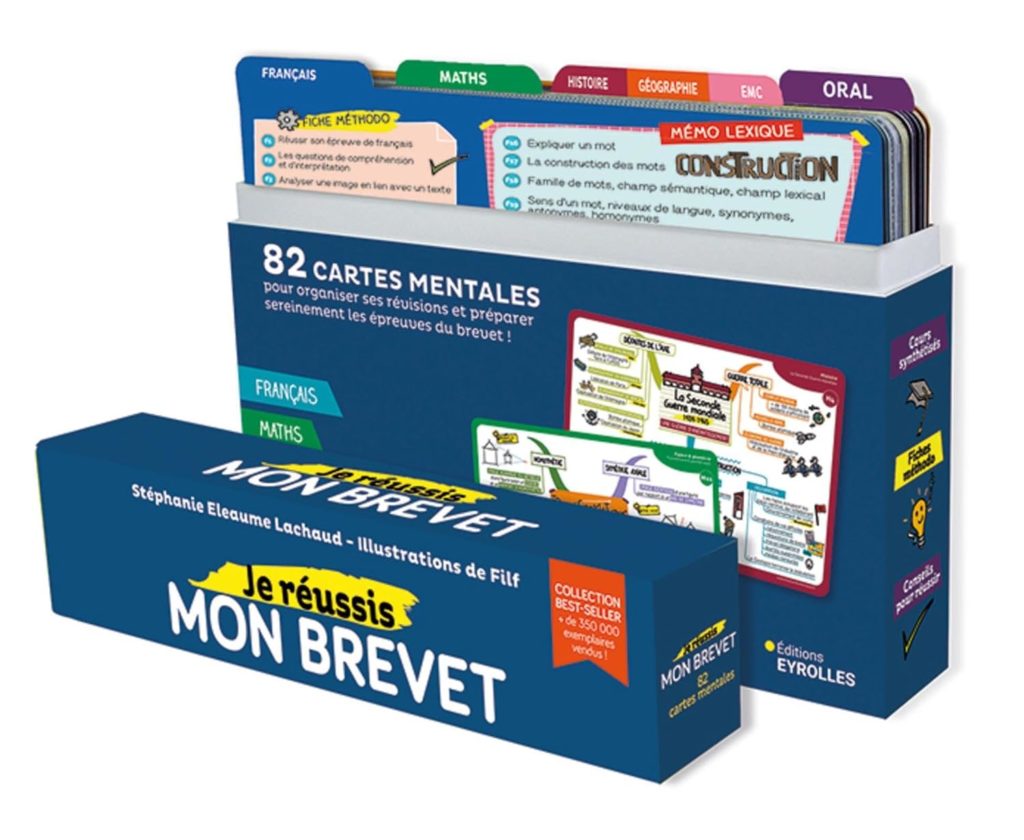
Mind maps for revision are one of the simplest ways to help a middle-school student see the whole shape of a chapter at a glance. This box of 82 mind maps covers the core subjects students need for the Brevet: French, maths, history-geography, EMC and the oral exam.
Six of the cards are dedicated to exam methodology and to preparing the oral, so the set works both as a content summary and as a guide to how each paper is actually marked. Colours, examples and small pictograms support understanding and memorisation, which is exactly what a visual format is meant to do.

Quick takeaways
- 82 mind maps covering French, maths, history-geography, EMC and the oral
- Six cards dedicated to exam method and oral preparation
- Branches follow lesson titles, making course structure visible
- Colours, examples and pictograms support memory
- Use daily for homework, at weekends, and intensively before the exam
- Read, question yourself and link chapters to revise actively
What a Mind Map Box Actually Contains
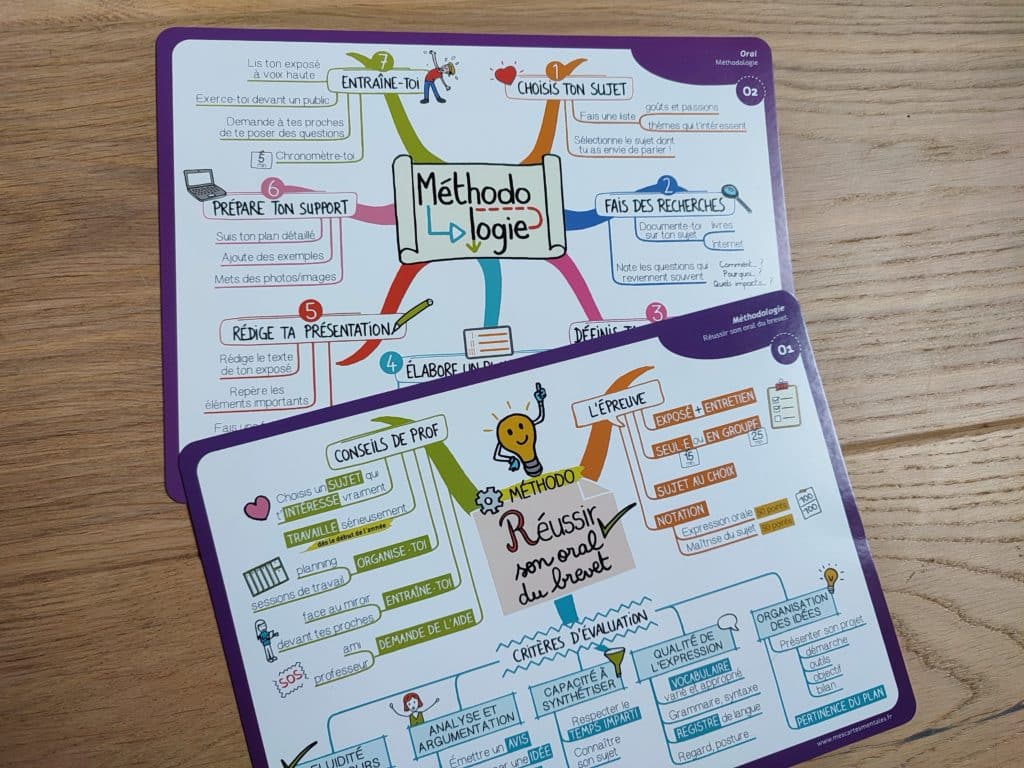
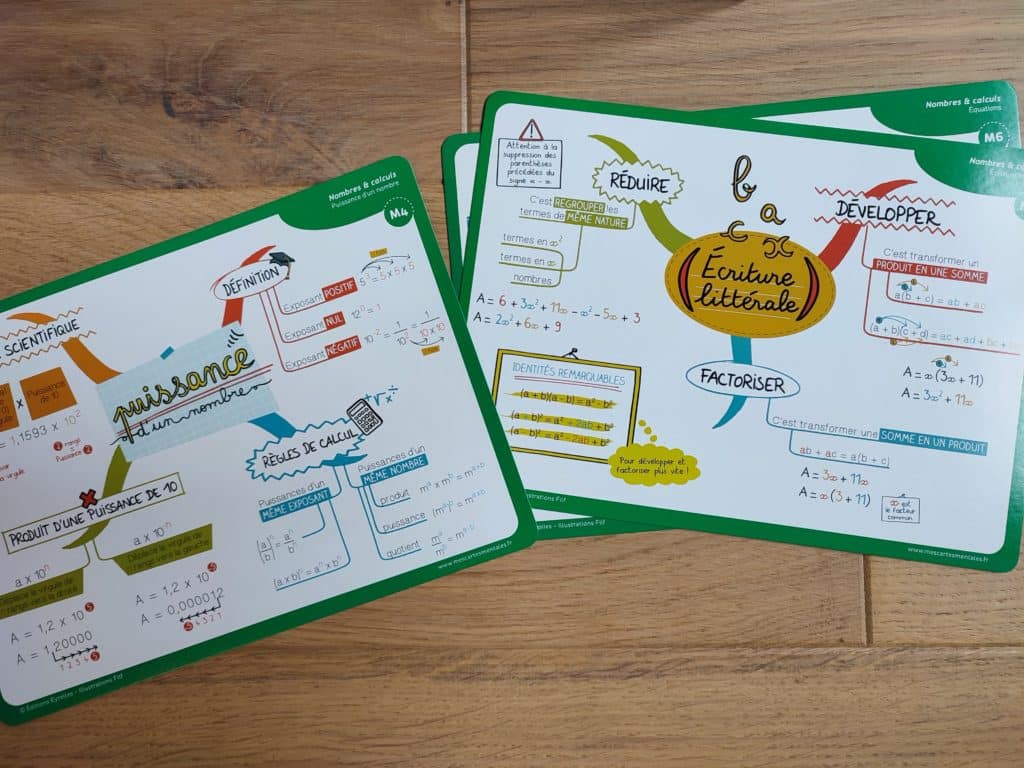
Each card is built as a real mind map rather than a list of bullet points. The main branches mirror the titles and sub-titles of the lesson, so the student can follow the structure of a course without re-reading pages of notes. Colours, worked examples and pictograms add a second layer that helps with both comprehension and recall.
The set is not limited to chapter summaries. Alongside the content cards, several cards explain how to approach an exam paper, from reading the question to organising an answer, and how to prepare the oral. That combination means the box can be used as a revision tool and as a method reference at the same time.

French: Grammar, Vocabulary and Text Types
In French, the cards cover the notions students most often mix up. Grammatical functions are laid out visually, and the trio of synonyms, antonyms and homonyms is grouped so the differences stay clear. The poetic genre and the argumentative text are also summarised, giving students a ready-made frame for the writing tasks.
This kind of visual summary is a useful companion to other learning habits. If your child is still building confidence with pen and paper, learning to write is worth working on alongside grammar revision, because clear handwriting and clear sentence structure reinforce each other. Reading widely also helps, and a shelf of illustrated children's books keeps vocabulary growing without feeling like homework. Parents know that motherhood reshapes priorities, so simple routines like these make a real difference. For a lighter break, the best toys under $50 can reward focused revision.
| When | What to do | Time |
|---|---|---|
| Daily homework | Open the card matching today's lesson | 10 min |
| Weekend | Re-read one card and cover a branch | 15 min |
| Holidays | Reactivate two or three older cards | 20 min |
| Final month | Read, question, link to other chapters | 30 min |
| Oral prep | Use the method cards to plan the talk | 15 min |
Maths: Equations, Formulas and Probability
The maths cards focus on the material that is easy to forget between terms. Equations, the formulas for areas and volumes, functions and probability each get their own map, with the key steps branching out from the central notion. For a subject where a single missing formula can cost several marks, that visual reminder is genuinely practical.
Revision works best when it is short and repeated rather than long and rare. Ten minutes with one card, then a pause, then a second card, does more than an hour of passive re-reading. The same principle of active, playful practice applies at other ages too, which is why learning toys for 3 year and learning toys for 2 year are built around doing rather than watching.

History-Geography and EMC
In history-geography and EMC, the maps summarise periods and themes such as the interwar years, the Fifth Republic, French productive spaces, France within the European Union, and the founding texts of the Fifth Republic. Dates and institutions sit on branches rather than in dense paragraphs, which makes the links between cause and consequence easier to see.
These cards reward a student who asks questions rather than one who simply reads. Cover a branch, try to recall what belongs there, then check. Linking a card to another chapter, for example connecting the interwar years to a later period, is exactly the kind of active recall that makes knowledge stick.
Method Cards and Oral Preparation
The six method cards are the part of the box that many students overlook. They explain how to approach each paper and how to structure the oral presentation, which is often the exam students feel least prepared for. A clear method removes a lot of the anxiety that comes from not knowing what is expected.
If you want to support your child through exam season without adding pressure, the practical approach is to sit alongside them and ask questions rather than test them. The same patient, hands-on attitude shows up in everyday parenting moments, from helping a child who does not want to chew to introducing new foods calmly, as in these tips for introduction of solids. It also echoes the relaxed approach behind these childhood ice creams and the gentle play ideas in these tummy time toys.
How to Use the Cards Day to Day
The box is designed for daily use as homework support, for weekends and holidays to reactivate memory, and for the final month before the exam as a structured revision aid. In that last month, the routine is simple: read a card, ask yourself questions, make links with other chapters, and let the colours and pictograms do their work on visual memory.
Used this way, the set helps motivate students by combining pleasure and success rather than turning revision into a chore. A short, regular session beats a long, reluctant one, and a card that fits on the table feels far less intimidating than a textbook chapter.

My hands-on take
I have watched a student revise from a dense textbook and from a single mind map card, and the difference is mostly about confidence. With the card, the whole chapter fits in one view, so the question "where do I even start?" disappears. I usually cover one branch with my hand and ask what belongs there, then let the student check.
The method cards turned out to be the most useful part for us. We used them to plan a short oral presentation out loud, timing it and cutting anything that did not answer the question. It took two short sessions, but the student walked in knowing exactly what the first sentence would be, and that alone changed the mood of the whole exercise.
Frequently asked questions
Which subjects does the box cover?
It covers French, maths, history-geography, EMC and the oral exam, with six cards devoted to exam methodology and oral preparation.
Is it only a summary of each chapter?
No. Alongside chapter summaries, the set includes method cards that explain how to approach each paper and how to prepare the oral.
When should a student start using it?
It can be used all year as homework support, at weekends and in the holidays to reactivate memory, and intensively in the month before the exam.
How does a mind map help with memorisation?
The branches show the structure of the lesson, while colours, examples and pictograms give visual anchors that make recall easier than dense text.
Product Reviews
 Best Toys for Dogs With High Prey Drive |
Best Outdoor Toys for 3-4 Year Olds |
Best Outdoor Toys for 6 Year Olds |
Best Harness for Poodle |
Best LEGO Sets for Adults |
Best Travel Toys for 4 Year Olds on Airplane |
Best Toy Stores in Washington DC |
Best Potty Training Toys |
Best Toys for Tripod Dogs |
Maillot equipe de france







