


Yelling at children can become an automatic reaction if you are not careful. You may feel that shouting is the only way to be heard or taken seriously by your kids. But how do you avoid yelling at your children when frustration rises?
Shouting is both ineffective and harmful over the long term. If you need to yell almost every day, it is a sign you are not managing to get through. And education through fear creates stress for the child and damages the quality of the parent-child bond.

The good news is that staying calm is a skill you can build, one small strategy at a time.
Quick takeaways
- Yelling triggers fight, flight, or freeze, so children stop listening.
- Fear-based discipline damages the parent-child bond over time.
- A short pause and slow breathing interrupt the anger spiral.
- Physical releases like a stress ball or cushion help discharge tension.
- Helpful self-talk reframes misbehavior as learning in progress.
- Modeling calm teaches children emotional regulation better than words.
Why Yelling Backfires on Everyone
Yelling is ineffective because if we need to shout daily, we clearly are not being heard. It is harmful because fear-based discipline is a source of stress for the child and wears down the parent-child relationship. The child's brain reads shouting as a signal of coming threat.
When the brain is on alert, three reactions are available: flight (the child runs off to hide or shut themselves in another room), fight (the child answers back and shouts too), or freeze (the child is paralyzed, stares into space, stunned). In all three cases, children are more focused on self-preservation than on anything we are trying to tell them.
The Comfort Paradox
Another stress response is seeking warmth and support from the very people meant to provide it, namely the parents. Yet those people are precisely the source of the stress caused by yelling, so the child lands in deep emotional insecurity. We tend to shout when we are out of control ourselves, and we cannot expect children to master themselves if we cannot master our own reactions.
Pause, Breathe, and Reset Your Body
Before anything else, buy yourself a moment. Take a pause or step away from the situation, even briefly, so the wave of anger can pass. Then breathe mindfully: inhale counting to three, exhale counting to six, focusing on the air entering your nostrils, your belly swelling and deflating, and the air leaving again.
Counting down from ten to zero with long, full exhales works the same way. Gentle physical anchors help too: softly stroking your lips, rolling a sheet of paper into a ball to tear up and throw away, hopping or stretching. A glass of cool water or a pleasant scent to breathe in can interrupt the spiral.
If you are expecting a baby or recovering postpartum, calming routines matter even more; our guide on yoga for pregnant women pairs well with these breathing exercises. And when the house feels chaotic, a few quiet toys can lower the noise level that fuels tension.
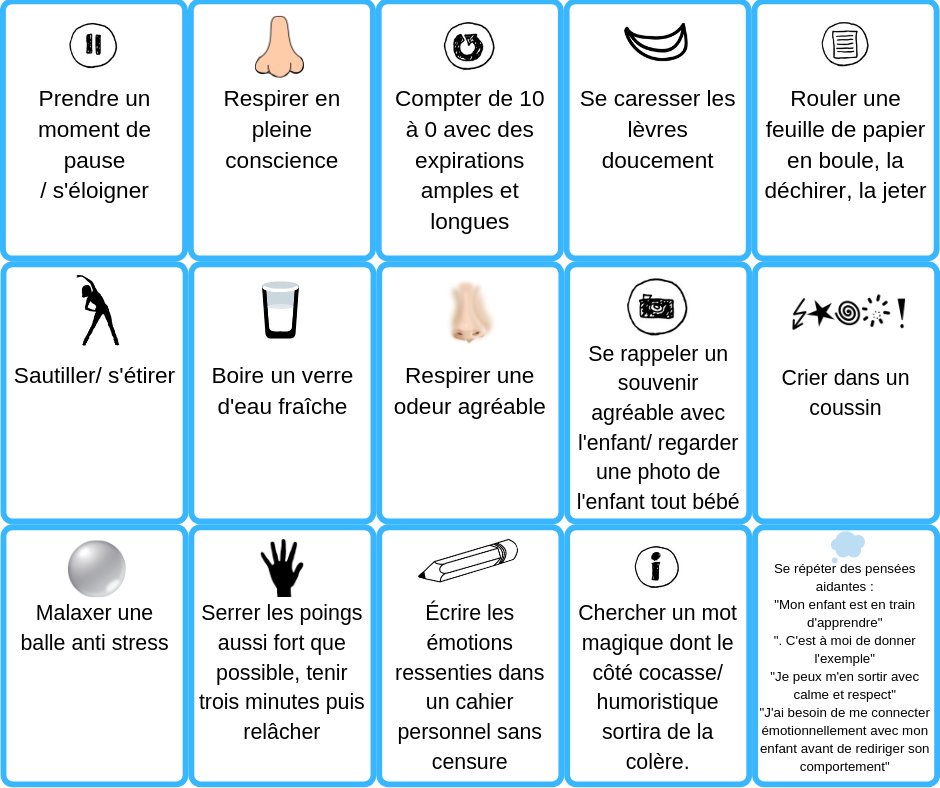
| Situation | Strategy to try | Why it helps |
|---|---|---|
| Anger rising fast | Step away and breathe out slowly | Gives the brain time to settle |
| Restless, jittery energy | Stretch, hop, or squeeze a stress ball | Releases physical tension |
| Feeling overwhelmed | Write feelings in a notebook | Gets the emotion out uncensored |
| Stuck in a negative loop | Recall a happy memory or photo | Restores connection and perspective |
| About to shout | Shout into a cushion instead | Protects the child from the outburst |
| Needing a mental reset | Repeat a helpful phrase | Reframes the behavior as learning |
Reconnect With Your Child in the Moment
Anger often blinds us to who our child really is. Try recalling a happy memory with the child, or looking at a photo of them as a tiny baby. This small shift restores the connection that discipline alone cannot build, and it reminds you that your child did not wake up this morning intending to drive you crazy.
Physical release helps as well: shout into a cushion, knead a stress ball, or clench your fists as hard as possible, hold for three minutes, then release. Writing down what you feel in a personal notebook, without censoring yourself, gives the emotion somewhere to go.
Humor is a powerful ally; find a magic word whose silly side pulls you out of anger. For parents of little ones, the everyday challenges of choosing nursery school or soothing a six month old bring plenty of stressful moments worth preparing for.
Rewrite the Story With Helpful Self-Talk
The words you repeat to yourself shape your reaction. Try: "My child is learning." "My child did not get up this morning to make me crazy." "I can teach my child to speak respectfully; it is my job as a parent to set the example." "I can get through this with calm and respect." "I need to connect with my child before redirecting their behavior."
These phrases are not magic tricks plastered over difficult behavior. They work best alongside a deeper shift in how you interpret what children do, which is why reading about child personality traits can help you see your child's temperament with more patience.
Keep in mind that every child develops at their own pace, and myths about baby intelligence can create unrealistic expectations that feed frustration. Understanding how pregnancy and the brain change a parent's own emotional landscape also makes it easier to be gentle with yourself.
Build a Calmer Home Environment
Prevention matters as much as in-the-moment strategies. Notice the times of day when shouting is most likely, such as the rushed morning routine or the pre-dinner meltdown, and prepare ahead so you are not running on empty. Fewer rushed transitions mean fewer triggers for everyone.
Play also lowers tension. Rotating in non toxic teething toys for babies or simple stocking stuffer toys keeps little hands busy and reduces the boredom that often sparks conflict. If you are shopping locally, our list of toy stores can help you find calmer, engaging options.
And remember that children learn emotional regulation by watching us. When you model a calm response, you are teaching a lesson no lecture could deliver.

My hands-on take
I remember the evening I realized I was shouting more than talking. My child had spilled a drink for the third time that week, and I heard my own voice rise before I had even decided to be angry. What changed things for me was not a grand resolution but a small one: I started stepping into the hallway for ten slow breaths whenever I felt the heat rising.
It felt ridiculous at first, and some nights it did not work at all. But over time, those pauses added up. I also began writing a few lines in a notebook after the hardest moments, and reading them back showed me patterns I had never noticed. My child still tests me, and I still slip. The difference is that I now recover faster, apologize when I need to, and treat calm as a practice rather than a personality trait.
Frequently asked questions
Why is yelling at children ineffective?
If you need to shout almost daily, it means you are not being heard. The child's brain reads shouting as a threat, so they focus on self-protection rather than on what you are saying.
What happens in a child's brain when parents yell?
The brain goes into alert mode and chooses flight, fight, or freeze. In each case the child is focused on survival, not on listening or cooperating.
Can I still set limits without shouting?
Yes. Connect with your child first, then redirect the behavior. Calm, respectful limit-setting teaches the same lesson without triggering fear.
How do I stay calm when I am already furious?
Pause, step away, and breathe out longer than you breathe in. Physical releases like a stress ball or cushion, plus helpful self-talk, help you regain control.
Product Reviews
 Best Toys for Dogs With High Prey Drive |
Best Outdoor Toys for 3-4 Year Olds |
Best Outdoor Toys for 6 Year Olds |
Best Harness for Poodle |
Best LEGO Sets for Adults |
Best Travel Toys for 4 Year Olds on Airplane |
Best Toy Stores in Washington DC |
Best Potty Training Toys |
Best Toys for Tripod Dogs |
Maillot equipe de france







