


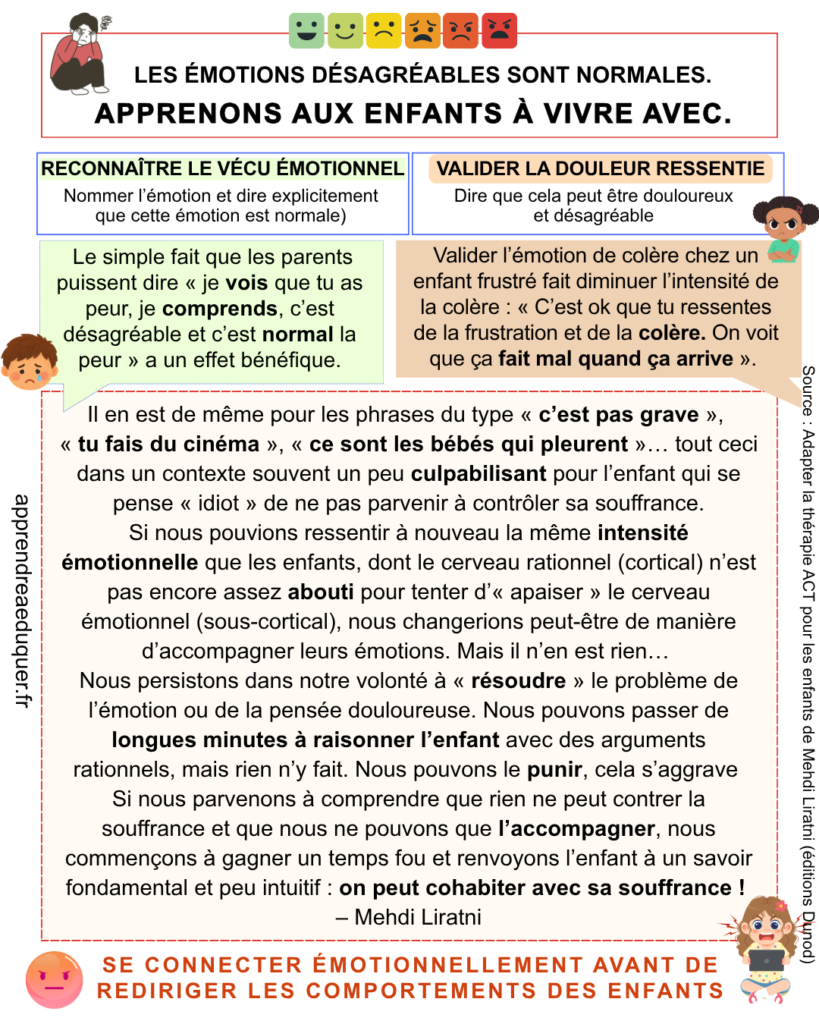
Helping children live with uncomfortable emotions starts with one simple shift: naming the feeling as normal instead of trying to remove it. When a parent says "I see you are scared, I understand, it is unpleasant and fear is normal," the child hears that the emotion is allowed.
That small act of validation has a calming effect on young children and teenagers alike. Validating anger in a frustrated child can even lower the intensity of the anger, because the child no longer feels judged for what they feel, only for how they behave.

This article explains why unpleasant emotions are a normal part of childhood, which phrases help and which ones backfire, and how to sit with a child's pain without rushing to fix it.
Quick takeaways
- Naming an unpleasant emotion as normal has a calming effect on children.
- Validating anger can reduce its intensity because the child feels understood.
- Avoid "don't cry," "don't worry" and "it's not serious."
- Validation means naming the emotion and acknowledging the pain.
- Reasoning or punishing a distressed child rarely works.
- Children can learn to coexist with their suffering.
Why Unpleasant Emotions Are Normal for Children
Families, cultures and personal histories shape how adults react to a child's emotions. Some parents treat difficult feelings as unwanted or even dangerous and try to remove every trace of discomfort. Others see emotional expression as shameful or out of place, and some suppress feelings in the hope of toughening children up.
Yet the opposite often happens. A child who is forbidden to suffer, to feel or to talk about it may learn that the only relational frame around their pain is silence and never asking for help. That lesson can follow them into adolescence and adulthood.
Recognising this is the first step toward a calmer home, much like the small daily adjustments that make parenting twins or any busy family run more smoothly.
Phrases That Backfire and What to Say Instead
Avoid saying "it's not serious," "don't be afraid," "don't worry" or "don't cry." When in doubt, say nothing at all. These well-meant phrases teach a child that the fear is something they should not have, because the adults around them keep telling them not to feel it.
Imagine a young child afraid of the dark. They cannot stop the thoughts, mental images or body sensations that come with fear. A parent who explains there is no monster under the bed and no reason to cry is trying to help, but the child simply files fear away as forbidden.
Gentler alternatives
Try "I see you are scared, I understand" instead of "there is no reason to be afraid." Skip "you are making a fuss," "only babies cry" and "you are imagining things," which often leave a child feeling silly for not controlling their distress. Avoiding blame and guilt fits the same respectful approach described in gentle discipline and other positive guidance methods.

| Situation | Unhelpful response | Helpful response |
|---|---|---|
| Child afraid of the dark | "There is no reason to be afraid" | "I see you are scared, I understand" |
| Child is frustrated | "Stop making a fuss" | "It is okay to feel angry, and it hurts" |
| Child cries | "Only babies cry" | "Oh, you are sad, I am here" |
| Child worries | "Don't worry about it" | "That sounds hard, tell me more" |
| Child is upset | Long rational explanations | Calm presence and gentle touch |
How to Validate Painful Emotions Step by Step
Validation of anger, fear, sadness and anxiety has two parts. First, recognise the emotional experience by naming the emotion and saying clearly that it is normal. Second, validate the pain it causes by saying it is painful and unpleasant, and describing how hard it is.
From about seven or eight years old, phrases containing "I see and I understand" work especially well. With younger children, a simple "Oh, you are scared" or "Oh, you are sad" may be enough, paired with a facial expression that shows you see their suffering and understand it is hard.
If possible, move closer and offer physical contact: pat their back, stroke their head, hold them or cuddle them. A calm, steady presence does more than a long explanation, much like the reassuring routines that help with baby sleep problems in the early years.
Stop Trying to Solve the Emotion
Children's rational brain is not yet mature enough to quiet the emotional brain, so reasoning rarely works. Parents can spend long minutes arguing with rational points, and nothing changes. They can punish, and it gets worse. Every attempt to fight the suffering is in vain.
Once we understand that nothing can counter the suffering and that we can only accompany it, we save a great deal of time. We hand the child a fundamental and rather counterintuitive piece of knowledge: you can coexist with your pain.
This is why lecturing a tired, tearful child rarely helps, just as constant tiredness needs care rather than argument. The same patience applies when a child is unwell, as with infant hernia symptoms that worry parents.
Building Emotional Habits That Last
Validation is a habit, not a one-off script. Practise noticing your own urge to fix, distract or dismiss, and pause before speaking. Over time, children learn that all feelings are allowed and that behaviour is what gets guidance.
Keep the words short and steady, and let your face and body carry the message. Children read tone and posture long before they process a sentence, so a calm presence is often the whole intervention.
Model this openly by naming your own emotions without drama, and keep routines predictable so children feel safe enough to feel. The same steady, low-pressure approach supports learning through play, whether that means Montessori climbing toys or a simple box of bricks.
When Emotions Come With Big Transitions
Big feelings often surface around change: a new sibling, a move, a holiday or a disrupted routine. Prepare children in advance, name the feelings you expect, and validate them when they arrive rather than talking them down.
Travel and schedule changes are common triggers, so plan for rest and keep expectations realistic, as with children's jet lag. Quiet, hands-on activities also give children a safe place to settle, whether that is a favourite film from a list of movies with lessons or a calm building session.
Above all, remember that your goal is not a child who never feels afraid, angry or sad, but one who knows those feelings are normal and can be shared.

My hands-on take
In my own home, the phrase "don't worry" used to come out automatically whenever my child was anxious at bedtime. I meant it kindly, but I noticed it never shortened the worry; it just moved the conversation elsewhere. When I started saying "I see you are scared, and that is hard," the tone in the room changed. My child still felt afraid, but stopped feeling wrong for feeling it.
What helped most was slowing down and staying close rather than explaining. I now sit nearby, keep my voice low, and skip the rational arguments about monsters and shadows. Some nights it takes longer than I would like, but the tears end sooner and my child asks for help more openly, which feels like the real win.
Frequently asked questions
Is it wrong to comfort a crying child?
No. Comforting does not spoil a child. The key is to acknowledge the feeling rather than telling them not to have it, so they learn that emotions are allowed and shareable.
What if I already say "don't cry" out of habit?
Habits take time to change. Start by pausing before you speak, then name the emotion and say it is normal. Small, consistent shifts matter more than perfect wording.
Does validating emotions mean accepting bad behaviour?
Not at all. Validation applies to the feeling, while behaviour still gets guidance. A child can be told that anger is okay while hitting is not.
At what age can I use "I see and I understand"?
From around seven or eight years old these phrases tend to land well. With younger children, a simple "Oh, you are scared" plus a caring expression is often enough.
Product Reviews
 Best Toys for Dogs With High Prey Drive |
Best Outdoor Toys for 3-4 Year Olds |
Best Outdoor Toys for 6 Year Olds |
Best Harness for Poodle |
Best LEGO Sets for Adults |
Best Travel Toys for 4 Year Olds on Airplane |
Best Toy Stores in Washington DC |
Best Potty Training Toys |
Best Toys for Tripod Dogs |
Maillot equipe de france







