


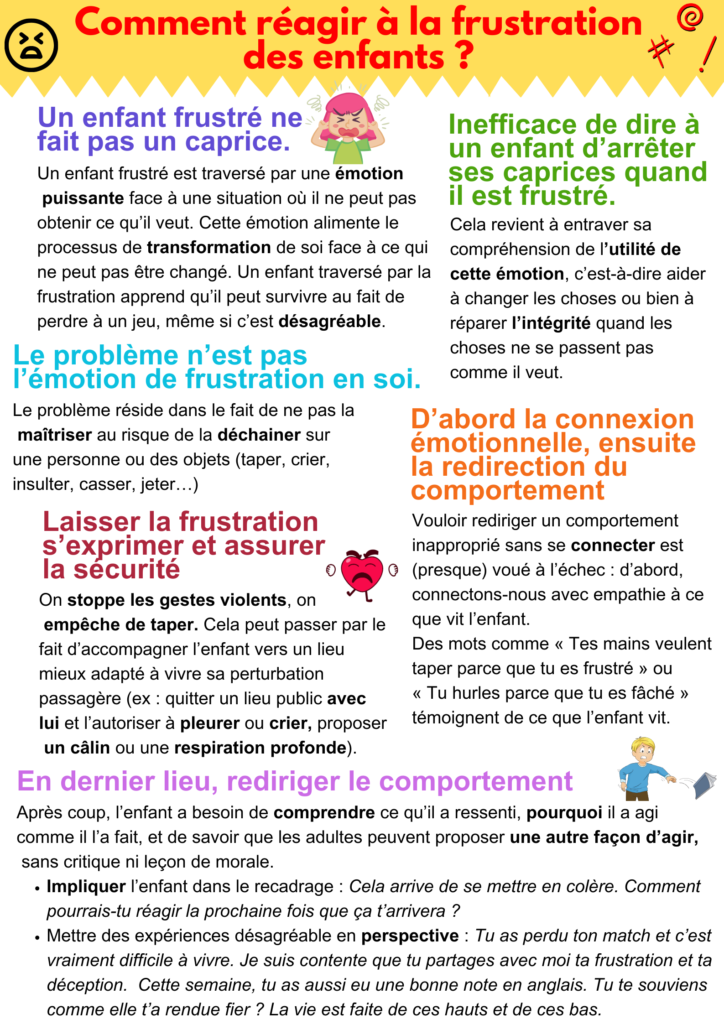
Frustration in children is a healthy emotion, and a frustrated child is not throwing a "tantrum": they are simply being swept up by a powerful feeling when they cannot get what they want. That emotion fuels change, or the process of transforming yourself in the face of what cannot be changed.
For example, a child who lives through frustration learns that they can survive losing a game, even if it feels unpleasant. Frustration in children is neither a whim nor play-acting, even though it poses big challenges for parents.

Anger, that sometimes loud and exasperating emotional display from an adult's point of view, is precisely what allows the child to recover from frustration. The problem is not the feeling of frustration itself, but failing to contain it, at the risk of unleashing it on a person or on objects: hitting, shouting, insulting, breaking, throwing.
Quick takeaways
- Frustration is a healthy emotion, not a whim or a performance.
- Anger is often how a child recovers from frustration; the goal is containment, not suppression.
- Reasoning, questioning, or reminding a child of warnings rarely works mid-meltdown.
- Impulse control develops gradually, roughly between ages 5 and 9.
- Stay calm and close; avoid punishment and isolation.
- Prevention through rest, routine, and movement reduces meltdowns.
Why Reasoning With a Frustrated Child Doesn't Work
Trying to reason with a child in the grip of frustration is ineffective. Asking a child why they are angry, reminding them that you warned them, or trying to explain logically why they cannot have what they want is simply unheard by the child. Listening does not necessarily mean questioning.
When emotions run high, the thinking part of the brain is not in charge. What the child needs first is your steady presence, not a lecture. You can name the feeling simply, stay close, and let the storm pass without trying to win an argument.
If your child is overwhelmed after a long day, the same principle applies to the whole family: rest and routine matter, and you may find gentle ideas in relieve parental fatigue so you have the patience to stay calm yourself.
The Growing Brain Needs Time
Before the age of 5 to 7 (7 to 9 for more sensitive children), we have to wait for children's brains to develop and allow for the mastery of impulsivity. This is not defiance; it is biology unfolding on its own schedule.
It is better to show children that frustration is OK and that they are capable of living through it without being overwhelmed, without punishing them or isolating them so they calm down. Punishment and isolation teach a child that big feelings are dangerous or shameful.
Your role is to be the calm anchor. A child who learns early that emotions pass, with a supportive adult nearby, builds confidence step by step. For a wider look at how everyday parenting moments shape this learning, see these forms of aggression that adults sometimes normalize without realizing it.
| Response | What it does | Better alternative |
|---|---|---|
| Asking "why are you angry?" | Child cannot process it mid-storm | Name the feeling simply |
| Reminding them you warned them | Feels like blame | Stay quiet and close |
| Explaining the logic again | Unheard while emotions run high | Wait until calm returns |
| Punishing or isolating | Teaches feelings are shameful | Comfort with calm presence |
| Giving in to stop the crying | Confuses the limit | Hold the limit gently |
What to Say and Do in the Moment
Keep your words short and warm. A simple "you really wanted that, and it's hard" acknowledges the feeling without giving in to the demand. Then wait. Silence, paired with your calm body, often does more than a speech.
Offer comfort rather than a lesson. A hug, a hand on the back, or sitting nearby shows the child they are not alone in the feeling. Once the storm has passed, you can talk about what happened, but only when the child is calm again.
Some children settle best through play or a change of scene. A favorite toy or a quiet activity can help them reset, and browsing ideas for imaginative play or simple toys for babies can give you reliable options for younger siblings too. Staying regulated yourself is the foundation of all of it.
Setting the Stage to Reduce Meltdowns
Prevention is not about avoiding all frustration, which would be impossible and unhelpful. It is about making sure your child is fed, rested, and not overloaded before a demanding situation. Tired children have far less room for disappointment.
Predictable routines and clear, kind limits help too. When a child knows what to expect, a "no" lands more softly. Keep the limits firm but your tone gentle, and let the child practice coping with small disappointments in low-stakes moments.
Outdoor time and movement are powerful outlets for pent-up energy. If you are planning family activities, these outdoor toys or options for outdoor play can give children a healthy way to burn off tension before it turns into a meltdown.

When Frustration Is Part of a Bigger Picture
Frustration often spikes during transitions: a new baby, an illness, travel, or a change in routine. In those periods, children need more patience and more reassurance, not stricter discipline.
If your child is unwell, for instance, their tolerance for "no" drops sharply. Knowing when to comfort rather than correct matters, and this guidance on childhood fever reminds us that physical discomfort often shows up as emotional fragility.
Travel and disrupted sleep have a similar effect. A child who is jet-lagged or overtired is not being difficult on purpose, and these tips on children's jet lag can help you plan around the moments when frustration is most likely to boil over.

My hands-on take
In my own home, the hardest moments were never the loud ones; they were the ones where I tried to talk my child out of a feeling. I remember crouching down and launching into a careful explanation of why we could not buy the toy, only to watch my words bounce off completely. What finally worked was doing less: sitting beside my child, saying very little, and letting the wave pass.
I also learned to check the basics first. More than once, a meltdown that looked like defiance turned out to be hunger or exhaustion in disguise. Now I try to protect meals and rest before outings, and I keep my own voice low when things escalate. It is not perfect, but staying calm and present has done more for my child, and for me, than any clever argument ever did.
Frequently asked questions
Is a frustrated child just throwing a tantrum?
No. Frustration is a genuine, powerful emotion, not a whim or play-acting. Treating it as real helps your child learn to cope.
Why can't I just explain why my child can't have what they want?
While emotions are high, the reasoning brain is not fully available. Logic lands later, once the child is calm again.
At what age can children manage frustration?
Impulse control develops gradually, roughly between ages 5 and 7, or 7 and 9 for more sensitive children. Until then, your calm support does the work.
Should I punish my child for getting angry?
Punishment and isolation tend to teach children that big feelings are shameful. Staying close and calm is more effective.
Product Reviews
 Best Toys for Dogs With High Prey Drive |
Best Outdoor Toys for 3-4 Year Olds |
Best Outdoor Toys for 6 Year Olds |
Best Harness for Poodle |
Best LEGO Sets for Adults |
Best Travel Toys for 4 Year Olds on Airplane |
Best Toy Stores in Washington DC |
Best Potty Training Toys |
Best Toys for Tripod Dogs |
Maillot equipe de france







