


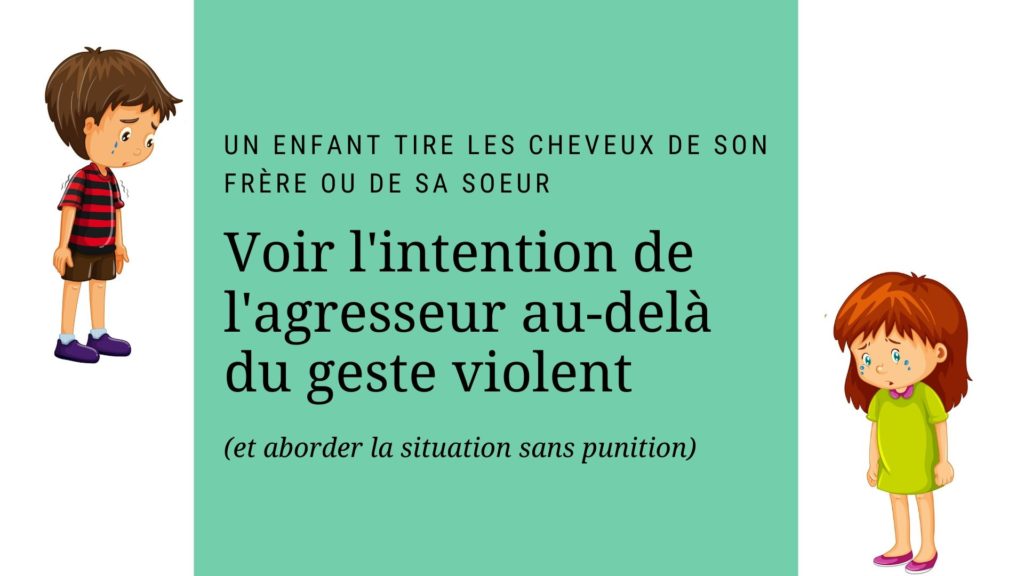
Hair pulling between siblings is one of those behaviors that can push a calm parent straight into punishment mode. Seeing the intention behind the aggressive gesture, rather than only the gesture itself, changes how you respond and can break the vicious circle of violence in the sibling relationship.
Many children fall into a habit of pulling hair or biting a younger brother or sister. Parents often try to stop it by punishing, threatening, or sending the child to a corner. Yet the behavior rarely changes, or it changes at a high price: lost self-esteem, or distress displaced into other acts.

Quick takeaways
- Hair pulling is often a message, not just a bad act
- Punishment and isolation rarely change the behavior
- Protect the younger child and support the older one
- A calm one-on-one outing opens real conversation
- Trust and empathy serve the whole family
- Sibling bonds built this way last a lifetime
Look Past the Symptom to the Intention
Family therapist Jesper Juul, in his book on parental authority, describes a three-year-old boy who kept pulling his little sister's hair. His parents had settled into a routine of time-outs, sending him to his room to calm down and think. After several rounds of this, the boy kept pulling her hair, then began walking to his room on his own, anticipating the punishment that would follow.
The child was protecting his dignity and choosing solitude. In a sense he was obeying: he had understood that after a bad gesture he was to be excluded. Forced isolation is ineffective when it comes to relationships and living together. Juul regrets that from the very start the parents saw only the symptom, not its motivation: fear of being loved less, sadness at no longer having all the attention.
What the Child Is Really Saying
The boy was struggling to accept that he was no longer the only child, and that he had lost half of what had once been his alone. His parents paid attention only to what they read as mean signs of jealousy and violence, and acted by punishing him. He was already feeling excluded; now he was excluded again.
Protect the Younger Child and Support the Older One
None of this means letting a child hurt a sibling. Parents have a duty to protect the more vulnerable child, and that duty comes first. In parallel, there is a duty to support and understand the child who lashes out, which is where holding a crying child and steady reassurance matter for both children.
Parents could decide that the aggressive reaction has meaning worth digging into, beneath what is seen and heard. Juul calls it an attempt at cooperation. Children need adults to pay attention to their intentions and to trust them, reading the behavior positively, as serving life and carrying a positive motivation.
This is not about excusing the act. It is about treating the act as information, the way you would read a educational toys choice to understand what a child is drawn to. The message is repeated patiently until someone decodes it, and decoding takes calm rather than a raised voice.

| Situation | Punishment approach | Intention-focused approach |
|---|---|---|
| Hair pulling happens | Time-out in the room | Calm separation, protect the younger child |
| Child repeats the act | Stronger consequence | Look for the underlying need |
| Parent-child talk | Lecture about the bad gesture | One-on-one outing and open question |
| Child's feeling | Excluded again | Seen, appreciated, included |
| Long-term effect | Distress displaced elsewhere | Healthier sibling relationship |
Try a Warm One-on-One Conversation Instead
One parent of the boy could have offered a pleasant outing, just the two of them, at a calm moment. The outing reassures the child that he matters enough for the parent to enjoy time alone with him. It also opens a constructive conversation: "You've pulled your sister's hair so often that we've understood it's hard for you that she's part of our family. Would you like to tell me what's so hard for you?"
The child may answer or not, but the invitation already shows he is taken seriously. The conversation gives him the feeling of being seen, appreciated, and included. Planning that kind of outing is simpler when the household runs smoothly, and tips like these organize at home ideas for two babies can free up the time and headspace.
If you are expecting another child and want to prepare the ground early, reading about perfect age children spacing or how a mother's love shows up in daily rituals can help you think ahead about attention and fairness.

A Leadership Style Built on Trust and Empathy
This style of leadership, based on trust and empathy, is not specifically "adapted to children." It is good for the whole family, because it gives each person what they need and, at best, what they also desire. It lets parents feel competent and valuable rather than powerless.
It also offers children a healthy foundation for the sibling relationship they will carry through life. Small rituals help: a stocking stuffer toys surprise shared fairly, a Halloween costumes children project planned together, or a quiet moment with baby vacation suitcase packing before a trip.
All of this can come from a three-year-old who had the courage to repeat his message until it was decoded. The same patience applies to sorting LEGO color together, where turn-taking and shared rules are practiced in miniature.
My hands-on take
I remember the first time my older child pulled his sister's hair. My instinct was a sharp reprimand and straight to his room, and I felt briefly satisfied, as if I had handled it. The next day it happened again, and then he started walking to his room by himself before I could even react. That was the moment it clicked: he was not defying me, he was agreeing with a verdict I had never meant to give.
What helped was a small change of routine. I took him out alone for an errand, no agenda, and asked gently what was hard about having a sister. He did not answer that day, but he talked more over the following weeks. The hair pulling faded rather than stopping overnight, and I stopped feeling powerless. Protecting the little one stayed non-negotiable; understanding the big one became the real work.
Frequently asked questions
Should I ignore hair pulling between siblings?
No. You still protect the child being hurt and stop the gesture. What changes is that you also look for the intention behind it instead of relying only on punishment.
Why do time-outs often fail with this behavior?
A child who already feels excluded experiences the time-out as more exclusion. Some children even anticipate it and isolate themselves, which protects their dignity but solves nothing.
What can I say to the child who pulls hair?
Name what you have understood, then invite them to talk: tell them you see it is hard for them and ask what feels so difficult. They may not answer, but being taken seriously already matters.
Does understanding the intention mean excusing the act?
Not at all. You keep the boundary and protect the younger child. Understanding simply gives you a response that can actually change the behavior over time.
Product Reviews
 Best Toys for Dogs With High Prey Drive |
Best Outdoor Toys for 3-4 Year Olds |
Best Outdoor Toys for 6 Year Olds |
Best Harness for Poodle |
Best LEGO Sets for Adults |
Best Travel Toys for 4 Year Olds on Airplane |
Best Toy Stores in Washington DC |
Best Potty Training Toys |
Best Toys for Tripod Dogs |
Maillot equipe de france







